Steve Goble

Choose life. (Deuteronomy 30:19)

Museum curator: "For the love of Darwin, it's a 15-metre tall tree! It's been stolen!"

If the series has been getting a bit more Doctor Who-ish of late, then this episode is definitely a lot more like The Sarah Jane Adventures.

(please God don't let it ever become like the other one)

It's easy to suppose that 'The London Museum' in SE14 is related to the arty one featured several times in that other children's series of late. When K9 discusses ways to sneak in past the cordons to get another sample of the alien goo left behind after a top exhibit's theft, well, it even feels like the same show.

I found the eventual solution to the mystery to be both a cliché, and also visually very well realised. After the people-in-costume aliens of previous episodes, the centuripede looks truly otherworldly, if anything reminiscent of the ectoslime from The Iron Legion comic strip.


As for K9 remembering having met Robin Hood in a previous life, I guess that's just a lucky fragment of his memory. He does seem a tad absent-minded.

K9: "I'm detecting abnormal levels of magnetic interference. Oh, and Jorjie's mother."

Labels: ,

Starkey: "What's happening?!?"

K9: "Powerful winds of extreme force, otherwise known as a hurricane!"

Starkey: "In London?????"

Yes, Starkey, in London. It's probably Wimbledon fortnight.

London is getting battered by hurricanes. I love that the Australian writers think that this is all so out of the ordinary.

The characters are quoting My Fair Lady, either being deadpan with each other, or just by coincidence. I love that the writers' research stretches to a song from 1956 but not the news.

As usual, the banter between the characters is one of K9's strengths. In fact this episode has quite a few of them. Not least the soundtrack which keeps up the storm's intensive battering throughout.

However in the midst of what becomes a planet-wide disaster, as soon as Jorjie is pinioned down by a piece of falling masonry, we know that the word 'deadweight' isn't going to apply to her predicament in just the one way.

Another of K9's strengths is its disregard for dwelling upon the characters feelings, but in this one they suicidally have a go at it. If Jorjie's motionless groaning isn't reason enough to fast forward, they actually send Darius to join her to talk about their feelings for each other. Oh, just bring back the CGI, please.

Notable connections, or disconnections, from the rest of the Doctor Who canon include:

1. The line about nobody controlling Earth's weather. The series must therefore take place before the establishment of the Gravitron in The Moonbase.

2. That the weather is affected by music, which is nicely consistent with the later broadcast A Christmas Carol.

3. Gryffen gets yet another line about the history of Centauri. Either quite a lot has gone down there, or more likely this is one particular area of space upon which he has intel.

The alien responsible for all this chaos doesn't appear for quite a while, giving the impression that it must be quite large and ethereal. In the end though, it's just someone with a bowl on their head.


Here things get a bit confused. Quite how Starkey's tune manages to attract the alien's mate, came across to me as just a huge coincidence. June's line about birds having set mating calls is another example of the writing's lack of global perspective. (birds' calls vary around the world)

At one point a reply message comes in from the Orpheus constellation 10,000 light years away. Well, if it's a sound wave impossibly travelling through the vacuum of space, then even if it somehow travels at light speed, it must have been sent 10,000 years ago. Professor Gryffen has the answer. "It's very faint." Groan.

Darius: "Can you dumb this down a bit?"

Basically the chaos of the weather gives way to the chaos of wrapping the story up, but I am pleased that the show is continuing to make some effort over itself.

Unlike in the final scene, when K9 asks everyone to define love.

Sheesh, does he not even have a dictionary file in there?

Overall though, this entry continues the trend set last week, with the series making another big effort over itself. It ought to - there are an insane number of production companies collaborating on this, so many that the closing music just can't run for long enough to credit them all at the end, and has to repeat sections.

What a shame that the BBC isn't one of them.

Labels: ,

I never thought that I would ever go to the Olympic Games.

So today the Olympic Games tired of my laziness and came to me.

Specifically, the Women's Cycle Road Race passed very near indeed to my house. Hey, said house is in London, and it is the year 2012. With the Queen's Diamond Jubilee going down this summer too, it seems like a daft season to spend back in rainy old New Zealand. That whole Rugby World Cup thing is so last summer.

I should probably have pointed this out to Flatmate Dave back in Auckland as I enthusiastically Facebooked him during breakfast this morning.

Steve
July 28
"If you're watching the Women's Cycling Road Race at 11:30pm tonight (NZ time), you might recognise Richmond Bridge as they go over it!"
Steve
July 29
"And it's just started raining. All the Olympic news updates from the track here."
David
July 29
"thanks for that"

Steve
July 29
"And it's just stopped. All the Olympic news updates from the track here."
David
July 29
"I feel special having my people on the inside"

Steve
July 29
"I should probably finish my toast and go out then."
David
July 29
"then I'll have people on the outside"

I bathed, dressed in my dad's old World Cup '98 t-shirt, and headed out far later than I had intended. Yesterday I had scouted-out a stretch of the route looking for any info that might assist on the day, particularly with regards to finding a good vantage point from which to take a photo. The church was no good because they had cancelled their services that morning. I realised that a few friends lived right along the course, but was feeling too British and reserved to invite myself over.

At the foot of Richmond Bridge however, I realised that I could get a famous local landmark - namely my ex-employers Richmond Odeon - in the background. I'd also have the luxury of a good few seconds of the cyclists heading down the slope towards me. Also, that the bridge itself was not lined with houses on either side offered to dissipate any bottleneck on either bank. Yep, that had seemed like a good place.

So as I left my house this Sunday morning, there was no indication that anything out of the ordinary might be pending just a couple of blocks away. However as I turned the corner, I immediately saw four separate people all heading in the same direction as myself. Oohh, now this looked like it could bottleneck quite quickly.

As more and more like-minded people converged in the alley, I was pleasantly surprised to reunite with two fellow travellers from my mum and I's recent walking weekend in Cumbria, where many of us had witnessed the passing of the Olympic torch! However upon reaching the road lined with barriers, there were few enough other people around that we parted company once again to each select our vantage points of choice.

I got exactly the spot that I had chosen. Wishes that I had brought along my tripod were quickly dispelled when I realised that it wouldn't have enabled me to lean over the railings with my arms. Instead I decided that, come the magic moment, I would step up onto the lower railing to take maximum advantage of my height. I tested this. I figured that I would be able to keep my balance.

Somewhere among the cyclists would be British entrants Lizzie Armitstead, Nicole Cooke and Lucy Martin, not to mention the New Zealand rep Linda Villumsen. I didn't mind who won, but without even knowing their names, these were the four who I had a bit more of a cheer in me for.

And so we waited.

Despite being lunchtime, the weather was becoming dark, and broody. In fact so dim that my camera decided to automatically turn the flash on. If I were going to blind a cyclist and lose my balance at the same time on international TV, well, at least on the other side of the globe Flatmate Dave might be laughing at the ensuing crash. Time to text.

Steve
July 29
"FB not working. If you happen to be watching on TV, I'm at the exit foot of Richmond Bridge on the right in a UK cap with me camera."
David
July 29
"I've got it on, will try to keep an eye out for you. Still using your Nz number!"

I don't know what the collective word for a group of cops is, but presently, shall we say, a prison of cops came by on their motorbikes. There were probably more than a hundred of them, certainly several per contestant. Either they held a really low opinion of how we were all going to behave or, more likely, I had shown up to the Mets Motorcycle Race by accident. Since there was absolutely nothing for any of them do but sit there and get paid our taxes, they were high-fiving the crowds and the like. This was fun to behold, but I really couldn't encourage it. Such enormous police presence surely looked a much more inviting target to a suicide bomber than some cyclists.

And then suddenly, in the distance, the racers emerged from around the corner!

Where they turned left to face us, there was a small dip which momentarily took them down out of sight, before they then came up into view again over the apex of the bridge. I stepped up onto the lower railing. Having realised that my auto-focus was not to be relied upon at such a distance, I'd accordingly set my manual focus for the centre of the bridge. I had four shots left on the film, but in the event only two of them would get used.

I pressed the button!

Almost unexpectedly, a gaggle of international cyclists were hurtling downhill towards us at some speed. As planned, with no time to adjust the rapidly shortening manual focus, I hit the camera's overall reset button, flicked the lens onto its widest-angle, and quickly jabbed the aperture back onto 'sport' setting.

A sea of cyclists filled my viewfinder. I pressed the button again.

The camera jammed!

I held the button down and panned with them for as long as was necessary for the unnecesary flash to recharge, and got away with just the one further image…

… before losing my balance and toppling backwards onto the pavement just as they came past! Fortunately, all the BBC caught of this international incident was my flash going off:

Still, good job that I fell in the right direction!

And then they all flew past - an enormous number of them - and were gone towards Twickenham, just like that. I didn't want any shots of them heading past or away from me, and so that was that. The lady next to me said that she reckoned film was better than digital for such a fast event as this, because you don't get any delay when you press the button. Well, I didn't disagree. After all, it had been the digital technology driving my analogue camera that had stalled it.

Still, I had done it. I had been here. I had attended a real, genuine race at the Olympic Games, wearing my dad's official World Cup France 1998 t-shirt. I'd chatted to a few friends. I'd got a photo of it. And it hadn't cost me a penny. Come on camera, let's go home.

The road empty, I ran a bit. Enough to cover a good 100 metres.

Just so that I could tell people afterwards that I had run 100m at the Olympics.

Steve
July 29
"Its all over! I was standing leaning over the railings, bit lost me balance as they came by! 2 photos taken."
David
July 29
"Rewound the recording, but couldn't see you. :-("
Steve
July 29
"Oh well, thanks for sharing the moment in spirit!"

And the British / Kiwi entrants? Lizzie Armitstead (UK) won our first medal - silver!

(available here)

Labels: , ,

K9: "Those cyborgs give all us robots a bad name."

Has anyone ever described a point in the life of a TV series as when it ducked the shark?

I mean we all know what 'jumping the shark' means (the point at which a show becomes significantly worse and never recovers), but I think it ought to have an antonym. Some shows recover and keep on improving, you know.

In this episode, the makers of K9 appear to have had a serious rethink about what they're up to, and had a go at launching the show a second time. And succeeded.

"ducking the shark". Hmm, 498 results on Google. (in 0.25 seconds - thanks for that)

In this episode, suddenly there's a whole story packed in there, with umpteen scenes and everything. Location work is all over the place. Characterisation and acting is turned up to about 300%. Jorjie's mum and Drake are back, but with a lot more effort gone to over explaining who they are, what they do, and how to play it.

Even Gryffen gets to voice some sort of explanation for why he hasn't left his house in 12 episodes. This was vaguely alluded to in the first episode, but here he openly acknowledges to us that he's just plain afraid. (this despite his making it onto location at one point, which alas does not match the studio set of his steps that it's doubling for) (must have been the back door)

K9 enters the pipe to the factory, which by a staggering coincidence is the same pipe from which he exited the wardrobe in Fear Itself. Without wishing to imply anything about its usual quality, this show appears to have real love of sewage.


I will admit to not being too clear on the whole tale that was locked away in here, but blimey there was a lot more of it than usual, making this edition feel longer in a great way. After so much happening, there's a real sense of resolution to events at the episode's conclusion.

I'm actually starting to believe in and connect to these characters, even despite the continued reliance upon dubbing as a substitute for just recording the dialogue clean in the first place.

At episode #12, if this were a series of The Sarah Jane Adventures then this would have been the last instalment. As it is, this series is 26 episodes long, so we have 12 more!

I'm genuinely looking forward to the next one.

Labels: ,


I don't understand the appeal of thrillers.

In Arlington Road, Michael Faraday is becoming increasingly worried that there is a terrorist living in the house opposite him. Also his wife is dead, making him a single parent. Then his new girlfriend leaves him.

Am I supposed to be connecting with this guy and wishing that I was him? On what level am I supposed to be watching this movie and daydreaming oh if only real life was just like this?

You can see why I find the genre such a conundrum.

It goes without saying that Faraday's neighbour is indeed the villain who he suspects him to be. The evil music that plays underneath his dialogue makes it hard to suppose anything else. Unless of course that's a red herring. I mean they have to pull some clever unexpected trick with the big reveal, don't they? It's a film.

In fact, despite everything that I've just said, remove Faraday's cypher girlfriend, and Arlington Road is a pretty well made movie. When a bomb goes off destroying an office block, it all takes place between scenes, yet without losing its dramatic impact. His wife's death is done very well too.

A lot of time is invested into making the protagonist someone who we can believe in, which is why all the melodramatic cinematography kept on rubbing me the wrong way. For example, when he goes to pick up his son from Camp Occoquan, even the Scouty camp leaders are lit from below to look thoroughly evil:


No matter how well the plot may function, there is just no chance of buying into believing shots like this. Just what do they have on that desk - their camp fire?

But whatever my problems with the thriller genre, the thing that made sitting through these 177 minutes so worthwhile will always be the absolutely stunning ending. To see a conclusion so satifying after so much build up is an impressive thing indeed, but Arlington Road pulls it off in exactly the way that I never expected it to.

Brilliant.

Alas, the light-hearted tone of this review is about to change, in the very worst way possible.

At time of writing, there's just been a very tragic real life act of terrorism in the US, with many dead. A day or so on I've just read in the New Zealand Herald a report saying that it's believed to be the work of one loner, complete with his yearbook photo.

Perhaps the point of this movie genre is specifically to make us feel uncomfortable with the world out there, and to remind us to be careful how we understand it.

(available here)

Labels:


It takes a lot to get me to read a book. Usually it's by recommendation.

In the case of Love Wins, it's more because of unrecommendation.

Upon its publication last year, it quickly became so divisive within the English-speaking Christian church that I felt it necessary to hold an opinion on it. Apparently author Rob Bell had typed some theologically unpopular thoughts regarding the nature of salvation. Well, so have I.

It's also because - again last year - I found myself flicking through a copy at work during a discussion about its impending availability locally. It immediately struck me as looking like a really quick read. Slow reader that I am, I don't think that about many books.

So now that I've got my own edition and read it cover to cover, in fact its chapters have struck me as overlength. Bell's style of using very short lines and para… what? Oh, right, what I think of the opinions he expresses.

Well, I'm actually not that clear on what the opinions that he's expressing are. I guess I probably should have read the book a lot more quickly than I did, to avoid forgetting about it between chapters. Despite making notes, I'm afraid that most of it has just not remained with me.

I think I need to to refresh my memory here. Perhaps I should trawl back through some of my sprawling and long-winded digital jottings. Mind you, be warned: When I agree with an argument, in case I'm wrong, I'll do my darndest to disagree with it...

If the message of Jesus is that God is offering the free gift of eternal life through him - a gift we cannot earn by our own efforts, works, or good deeds - and all we have to do is accept and confess and believe, aren't those verbs?

And aren't verbs actions?
[p.11]

I disagree. Accepting, confessing and believing are verbs, but they are not usually actions. No two words mean exactly the same thing. That's why the book doesn't simply ask 'Aren't accepting, confessing and believing actions?'

[on heaven]
"Second, one of the most striking aspects of the pictures the prophets used to describe this reality is how earthy it is. Wine and crops and grain and people and feasts and buildings and homes. It's here they were talking about, this world, the one we know - but rescued, transformed, and renewed." [p.34]

The prophets would have to describe heaven through their own experiences, hence they had no choice but to describe heaven in earthy terms. How could they possibly get any other terms in which to describe it? They couldn't have had the words, and if they did, then we, being unfamiliar with those concepts, could not have understood them. So of course they described heaven in earthy terms.

"To name is to order, to participate, to partner with God in taking the world somewhere." [p.35]

Great!

"When we hear people saying they can't believe in a God who gets angry - yes, they can. How should God react to a child being forced into prostitution? How should God feel about a country starving while warlords hoard the food supply? What kind of God wouldn't get angry at a financial scheme that robs thousands of people of their life savings?" [p.38]

Again, WE have emotions such as anger, so we are inherently compelled to perceive God in terms that we can comprehend.

"Rewards are a dynamic rather than a static reality. Many people think of heaven, and they picture mansions (a word nowhere in the Bible's descriptions of heaven)…" [p.43]

Unless you count: "In my Father's house are many mansions: if it were not so, I would have told you. I go to prepare a place for you."

- Jesus' words in John 14:2 (King James Version)

D'oh! :)

"But heaven also confronts. Heaven, we learn, has teeth, flames, edges, and sharp points. What Jesus is insisting with the rich man is that certain things simply will not survive in the age to come. Like coveting. And greed. The one thing people won't be wanting in the perfect peace and presence of God is someone else's life. The man is clearly attached to his wealth and possessions, so much so that when Jesus invites him to leave them behind, he can't do it." [p.49]

Brilliant!

"… think about the magazines that line the checkout aisles at most grocery stores. The faces on the covers are often of beautiful, rich, famous, talented people embroiled in endless variations of scandal and controversy.

… are we seeing the first who will be last that Jesus spoke of?

When it comes to people, then - the who of heaven - what Jesus does again and again is warn us against rash judgments about who's in and who's out."
[p.54]

Uh, isn't that what you just did? :) Or did I miss the subtlety there?

Sad to say it, but pages 54-58 - obviously too long to quote here - strike me as a poor attempt to reconcile scripture to theory. The summary on pages 58-9 is clear, but requires Jesus to have meant any of three different things whenever he used the word 'heaven'. Also, the author seems unaware that definitions for words from 2,000 years ago are only the definitions that we today infer that those words had back then. Quite apart from which, observing how hard he seems to be working here to get scripture to fit his theories, he probably didn't intend to suggest that God was such a poor communicator.

Anyway, having taken apart the use of the English word 'heaven' in translations, Rob inevitably moves onto that other place.

"To answer that question, I want to show you every single verse in the Bible in which we find the actual word 'hell.'" [p.64]

Now obviously, he does not actually mean the actual word 'hell', because that is a word in English. He must mean any word in the Bible's original lexicons that has been translated into English as the word 'hell'. He just about makes 34 references, even fewer of which he concedes mean what is traditionally thought of as 'hell', and even fewer of which he quotes.

"And that's it.
Anything you have ever heard people say about the actual word 'hell' in the Bible they got from those verses you just read."
[p.69]

I have two big pushbacks here:

a. I have not just read them, because Rob hasn't quoted them all.

b. Most of Rob's hypothetical 'people' won't have read the same English translation as he, and as a result may be privy to a whole pile of additional uses of the word in the Bible.

To check this out, I've run a quick whole keyword search on the number of instances of the word 'hell' occurring in each of the full English Bible translations available on biblegateway.com. In Rob's favour, I'm surprised to find that most do produce quite a low number of matches. But not all.

Remember now - Love Wins found about 34, give or take: (cue Alan "Fluff" Freeman music)

21st Century King James Version: 54
American Standard Version: 13
Amplified Bible: 13
Common English Bible: 19
Complete Jewish Bible (I guess the one Jesus would have used): 0
Contemporary English Version: 20
Darby Translation: 12
Douay-Rheims 1899 American Edition: 108
Easy-To-Read Version: 16
English Standard Version: 14
English Standard Version Anglicised: 14
God's Word Translation: 35
Good News Translation: 21
King James Version: 54
New King James Version: 32
The Message Bible: 57 (r3sp3ct dude)
New American Standard Bible: 13
New Century Version: 17
New International Version: 13
New International Version 1984: 14
New International Reader's Version: 22
New International Version - UK: 13
Today's New International Version: 13
New Life Version: 35
New Living Translation: 17
Wycliffe Bible: 88
Young's Literal Translation: 0

So out of those 27 translations (admittedly some of them very similar, such as all the NIVs), five contained a significantly higher number of instances of the word 'hell'. What's that? You don't count da funky Message Bible? Okay then - four. Clearly, still too many for the assertion that "Anything you have ever heard people say about the actual word 'hell' in the Bible they got from those [34-ish] verses you just read."

Still, as you can also see, his argument comes out of this battle strong, if not successful. Most of the translations above come out with even fewer references than Rob's!

Nonetheless, the argument on page 68 that the word Gehenna means the city dump is a double-edged sword. The reasoning goes that Jesus was using it as a metaphor for the terrible earthly consequences of our actions. Yet if Jesus were looking for an understandable way to convey the actual fire of literal eternal torment in hell, then equally Gehenna would be the perfect metaphor for that too. Ultimately, there is no argument to be made either way by explaining this word.

Despite this, I found Rob to really be getting into his stride in this chapter. He gives a great illumination of the rich man and Lazarus story, including the folly of exaggerating a hierarchy. His view of man's freedom - including freedom to hurt - being an enormous gift of grace from God is inspiring.

"Failure, we see again and again, isn't final,
judgment has a point,
and consequences are for correction."
[p.88]

YES!

He goes on to realise Satan more in his accuser persona, and then to disassemble the idea of 'eternal punishment'. Universalism, I think he argues, is not an interpretation of the Bible, but rather one of its foundations.

"It's not 'Does God get what God wants?'
but
'Do we get what we want?'

And the answer to that is a resounding, affirming, sure, and positive yes.
Yes, we get what we want.

God is that loving.

If we want isolation, despair, and the right to be our own god, God graciously grants us that option."
[p.116-7]

In chapter five Dying To Live the book moves onto emphasising how much Jesus' death on the cross accomplished. However here again I found the argument sprawling, with repeated asking of the same growing set of questions Twelve Days Of Christmas-style, rather than just presenting them once.

"Think of what you've had to eat today.

Dead. All of it. If you ate plants, they were at some point harvested, uprooted, disconnected from a stalk or vine, yanked from the ground so that they could make their way to your plate, where you ate them so that you can… live. The death of one living thing for another.

… [so] when the writers of the Bible talk about Jesus's resurrection bringing new life to the world, they aren't talking about a new concept. They're talking about something that has always been true. It's how the world works."
[p.130-1]

Except that the vegetables I ate today are still dead. And I sincerely hope are going to remain so. Granted, all metaphors break down sooner or later, but not usually this quickly.

"How many people, if you were to ask them why they've left church, would give an answer something along the lines of, 'It's just so… small'?" [p.135]

In my opinion, a minority.

In chapter six the author gently crushes his own argument for Jesus' divinity at its launch, but then proceeds to go on and impart it anyway. Hey, there's a lot to be said for positive-mindedness.

"If you find yourself checking out at this point, finding it hard to swallow the Jesus-as-divine part, remember that these are ultimately issues that ask what kind of universe we believe we're living in. Is it closed or open? Is it limited to what we can conceive of and understand, or are there realities beyond the human mind?" [p.147]

After this, you just know that he's going to plunge on and explain the limited understanding of the whole undiscovered universe that he believes in his own human mind… ouch...

"Or are they referring to the very life source of the universe who has walked among us and continues to sustain everything with his love and power and grace and energy?" [p.156]

Yes, I really hope so too, but I cannot know for definite either.

After embracing the idea of the kingdom of heaven as working its way through the universe like yeast through dough, presently we get to a terrific examination of the prodigal son story. Like the parable of the rich man and Lazarus earlier, I found tons of great illuminations in here.

Yet still, there is this ongoing swinging between beautiful realisations of truth, and, well, things you can't edit once the book has been printed.

"God has no desire to inflict pain or agony on anyone." [p.177]

Except in the Bible! :)

"When the gospel is understood primarily in terms of entrance rather than joyous participation, it can actually serve to cut people off from the explosive, liberating experience of the God who is an endless giving circle of joy and creativity.

Life has never been about just 'getting in.' It's about thriving in God's good world."
[p.179]

Awesomely inspiring.

"God is not a slave driver." [p.181]

Tell that to poor Ezekiel! :)

"When you've experienced the resurrected Jesus, the mystery hidden in the fabric of creation, you can't help but talk about him." [p.181]

Again, I beg to differ.

"Many have heard the gospel framed in terms of rescue. God has to punish sinners, because God is holy, but Jesus has paid the price for our sin, and so we can have eternal life. However true or untrue that is technically or theologically, what it can do is subtly teach people that Jesus rescues us from God.

Let's be very clear, then: we do not need to be rescued from God. God is the one who rescues us from death, sin, and destruction. God is the rescuer."
[p.182]

I so agree.

"This is crucial for our peace, because we shape our God, and then our God shapes us." [p.182]

If one is sincerely seeking truth, then I don't agree that this is always true. I cite Paul of Tarsus, who was shaped by a different God to the one he had himself shaped.

"In Romans 5 we're told, 'At just the right time, when we were still powerless, Christ died for the ungodly.'" [p.189]

By this point I was lost as to why Christ had died.

"What Jesus does is declare that he,
and he alone,
is saving everybody."
[p.155]

I love that idea.

So, in conclusion, just what is the case that Rob Bell is making here?

I think it was:

Maybe God is so great that everyone goes to heaven.
Maybe heaven is here, and is at least partly up to us to restore it.
Maybe there is no hell, in the traditional sense, but we can corrupt this world into a similarly terrible place if we collectively choose to.
Maybe the verses that he quotes actually are the only ones on that subject in the Bible.
Maybe there is no heaven, in the traditional sense, at all.
Maybe there is no afterlife.

The whole thing carries a momentum that suggests he's both building to a point and rerealising Christianity, but neither of these journeys seem to me to come to fruition.

I'm also reminded of a feeling I once had while watching a video of a Christian man enthusing beliefs about God that he seemed to hope were true so strongly that they had become an assumption. A moment after recognising this feeling, I realised that that guy had been Rob Bell too.

I think I love Rob's vision. It makes a lot of sense to me, and sounds awesome. As I've read this book, I've found great teaching in the parables that he's examined, and a renewed understanding of Jesus divinity. And yes, I feel inspired to take more responsibility over this world and its occupants.

I think I just have two problems though:

1. The absence of life after death. I spent the entire book waiting for him to get onto covering this. If God is that loving, then he can't let babies die.

2. The book-long attempt at making the argument Bible-based.

I can't help thinking that the vision described in Love Wins would function a lot more clearly if it didn't keep trying to reconcile 66 other books on the same subject into agreeing with it. It would probably be easier to mount this argument without the Bible.

But maybe this book is one stage on the journey towards discovering that agreement.

Labels: ,

K9: "I bypassed the impulse gyrator by re-aligning the micro-temporal signalling inhibitor to reactivate the nano-capacitator, which had come disengaged from the gravitational time dilator, which temporarily released the quantum eraser, allowing me to secure the plasma thruster."

Starkey: "I'll remember that for next time."

The most Doctor Whoish story yet.

The TARDIS, sorry I mean time rift, sorry I mean Hellmouth, sorry I mean wormhole, sorry I mean jumpgate, sorry I mean space/time manipulator (sheesh I'm such an eedjit) starts playing up, and literally before you know it, time is going haywire all over London.

As usual, all this really results in are a few hilarious instances of people repeating a sentence, and the odd scratching of heads over the disparity between the world and one's memory of it. Poor Starkey even has to pay Darius a couple of credits' debt twice, despite knowing for sure that he's already done it.

At one point they turn on their ever informative TV to watch what can only be described as a sketch about time distortion across the capital. Said skit is ill-conceived, abysmally realised, and every bit as stupid as the opening of The Wedding Of River Song, but without anything like the same sense of style or fun.

Newsreader: "Apologies to all those who complained about missing the broadcast of the King's birthday message, and to those unhappy about seeing it twice. Our next guest is spokesperson for TubeCorp Brook Thomas."

Miss Thomas: "Pleasure to be here."

Newsreader: "Yes. Miss Thomas, wild reports are coming in from all over London that tube after tube is arriving on time?"

Miss Thomas: "That's right, we are proud to announce 100% on-time running, even for trains running several hours late!"

Newsreader: "But surely that's impossible?"

Miss Thomas: "Oh, nonono, no. According to the TubeCorp timetable, some trains are arriving before they leave! The timetable is much more reliable than the trains."

Newsreader: "Our next guest is spokesperson for TubeCorp Broo -"

Voice off-camera: "You've already said that!"

Newsreader (confused): "No I haven't!"

Quite apart from the acting and the protesting voice off-camera, tube trains don't really have a public schedule, or a reputation for being late or cancelled. That's overland trains they're thinking of. Another symptom of producing a show set in London, in Australia. It's like watching a different show, but not in a hip way. Still, at least interviewee Brook has the standard-issue watery name for Doctor Who-land these days.

The series' simple stories and dialogue are continuing to pick up though. Starkey gets so wound up over being accused of lying that he decides to leave. Once Gryffen, Jorjie and Darius understand what's actually going on, they realise what a mistake they've made.

Gryffen: "Why didn't I believe him? I as good as accused him of sabotage!"

Jorjie: "He was telling the truth. It's our memories that have been stolen."

Darius: "Well I'm keeping that money."

So, just who is responsible?

K9: "Skin cells are from an oroborus."

Gryffen: "The cosmic serpent! Hoyle's boil!"

Darius: "Slow down, what's an oroborus?"

K9: "It is a predator which leeches time from other dimensions."

Gryffen: "It turned Centauri into a black hole by syphoning off its future!"

Really? Is this the same Centauri which last week was revealed to have been enslaved by the Anubis?


Eurgh, tough existence. Or not.

Jorjie: "Indian snake charmers use very slow hypnotic movements to send the snake into a trance…"

Gryffen: "No they DON'T, they sow the cobra's lips together!"

The oroborus snake - who is in the cellar stealing people's futures Weeping Angel-style - looks great. However as soon as it had been sucked back into the void, well, somehow I just knew that they were going to have Gryffen, Darius and Jorjie worry whether Starkey had survived without remembering the video feed from his jacket. Sure enough. :( K9 even laughs at the end again, which I now accept.

One of the big fails of modern Doctor Who, Torchwood and The Sarah Jane Adventures has been these series' sense of arrogance. No matter how utterly pitiful a script (eg. Love & Monsters), it would always be presented with this supreme sense of smugness.

At the other extreme, K9 doesn't seem to take any sense of pride about itself at all. The scriptwriter fills 25 minutes, the actors deliver it and fix their lines in post, and someone else plays the organ to fill up as much as possible of the background before going home. No-one ups their game, gets excited, or betrays any sense of enthusiasm.

Come on guys, we're believing in you more than you do. You're not getting anything that wrong here, but you're sure not making much effort either.

You have so much potential - so use it! :)

Labels: ,

*** CONTAINS SPOILERS ***
We do not have enough memory to properly understand even one other human being.

So we use shortcuts. For example, rather than try to comprehend every individual in the country of Germany, we just assume that they all speak German. Sure, some of them might not, but how else can I fit them all into my very limited brain?

Geeks. For some reason pop-culture has similarly classified them all as awkward, socially retarded idiots. The Big Bang Theory, Primeval, Doctor Who and all its BBC spin-offs… In real life even actual geeks will now sometimes parody themselves by referring in a derogatory way to their own geekiness, likening themselves to the popular impression that is held of them. "Sorry, I'm channelling my inner geek."

Not many TV shows have ever portrayed geeks well. Conversely, it seems to me that if aliens ever do land, then it's going to be the geeks who are the least surprised, and probably the best-equipped psychologically to cope with it. And yet almost every time they are portrayed on that flickering box in the corner, for some reason the opposite is displayed. Geeks are not heroes. Geeks are pathetic. Geeks don't live in the real world even when the government actually is being infiltrated by aliens.

Buffy The Vampire Slayer was a rare show to embrace and positively encourage the open-mindedness that comes with getting to grips with technology, and imagining that things in our world may well not be the same as the way in which they are popularly believed to be.

Another was The X Files.

(see - I got here eventually)

John Byers, Richard Langly and Melvin Frohike - collectively known as 'The Lone Gunmen' - were never forced down the viewers' throats. They made guest appearances throughout the series' nine-year run, usually helpfully, and always a pleasure to see. They were dedicated to finding out the truth, and exposing it. They took big risks to achieve this altruistic objective. Their determination to do this good work had furnished them with a wealth of life experiences, a healthy cynicism, and a pure integrity. Through their striving for a better world, they became heroes, but quietly. And not by conforming to what others wanted them to be, but by just being themselves.

And they were funny.

It got to the point where they were holding entire episodes of The X Files by themselves, without the need for the lead cast to be present. Perhaps it was only a matter of time until someone realised that they could probably hold their own series…

If they had been left the way they were, then for my money The Lone Gunmen could well have been a success. Instead these three ordinary unattractive guys - whose appeal lay in their hearts - were given two sexy co-stars, just to dilute their act's uniqueness.

The first was their incredibly dumb intern Jimmy Bond. Actor Stephen Snedden did what he could with the role, but ultimately seems to have been given no direction to go in. It must have seemed impossible to find the motivation for some of the brainless ideas that this guy had, and yet week after week, Snedden manages to take the character off of the page and just about get away with it. Just. Jimmy becomes less stupid over the course of the show's run, but never more intelligent.

The other was femme fatale Yves Adele Harlow. It's a credit to the writers that with 13 episodes to fit her into, they never made her officially one of the team. Week after week the motivation was found for Yves to somehow be connected with events, and only once I think did she walk in without any explanation, which was an acceptable number.

It could have worked. What ultimately let the whole shebang down for me though, were two things:

1. The plots, which often robbed the heroes of the motivation to do what I thought they should have done. Nowhere did this betray me more as a viewer than in their final outing, in which they died because none of them thought to duck under the doors.

2. The pacing. Gone was all the vaudevillian rapport between the three, and in its place were pauses between lines and, oh no, a bit more realism. For me, it just needed to all be a wee bit tighter…

As I've been watching these each week on DVD over the past quarter (the BBC never let us see them), the characters have all grown on me though. It's quite sad to think now that there are no further adventures to be had with Byers, Frohike and Langly.

Episode Guide.

#1: The Lone Gunmen: Bond, Jimmy Bond

The US government plots to hijack and crash a 727 passenger airliner into New York's World Trade Centre in order to blame it on an international dictator and get to up their arms sales in the ensuing war. Does that plot sound insensitive? Believe it or not, this was made six months before the real life event you're thinking of. Really - they went to the World Trade Centre in 2001 and filmed this, complete with climactic struggle to veer the plane into a near-miss. Utterly compelling, in an awful, gnawing way, and believable in a way that TV rarely is. Mulder would be beyond proud. John Loengard might sue.

#2: Bond, Jimmy Bond

A top computer hacker is murdered, and the penniless team have to uncover an international financial scam without enough cash of their own to buy petrol. So they steal it. Using their mouths.

#3: Eine Kleine Frohike

Jim Robinson, speaking German like a second language, contracts the team to expose a Nazi war criminal for pastry-poisoning. Despite his stint as a Jap last week, Frohike is bewildered at the idea of having to pose as a foreigner. Presently they employ the reliable ol' Mission: Impossible face mask and voice-changer.

#4: Like Water For Octane

The guys track down a water-powered car, and at the end make history with the lamest excuse for inaction that the writers could come up with. On the plus side, the way they lose their van is spectacular.

#5: Three Men And A Smoking Diaper

As if the comedy weren't diluted enough already, tonight they kidnap a baby… with extremely well-worn results. You'd think they didn't know that babies wore diapers or something.

#6: Planet Of The Frohikes

Guest-starring Edward Woodward as Peanuts.

The team are outsmarted by a chimp. I was laughing out loud all the way through this one!

Jimmy: "See, I think that's sad. You separate 'em, you give 'em slave names…"

Doc: "Slave names?"

Jimmy: "Yeah. 'Zuzu'? 'Peanuts'?"

Doc: "How could you possibly know his name?"

Jimmy: "Uh… whose name?"

Doc: "My missing chimpanzee. He contacted you, didn't he? He emailed you."

Jimmy: "Wow. That would be some trick, huh? Seeing as how I don't HAVE email!"

#7: Maximum Byers

Byers and Jimmy have to infiltrate Death Row by disguising themselves as inmates, just like on The A-Team.

Jimmy: "It's not like on TV."

Yes, yes it is. To the very last pixel. (it took me days to pick up on the subtlety of this gag!)

#8: Diagnosis: Jimmy

The team battle sub-zero temperatures with no condensation on their breath. (listen to Langly complain about the cold) Frohike falls to the floor despite being suspended from a wire. (listen to his body fall) While in hospital, Jimmy recognises a Doctor Death off of America's Most Wanted, and then dies. (listen to his heart monitor) Everyone fights an uphill battle to be funny against harp music. (listen to… no, best not) With such slipping production standards, the setting of a scene in Vancouver - where the show is filmed - indoors seems merely unfortunate.

#9: Tango De Los Pistoleros

Eve kills Langly to get into a tango competition. Now this is the standard I was expecting!

#10: The Lying Game

A difficult plot to follow, despite the giveaway title and Jimmy's… narration to camera?! Skinner meets his double, but there's no suggestion of his thinking it might be an alien from his own series.

#11: The Cap'n Toby Show

The team are reading the newspapers over breakfast.

Frohike: (to Jimmy) "These guys have to report the stories they've been handed. Plus, they all work for The Man. So, their coverage only goes so deep."

Byers: "Sometimes the truth lies beneath. That's why we try and read between the lines."

Jimmy: "Count me in! So - what do we do? Look for like, clues, and hidden meanings and whatnot?"

Byers: "Ahh, not quite. That's not really what we meant."

Langly: "Sure it is. Here - check out the comics. And pipe down already!"

Jimmy: "Guys! The Wizard Of Id! In the first box the king has three jewels in his crown. In the next box - four. Eh? What's up with that!"

Frohike: "Oh, baby! This is what I was talking about! Yesterday's Glenburnie Suburbanite. The obituary section - Adam Vaughan, age 35 of Glenburnie succumbed to a heart attack. He was a member of the International Brotherhood of Stage Technicians local 614. Now - yesterday's Severna Park Monitor - Eric Rice, age 33, dead of a heart attack. He was a member of the International Brotherhood of Stage Technicians local 614."

Byers: "You're thinkin' murder?"

Frohike: "Well…?"

Jimmy: "I don't get it. I mean yeah, I get that they're both pretty young for heart attacks, but what does that have to do with them being in a union together?"

Byers: "Organised crime possibly."

Langly (at computer): "Oh it gets better. I got a list of 911 calls from the Glenburnie fire department. Those two union guys? Vaughan and Rice? Both had their heart attacks the same day at the same mall. Now there's readin' between the lines."

Langly's childhood hero - Cap'n Toby - gets his TV show revived. But at what cost to America?

#12: All About Yves

Byers: "Gentlemen, this is it. I suspect that every answer to every question we've ever asked lies behind this door."

Frohike: "Heh. All we gotta do is open it."

This final episode of the series sure isn't the guys' finest hour. While the way they fool the facial recognition system to break into the vault is genius, any of them would have smelt a rat very early on in this setup. Well, any of them except Jimmy, who gets to meet Mulder and in so doing furnish David Duchovny with his greatest performance in the role. All this and Morris Fletcher refers to himself as part of Dark Skies' Majestic 12!

As I type this straight afterwards, I have strange feelings about next week rewatching the episode of The X Files that told their final chapter. It's the last time that I will see the gang. And yet, since I already watched it some years ago when it aired as part of that series, it's actually already all over. :(

#13: The X Files: Jump The Shark

As I say, a year later, the parent show was responsible enough to tie-up its failed spin-off series, and in production terms was a textbook example of how to do so. The whole cast was reunited. The cliffhanger ending was explained, albeit a little remotely. The icing on the cake is that even guest character from both series Kimmy appears throughout!

Due to the BBC's non-showing of The Lone Gunmen series, in 2005 I found myself watching this final episode without having seen any of the season that it was resolving. I remember one thing jarring with me on that viewing, which was an overly slow exchange between two of the characters about how they felt. Such feelly material had never featured in The X Files, but this morning it made a lot more sense.

Since the guys had already spent years in this parent series, there aren't many connections with the cast left to be made, which frees the script to just get on with being the next episode of The Lone Gunmen.

However, that ending still doesn't work at all for me.

The guys pull a lever to trap a man who is about to release a deadly virus into the atmosphere, but in so doing get trapped too, and die with him. They easily have enough time to duck under the doors that slowly come down just behind them, but none of them do. So they didn't die heroically. They commited suicide, senselessly. There are even three of them, when only one is needed to stay to pull the lever, although as I say he could still have got out after having done so. Even the baddie doesn't think to duck under the doors. What a terrible way for these guys to go out. Still, at least they did get to go out, not fade away.

Still, so long everyone. It was nice to have you back for another season. In the end, I think I actually preferred watching your adventures to even Mulder and Scully's.

(available here)
Related Posts:

1. The X Files (TV series)
2. The X Files (1998 film)
3. The Lone Gunmen (TV series)
4. The X Files: I Want To Believe (2008 film)

Labels:

"I live to see you eat that contract, but I hope you leave enough room for my fist because I'm going to ram it into your stomach and break your god-damn spine!"

(no-one can deliver this line funnier than Arnie)

I watched the first half of this film with Rob back in 1991, so this morning in 2012 it seemed about time that I watched the second half.

And my, but in 21 years, how my viewing context has changed.

This adaptation of the 1982 book by Richard Bachman (cough) finds Arnie jailed for a crime that he didn't commit, and agreeing to have his own jailbreak televised for the bloodthirsty public on LWT, sorry I mean ICS.

Upon its release in 1987, this was probably intended to be viewed as based upon the violent videos which at the time were called 'video nasties'. That and/or the reputation of TV shows from Japan like Endurance.

By the time I got to see the first half in 1991, the gameshow Gladiators had become all the rage on real TV, and indeed the WWF-type supervillains who Arnie and friends have to defeat are as colourful and farcical as that genre too.

In this millennium however, it can be viewed as being all about reality TV, even including the routine passing-off of body doubles as the actual contestants.

And tomorrow?

Opening creep: "BY 2017 THE WORLD ECONOMY HAS COLLAPSED."

Oh dear…

Truly, a movie that has remained fresh and relevant down the decades then.

Well, as fresh as it was when it was first released anyway, which is a bit of a veiled compliment. The opening scene has some appalling back-projection, which starts off bad and just keeps on getting worse. It's quite unfortunate that the story required this scene to be replayed later on in the film, twice.

Funnily enough, the opening credits probably looked futuristic in its day too, whereas now they look seriously retro, helped along enormously by the 1980s synth music.

Even the sub-credits only start over scene two, resulting in one of those creditless opening scenes reminiscent of the way that British TV used to bump back the prologue from American TV shows to just after the theme.

Perhaps the biggest change in my attitude though is that back then this depiction of the future was supposed to look hideous. Now, in the actual second decade of the 21st century, it looks so 1980s and retro as to seem extremely cool.

Other smart predictions for 2018/9 include widescreen TVs (yes they were already available in the 1980s - I saw them), and the phrase "Digital Video" to describe TV recorded on a small diskette.

Plot wise it's pretty thin. The TV station have laid out the show in such a way as to make it embarrassingly easy for contestants to kill their employees, destroy their property and overthrow their station. They even televise the room in which they have left the bodies of previous secretly deceased winners - duh! (whoops, sorry, wrong decade creeping in there… like, whatever)

Even the hero, supposedly a good guy for letting Dynamo live for being "a helpless human being", later kills both Fireball and Killian while they are similarly unarmed.

But this is not intended to be high-brow, or even average-brow, stuff. Pretty well the only thing on this film's agenda is fun. The gags come thick and fast, and there are plenty of extra jokes to be found in the background if you're enjoying repeated viewings on one of those home video-recorder machines. Anyone else spot the poster for the TV series The Hate Boat?

But I'll leave the final word to Arnie's apathetically named nemesis Killian:

"This is television, that's all it is. It has nothing to do with people, it's to do with ratings! For fifty years, we've told them what to eat, what to drink, what to wear... for Christ's sake, Ben, don't you understand? Americans love television. They wean their kids on it."

I guess that would be why, at the end of the movie, the public is okay with the exposure of lying on TV… on TV then! :)

(available here)

Labels: ,

Part 1: Introduction

The Doctor is trapped, surrounded by very noisy hard surfaces in the void that is the Land Of Fiction. Amy and Rory are with him, but off-camera, and conspicuously silent throughout. This definitely isn't cool, in fact it's embarrassing, but the Doctor goes for it anyway with gusto.

Blatantly alone, he appeals through the camera for primary school children of Great Britain (not you Ireland) to get writing a story to enable them to escape.

"So, here's something to get you started - the Olympics! Love those games! From those on Earth, to those right out on the edge of time. Just not the 2012 ones. Been there already, and I'll only bump into myself, which is just so embarrassing."

Part 2: Amy update

The Land Of Fiction has not been kind to Amy, and just as it once transmogrified Jamie into looking quite different, now the same fate appears to have befallen her:

Outside what I am calling the TVC TARDIS, she too appeals to Blue Peter viewers to write a story for her, Rory and the Doctor to star in to save them.

Part 3: Good As Gold

The winning story.

The Doctor and Amy are inside the TARDIS. Rory is still not visible, and now is not even mentioned. This is entirely consistent with the focus of the series. Let's just assume that he refused to take part in their escape and is sitting in another room doing absolutely nothing as usual, as awkwardly as possible.

Amy: "Doctor? It says in The Intrepid Space Traveller Handbook that if you wanna properly call yourself a space traveller you're supposed to have an adventure at least once a week."

Doctor: "Well!"

Amy: "Well. We haven't had an adventure in ages."

Doctor: "You're absolutely right! Adventure it is!"

[HE AIMS THE SONIC SCREWDRIVER AT THE CONSOLE. IT EXPLODES.]

Amy: (small scream) "What was that? What did you just do?"

Doctor: "Er, exactly what you asked me to - I set the TARDIS to Adventure Setting."

[HE PULLS A LEVER. IT EXPLODES AGAIN. AN ALARM GOES OFF.]

Amy: "Are you sure you didn't set it to Kill Amy And The Doctor Setting?"

Doctor: "Now now now now now, hang on, that was meant to happen." [HE PUSHES TWO LEVERS AND IS ENGULFED BY A CLOUD OF SMOKE.] "So was that."

As you can tell, the dialogue here is pretty slick, and honed like the regular series, right down to the incessant music drowning much of this comedy out. And the ever-quonging cloister bell.

What;s impossible to escape though is that this winning story must surely have made the losing contestants quite unhappy. In direct contravention of the stated guidelines, the Doctor and Amy do land at the 2012 Olympics, and even meet the runner about to light the flame, who isn't the tenth Doctor during the events of Fear Her. (in other words, the Doctor must be mistaken, and these are not the 2012 games but another year)

This runner's just been chased in front of potentially billions of people by a Weeping Angel. (who can only move when noone's looking at them) Conversely, perhaps this villain was originally intended to be one of the Silence.

The final shot also repeats the same open ending as in last year's competition, by furnishing the 'sode with an unresolved cliffhanger. How do the Doctor and Amy escape? We'll sadly never know, although the story potential of Amy and the Doctor getting touched and awakening many decades earlier in the same TARDIS is enthralling.

All in all, a promising script with its own voice, and since it doesn't follow either the series or the competition rules, I'm sure the Doctor would be tickled. I wouldn't be surprised if next year they receive fewer entries though. :)

It's just great that these minisodes get made.

Placement: Given the inclusion of Amy and Rory, and the public nature of their appeal, I'm listing this as before The God Complex.

Labels: ,

It's World War II, and in the English country village of Little Weirwold, aging recluse Tom Oakley is forced to take in boy evacuee Will Beech against his wishes. Poor Tom is still missing his wife and young son lost during the last war. Well, you'll never guess what happens to their awkward pairing by the end.

When Will's mum is revealed to be a mentally ill anti-semite religious-extremist child abuser, are we really supposed to fear that the programme makers might have him finish up with her?

John Thaw is a terrific actor in this, and the others are okay too, but I'm afraid this just didn't turn out to be my sort of thing.

(available here)

Labels:

You can't fight city hall, but you can shoot it.

Labels:

You will not believe the day I have had.

Part 1 of 6

On Wednesday 18th July 1888, just off Beachy Head, the steamship Elysium sank.

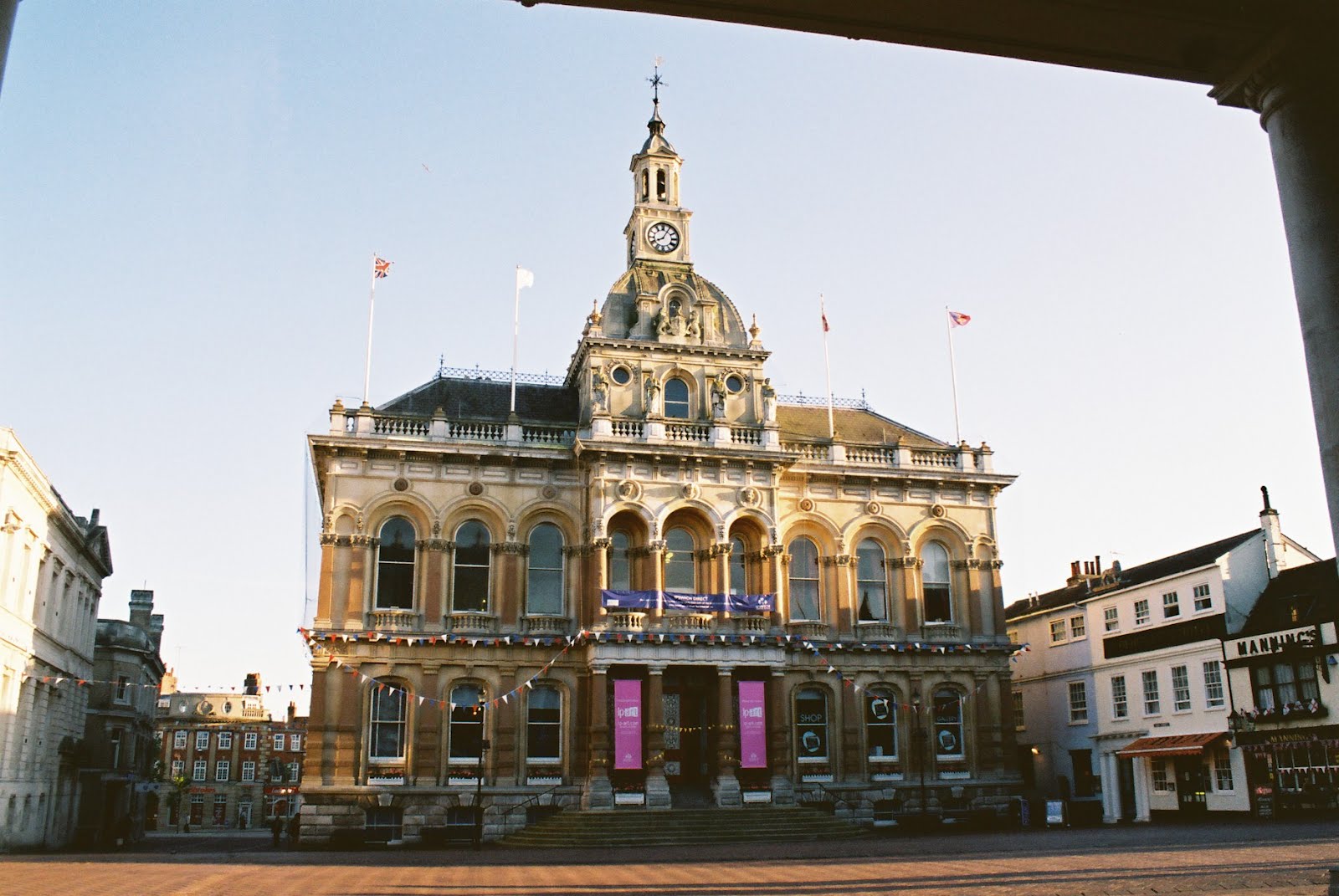
It’s one of merchant shipping's biggest disasters, which is how today - 124 years later on 6th July 2012 - I found myself outside an exhibition all about it in Ipswich, sensitively entitled The Crash Of The Elysium. I'm not that into maritime, but I always like to broaden my horizons, a bit like the SS Elysium herself.

Ipswich is one of the towns from which she used to launch, so in the museum they had tables displaying things like her anchor, fading images of the crew, plaques displaying several paragraphs of text for you to follow around the room, that sort of thing.

There was even the standard-issue gentleman there to talk to us through a slideshow about it all, albeit one which was slightly at loggerheads with one of the plaques, but I digress. (July is not usually celebrated in autumn in this hemisphere, so I will politely assume that he was from the equator)

Anyway, pretty standard local history stuff, until some members of Her Majesty's armed forces came in to curtail his presentation and lead him away.

Ooh, that sentence doesn’t look like it belonged there, so I guess it can't have actually happened then. But, wait, yes it did. I was there. I saw it. It happened right in front of me. Curse you museums for your double-minded discouragement of the use of cameras. Who's gonna remember YOU in the future, huh? HUH???

So I snuck a peek through the window into the adjoining room where the fellow had just been taken. I couldn't make out what was being said, but he looked absolutely dishevelled. Perhaps the shouty army guy was suggesting that his assertion about July being in autumn might confuse countries coming over for the forthcoming Olympics?

But then, as I and the other members of the public milled around the room wondering what to do now, the army turned their focus off of him and onto us.

Said soldiers explained to those of us dumbly looking on that they had just had to interrupt his presentation, because there was a really big national security matter going on, and now we were all going to be evacuated.

Evacuated? More like drilled. Yes, they actually did the Tour Of Duty thing and yelled at us all to "Go! Go! Go!"

If this attitude was supposed to elicit respect from us, it wasn't working.

Still, with Shouty leading us, we forgot our Britishness and duly hurried, single-file of course, out of the building's back door. Museum-guy got led out the front way. I hope they weren't planning to get any information out of him.

Up the stairs, round a corner, down a corridor, through the fire exit, outdoors into the hazy sunshine… given that I had never been to Ipswich before, whatever few bearings I had acquired back on the high street were lost immediately. Apart from anything else, out the back of the museum, there was now a small army camp set up, or being set up.

There were tents. I caught snatches of conversation from passer-by soldiers, something about fluctuations. There was even a metal hut. This we were all lined-up outside, which seemed a bit of a flourish, given how seconds later they bundled us all inside it.

And then we were given two minutes in which to put on the decontamination suits.

No word of explanation, nothing. Yet we dutifully obeyed, one young redhead looking as abject as if she had been through this a hundred times already.

"First one dressed gets a gold star, last one dressed gets a hundred press-ups." WHAT? "I'm only kidding." Whew! "Ten press-ups."

As you can tell, Shouty obviously had a second job as a stand up comic. Further one-liners of his included:

Lady: "Do we have to do them up?"
Shouty: "No, don't worry about that. It's a precaution."

And:

"Lot of space down here nobody is utilising. It's a free country I suppose."

(ba-dum tish)

Now all standing there in our white plastic body-length bio hazard outfits, we looked like a fancy dress party for people with no imagination. I even had a freakin' mask on over my nose and mouth.

Then they herded us into what they described as a "briefing room", although the sign on the door ominously read "quarantine area". Here, unexpectedly, events still insisted on becoming even more hypnagogic.

All over the walls were black-and-white photographs of the ground, bagged and tagged soil samples, and one or two large maps of Ipswich. I squinted at the wall next to me. It had cross-sections of the human brain on it.

"Please soak up all of the intel that you can see," said a guy who wasn't Shouty.

Clearly the hazmat outfits were doing their job - already we had been mistaken for a group of other soldiers. Which was understandable, given how dumbly we were doing everything that they told us to. We didn't know what to do. They knew exactly what to do. So we did whatever they told us to. Very military - this is how wars get fought.

Then apparently realising his error, he instead ordered us to assemble ourselves into three lines. Which we did. Unquestioningly.

They had names, it transpired. The Captain was T Solomon and the Corporal (Shouty) was an Albright. We however didn't have names any more because being soldiers they found it easier to cope with numbers, and duly assigned us all them from 1 to 17. (I was 15, since you ask) It was starting to look as if we were being either conscripted as temps, or sent off to The Village. Collectively we were given the official name 'Alpha Unit', yet one suspects these soldiers really wanted to think of us as Alpha One.

Then they explained everything. They said there'd been a crash out the back of the museum. The vehicle was still here. They said they didn't know what was inside it, but they used the word "critical". I'm not familiar with military terminology, so I had to find it surreal when they also managed to describe it using the words "space" and "ship" close to each other.

Frankly, by this point my brain was starting to hear Doctor Who incidental music behind it all, more specifically the season 31 march with the flutey bit that they got rid of for 32. Their über-motivational speech helped.

"You are now going to face one of the most dangerous situations of your lives, and the fate of the planet depends on what you do next. Are you ready troops?"

"Yes!"

"I said are you ready?"

"Yes!"

"Then move out!"

"Go! Go! Go! Go! Go! Go! Go!"

With Solomon taking point and Shouty as backstop, we were ordered to plunge out of the decontamination area and into a synthetic tube that was filled with a white gas. Between the white cloud, the white light, and the white of everyone in front and behind me's hazmat suits, I was completely dazzled. This total white-out was an environment like no other that I had ever found myself in. With no visible surroundings by which to orient myself, I found I had nothing but my own willpower to depend upon. Feeling like I was back at scout camp, I grimly focused, outstretched my hand, and blindly pushed on through the void, with no idea how far this tube went, or even what might be waiting for us at the other end.

In the event, we emerged inside a giant fully-enclosed tent, with the floorspace of about two houses. Parking bays were marked-out on the concrete underfoot. Umpteen other hazmatted soldiers were dotted around, some with equipment. A few computers had been set-up in the middle. And, oh yes, filling the centre, about the length of a long lorry, and surrounded by rubble, was indeed the side of a crashed spaceship.

By now they'd broken us up into three groups. Tech Team were assigned to search through the rubble for the spaceship's black box. Data Team had something scientific to do. We in Patrol Team had to check the perimeter for any breaches in security. This probably would have been easier if there had been a bit more light in the tent. Spiralling military budgets I suppose. We found nothing, which still bothers me.

Barely 30 seconds later, the black box had been found and we were all gathering around the screens to view it.

Well. You'll never guess whose improvising face swam into view on the flight recorder.

"Hello? If you can hear this, please, listen to me! It's about time, and how very little of it I've got left... I'm on a spaceship called The Elysium, and it's crashing to Earth, and there's going to be a very big bang, ooh I love a big bang me, though not especially from the inside, and that's still not the bad part because the Elysium's a sort of… well, maximum security art gallery and to cut a long story short, some of the art… escaped... I managed to get the crew off safely, but now I can't reach my TARDIS… You need to open my will and follow the instructions. But remember what I said about escaped art. Keep watching the shadows, and whatever you do, don't bl -"

Yep, that's where the recording cut off. And yes, I do know what you're thinking. The spaceship had the same name as the steamboat that had sunk in 1888. What were the chances?

But there's more. The envelope containing the Doctor's will had somehow found its way outside the crashed ship and been salvaged. However before anyone could do anything with it, the hitherto dormant ship unexpectedly started powering up in front of us.

From my limited perspective, massive red light after massive red light was illuminating in sequence all along the side of the ship. The engines roared. Some of us backed away. Two of the soldiers memorably fled.

In danger? We were all just standing there, awestruck, watching the whole spectacle unfold right in front of us.

With a firework of sparks, a doorway into the ship was cut open, and we were being barked at to board through it. Yes, board. Worst. Plan. Ever. Sheesh, now the dark lights and compulsory conscription were starting to make sense. The military was short on funding, and we - 'Alpha Unit' - had been enlisted as canaries.

As Brits, we really should have politely declined.

Part 2 of 6

Despite all the lights coming on outside the ship, inside it was dark. Really dark. A deafening alarm was clanging. We flailed our way through plastic and dangling tubes to find our way down into a room full of glass tanks containing vegetation, lowly lit in green.

Solomon commanded three of us to look around for any signs of life. I felt impertinent reporting back. "There's lots of plant life." He repeated to me to look for life again. He obviously didn't share his colleague's sense of humour.

Data Team stabilised the oxygen levels, and we were told it was safe to remove our masks. I think I was the only person actually wearing it. I suppose we really ought to have been given gloves too, but then I guess we were expendable, and the budget for gloves wasn't.

Suddenly Tech Team had another video message from the Doctor up and running on a screen.

"Hallo. I'm the Doctor. And I'm dead. BOO! Hah! Oh! You should see the looks on your faces! SHE was like WHOAAAH and he was all BLEUGHH, and…"

I looked behind me at where he was pointing. There was indeed a girl standing there. But not quite in the right spot.

"No, I'm kidding, I can't really see you, this is a recording."

Promisingly, this time he had recorded this inside the stationary TARDIS. Less promisingly, he was asking us to find the wreckage of his TARDIS and destroy it to prevent it from falling into the wrong hands. (or whatever appendages any hypothetical baddies might have) He even pointed out where the doomsday button was on the console for this purpose - right next to the other button of the same colour for putting the bubbles in the lemonade. I suppose if we picked the wrong one then at least we would have some nice lemonade to drink. Oh, and still be alive.

How he could have recorded a message inside the TARDIS, about how to destroy it, because he couldn't get to it, was a bit of a conundrum. This could have been an automatic message transmitted by the TARDIS in the event of his death, or maybe for his own reasons he had recorded it at a point in time after his and its eventual rescue. I'm with the latter theory. I don't think the TARDIS even has a doomsday button. This one'd be falling onto it five times a day.

More comprehensible news was that, thanks to the nearby TARDIS' translation field, we ought to be able to read any alien languages around us. Also, a copy of the TARDIS' key had been in the envelope with the will, and in an emergency like this one (presumably his anticipated death) would only work in the hands of a human child. At this, Solomon was very positive-minded, telling us, "You all seem like big kids to me."

Well, takes one to know one, soldier.

There was also half a photograph of a lady called Dolly, dated 1884. 'The first woman on the moon.'

Solomon asked us if we were clear and okay about destroying the TARDIS. A few people mumbled their consent. I kept my unease a secret. Shouty tried to as well. "Let's go, let's go, let's go," he muttered quietly in great disappointment as we moved on. I think I'm going to go back to calling him Albright again.

In retrospect, I think we both had the right idea though. Being Brits, we really should have politely declined.

As we pressed on deeper into the ship, I felt even uneasier when I heard the cloister bell start tolling (quonging) for about a minute. Oh, well, that happens for any old reason nowadays. Maybe the Elysium was a TARDIS too.

Albright's scanner registered a lifesign coming and going beyond a door. We went in. One of the soldiers removed a cloth sheet from a stone statue of an Angel.

Well, forget the firework display outside the ship moments earlier, we really couldn't take our eyes off of this.

Part 3 of 6

Fortunately Albright knew what a Weeping Angel was, so Solomon dutifully watched it for us as in seconds we all shuffled around it in front of him. Well, now we knew why the interior of the powered-up ship had all its lights off - the Angel didn't want to be seen, and I suppose had put the cloth over itself when we had approached with torches for the same reason.

This was all fine until, in the next corridor, Solomon took such an inordinately long time to catch up with us. I suppose we should have gone back for him.

Once he had caught up, we were all crouching in the darkness, with the door behind us safely shut. We heard the cloister bell have another go at quonging and stop again. We 'sounded-off' our numbers in ascending order by way of a role call, but only made it as far as three, following which there was a really spooky long silence. Grimly Albright radioed back to base.

"Alpha four is down."

Darn it, they were too young to die.

Something else was bugging me though. "Should we check the other numbers are here as well, in case anyone else is missing?" Thankfully, no one was, although the delay to check may not have been so smart, as upon finishing we heard the nearby TARDIS begin to dematerialise.

Albright meanwhile was still berating himself for the loss of number four. We all let him. I must admit I now regret not being there for the guy. It was all a bit like being in Alien except there was no Ripley. Perhaps the army should have accordingly sent along a kindly Medical Lieutenant to help its employees cope, perhaps a good assignment for that redhead. Or perhaps not - maybe she had been number four. Where was Albright's earlier sense of humour now. Perhaps I should now start calling him Alldull.

Alldull, two and nine checked out the flight deck, before reporting back that it was safe. Upon our entering it however, Control radioed through the warning that the apparently lifeless 'suits' were in fact the ship's automated defence system, attracted by light. Now just how did they know that?

In worse news, burn marks on the floor were concluded to indicate that this was where the TARDIS had been parked, until I had delayed everyone from entering the room by suggesting that we continue counting. Now who's berating himself? Well, hang on, now that I think about it, I suppose that maybe I had just saved the TARDIS, albeit from ourselves. Go me!

As we began to look for any clues that the Doctor might have left behind, I picked up a couple of circuit diagrams and examined them. Without the TARDIS present, all the 'alien' writing was revealed as being in English anyway! Result! Unless of course, again, we were also inside a TARDIS, or there was another one somewhere else around. Now that I think about it, I find myself wondering how I recognised whether technical gobbledegook was in English or not anyway. Same characters I suppose.

There was also a small wooden box with a round metal handle, which resembled an oversize padlock.

Alldull was beginning to cope with his guilt by spontaneously developing a sixth sense. In fact, from this point onwards, he and Solomon both seemed to be in something of a race. When one of our number discovered a box with an 'X' on it, they both chanted in unison at him "Open it now!!!"

After we had followed a whole set of clues that the Doctor had left for us to follow, Alldull read off a list of several colour-coded wires for Solomon to plug into the correct sockets, upon completion of which the latter declared to us "Alphas - well done!" I suppose the broader task had been a team effort.

Immediately (what appeared to be the middle of) a third video message was playing on the screen facing the chair that they told us was the driver's seat. Now the Doctor's image (again from inside the TARDIS) was filling us in that, whenever someone tried to break in, the TARDIS was programmed to perform an emergency time-jump thing to an old friend of his for safety. An option of the HADS I guess.

It therefore seemed as though the TARDIS had just dematerialised to escape from a threat that might still be in the room with us. However it also makes sense that an Angel would probably have tried to board the TARDIS before the spaceship Elysium's crash, equally prompting the same emergency dematerialisation. So, had the TARDIS in fact returned after the crash-landing, and then left again a moment ago?

Whichever, Alldull spotted that one of the gasmasked suits was now standing up behind us. He advanced towards it, and within half a minute they were again barking at us to "Go go go go go!"

We ran on deeper into the ship, or more likely closer to the other side of it. The end of the next corridor was blocked. Now it was Alldull seriously taking his time to catch up. What was he doing back there, talking to someone? Resetting something? I suppose we should have gone back for him too. Presently he too caught up, closing the door with himself on our side.

Not that it did any good.

It was very dark, so the Angel had overtaken the suit-zombie, in the process presumably either breaking its neck or sending it back in time depending upon what type of Angel it was. (Angels are much faster than suit-zombies y'know)

Not that it made much difference to us which one of them we were being stalked by. The flickering of the lights would enable either enemy to slowly advance upon us.

We were almost huddling against the bulkhead, but being British we were still avoiding touching each other. Good job they didn't ask us to hold hands and use the buddy system or anything.

The darkness itself seemed to be flashing. Lit by such strobing flares, the Angel got into the corridor. It appeared to glide towards us, advancing like a really old silent movie. We cowered. There was nowhere to escape through, and no way back around it.

The Angel bore down on us. We were all completely trapped. One of the girls from the museum grabbed my arm in fear. This time, as a Brit, I really should have politely declined.

Our wider female contingent began screaming, apparently in an attempt to harmonise with all the other deafening noise roaring through the walls at us.

And then… the return of pitch darkness and peace again, broken only by Alldull's pained voice urgently cutting through it with a disastrous admission.

"I think the Angel might have touched me Sir…"

He was really not having a good day.

Part 4 of 6

The bulkhead itself seemed to open and melt away, so we unquestioningly bundled through where it had been, and into… huh?

The ship had vanished. However instead of being back on the makeshift military camp, we were now surrounded by various misty fairground sideshows with names like The Mighty Bacchus (weightlifting) and Visions Of The Future. (intriguing!) In the distance, carnival music was playing. The soldiers' radio couldn't get a signal. Either this was the soldiers' very elaborate rec room, or… no!

A lass who one of our team thought was Dolly from the earlier photograph was walking up to us although I wasn't so sure. Said team member could have got out of the army on grounds of insanity, had 'Dolly' not answered Solomon's insightful question about today's date with 6th July 1888…

Yes, the Angel had transported us en masse back in time 124 years to the very day, and in so doing presumably harvested the rest of our lives. After all, that's what these Weeping Angel types do. Check your facts all over again, Dan Brown.

With the carnival-tent sadly closed for the night, Dolly was dewey-eyed to see us. I can't recall now, but she probably had the other half of the photo. Alas we did not get to meet her boss Mr Valentini. We all sat down on some hay-bales. With Alldull's help, Dolly took another photo of herself (with number four?) that we'd already glimpsed of her back in the future on Mr Willard's screen in the museum.

She told us how, as a kid, she had first met the Doctor while metal men had been invading the city. Later, for her 21st birthday, the Doctor had taken her to the moon. She said the Doctor had asked her to look after the TARDIS if it ever came to her without him. This sounded positive. Although all we talked about was how to send the TARDIS forward to save the Doctor from the crashing spaceship, we had to somehow get back to the future ourselves too.

She told us that, as time-travellers, we were now charged up with artron energy, which I suppose was a synonym for chronon energy. She lead us in charging up the TARDIS key with it. So far so good. However THEN she said we had five minutes in which to enter it into the TARDIS' lock over in the nearby Cabinet Of Curiosities attraction, after which the charge would fade. (I really think we should have located the TARDIS first, but hey, like I was being any use here)

Sadly, in the five minutes that we got to spend with her, no-one in our group - not even the insightful Solomon or Albright - thought to ask her to get a message to the crew of the steamship Elysium to warn them of their impending deaths in a force 12 storm in 12 days' time on July 18th 1888. (source: plaque number one at the museum)

Frankly, I blame Mr Willard for

a) fudging when the crash had taken place,

b) suggesting that the photo of Dolly with one of our number had been taken contemporaneously with the fairground's pitching near the ship's wreckage after her crash (which was impossible whichever crash-date was correct), and

c) not coming with us. (he should have rendered the soldiers unconscious with another delivery of his speech or something)

In fact, for a raft of subtle reasons, I'm tempted to accuse Willard of being a fraud. Had we asked him any questions, I really think he would have just stood there and made something up. That said, the fact remains that I did not weigh his historical statements against more primary nineteenth century evidence while I had the opportunity to. Had the steamship that he was talking about ever even really existed? Hrrm.

Still, hypothetically, assuming that the SS Elysium was going to sink in 12 days' time in 1888, then IF we had found a way to avert this, then I suppose it might have taken another 12 days for the crash's consequent museum in our present to accordingly disappear. I'm just sayin'.

However if I'm honest then I'm shifting the blame here. I am much more responsible for this potentially deadly oversight. But the stress-break to sit down and listen to Dolly natter on for a few minutes had clean taken all the adrenaline out of my system. I was tired. I was sweating. That blasted cloister bell was still quonging in my ears. I couldn't concentrate. Dear God please don't let those crewmen's deaths prey on my conscience every night until I join them.

But enough of what we didn't achieve in the nineteenth century...

With Dolly having rather unhelpfully hung back, our unit now stood surrounded by a large circle of red curtains, with about twelve signs dotted high around the circumference like the numbers on a giant clock. These signs read things like 'The Sprite's Chamber', 'The Dog Faced Man', and 'The Lost Temple Of Nostromo'.

I had no idea what they were or meant. Perhaps I should have invested some of our five minutes in investigating further, but with Solomon and Albright there, there just wasn't much opportunity. We really should have torn around all over the place like children.

Perhaps the curtains hid other works of art sent back by the Angels in the future, or suit-zombies, but we'll never know now. The soldiers' scanner took us straight to the curtain with the TARDIS behind it, with barely a sentence wasted. Good thing too. Surely only Dolly could have found it quicker.

The key was put in the lock, and thanks to the artron energy, the TARDIS duly dematerialised. I've no idea what attraction Dolly normally keeps behind the 'Box Of Delights' curtain, but I'd like to think that it's the ten-year-old John Masefield reading a book.

So, our only means of escape from the year 1888, other than taking the slow way round, had just gone.

We accepted this disastrous development remarkably well.

Part 5 of 6

Suddenly radio communications with base were working again, unless you count the Doctor's voice sneakily cutting in over them to thank us all for returning the TARDIS to him and saving his life!

Where the TARDIS had just dematerialised, it had somehow left behind a vortex manipulator, a fez and a written note from the Doctor with instructions on how to get home via the nearest time rift. I'm not sure how he had set up the TARDIS to leave those things there at a point in his life before we had saved him.

Another lone nasty had snuck up behind us to stand menacingly looking at us. None of us could work out what it was doing in this time zone. It was either an Angel or a suit-zombie, I can't even remember which. It was just time to run, well, hurry away again. Whichever it was, there wasn't much chance of it catching us.

We headed as quickly as was practical through the mirror maze, briefly passing an Angel trapped looking at its own reflection. How had that got back here to 1888? Had it met another Angel and thoughtlessly gone and shaken hands? Had it threatened the TARDIS on the spaceship Elysium and come back with it clinging onto the outside? Anyway, good luck Dolly when it gets dark, which since they were closed for the night ought to have been very soon after we passed it.

Safely arriving non-stop at the other end with no-one getting snatched at the back or stopping for any other reason, Solomon and Albright kept their sanity to make further leaps of deduction to confirm that we were now once more back in the year 2012, and inside the spaceship Elysium's warp core. (maybe the Angel in the mirror maze had simply been walking in the opposite direction) Unfortunately the monitors, rather than showing us another message from the Doctor as usual ( :( ), were instead displaying more Angels just outside the door. ( :(( )

One of the group (number two I think) dared to recall that we shouldn't look at them because an image of an Angel becomes itself an Angel. This has always struck me as double-think, so I ignored her and looked straight at them.

The soldiers' babbled plan was to power up the warp core and suck the Angels into the walls. Hm, an intriguing plan Sir, with just two minor drawbacks - one, the ignition wasn't on, and two, we didn't have enough power anyway.

Well, not unless you counted Alpha Unit's second dose of residual artron energy! (we had just travelled in time again)

One last push. Joining hands around and against the massive stone column that was the core, we began to concentrate as we had done moments earlier with the TARDIS key. The engines roared. The enormous heavy stone column shook about under our hands like it was in an earthquake. Was this really going to work? If only we had found some kind of instructions to follow, instead of relying on what seemed to be a guess.

Perhaps we should not have doubted. For at that moment I think our younger selves were outside the ship, watching it mysteriously powering up, and backing away in wonder. Yes, I think we had taken a left turn in time too many, and arrived back in the present twenty minutes too early. (a fitting conclusion to such a counter-clockwise hour) If only we had practised some method of focusing our swift hurry back through the time rift.

Then suddenly, there was silence, and a calm computer voice.

"+++CHRISTOPHY WARP DRIVE ACTIVATED+++"

There was cheering, clapping, and jubilation! And saluting! Captain Solomon was no longer such a solemn man. Albright was all bright again! They told us that the world would never ever know what we had done in saving it, and I didn't burst their bubble by pointing out that I wasn't sure either.

I reckon we should have ended on a song, but she would probably have just told us not to give away any spoilers. Spoilspoilsport.

We bade Solomon and Albright farewell, each headed through the now open door, and down a corridor lined with fragments of Angels melded into the walls. We were still being careful not to get touched by any of them, although they don't seem to be a danger while you can see them.

In a moment that somehow summed up the day, it was one final task for which we each had to depend upon our own determination.

Part 6 of 6

We emerged back onto what still appeared to be a military base outside, and de-hazmatted ourselves in a similar metal hut to the earlier one where some of us had left belongings. From my perspective, 53 minutes had passed since we had entered the museum. I really needed an orange juice but the army were not offering them.

As we removed our uniforms, one of the staff asked "Does anyone have the letters from the Doctor?"

Yes, The Doctor had typed each one of us a letter to thank us for our help… including me!

These hadn't been left by the departing TARDIS from 1888, so I can only stab at quite where and when they had been happened upon. I'm guessing that the Doctor had left them for us to find in the warp core room.

As I headed away from the military encampment into Ipswich's silent back streets, I had absolutely no idea how to get back to the museum to check if Mr Willard was okay or facing a military court martial. But now I also had a significantly earlier train to catch home than the one I had been expecting to.

The sun above me was shining again, and with the events of the past hour echoing in my head, I opened the unique envelope which the Doctor had written my own name on…

BTW we don't have a shrubbery, so unless I move, I guess he got the wrong house. Yeah, yeah that'd be about right...

(Of course, after posting this, I learnt that we do have a shrubbery after all. Who knew.)

We never found out what had happened to the steamship Elysium. Or why she had borne the same name as the spaceship. Or whether our visiting the carnival shortly before/after the ship had sunk was a coincidence, although I believe the Doctor lied to us about destroying the TARDIS and planned for us to get sent back in time by the Angel.

Had pirates boarded the steamship Elysium and accidentally released a cargo of Angels, who had then built the spaceship Elysium from the wreckage and other freight? And as for Willard's talk contradicting his own exhibits... was that the Doctor's doing too? Had he set events up in each of our lives to draw each one of us here this day? If Willard wasn't genuine, then was the entire exhibition similarly false, perhaps just to get us there to save him and the whole of planet Earth from yet another contingent of Weeping Angels? Did the steamship Elysium ever really exist? Or was its expensive cargo just a myth to explain the carnival's fine artefacts from the future? Were WE the crew of the Elysium? Is this a good time to mention that my ticket to the museum had been another of THIS year's birthday presents?

I shudder to think what he meant in the letter about NEXT year's birthday being "amazing"...

Basically I still had this deep, nagging feeling that there was a great deal we simply missed out on here. And the more I realised we had missed, the more it felt like we had failed.

Perhaps if I quickly review it all again a second time, only this time from what I perceive might have been the TARDIS' point of view...

1. On the crashing spaceship Elysium, the Doctor is separated from the TARDIS, and records a mayday message on the ship's black box flight recorder.
2. A Weeping Angel tries to enter the TARDIS, causing it to dematerialise for the safety of Dolly in 1888, taking the Angel with it.
3. In 1888, the Angel leaves the TARDIS, enters the mirror maze, and becomes trapped looking at its own reflection.
4. We arrive in 1888, meet Dolly, and send the TARDIS forward to the Doctor by putting the artron-powered key in its lock.
5. On the Elysium, the Doctor sees the TARDIS arrive from 1888.
6. Taking the black box with him, he uses the TARDIS' fast-return to travel back to 1888, arriving after we have left, and hopefully dealing with the Angel by the mirror and any other potential nasties.
7. He meets Dolly for the first time (too much of a coincidence otherwise), and is told by her about us, including Solomon and Albright, each of whom he will probably never meet.
8. He goes back in time four further years and takes Dolly to the moon for her 21st birthday, having their photo taken, and putting half of it in his wallet. He asks her to look after the TARDIS for him when it will one day return to her without him, and he educates her about Artron energy.
9. He goes back in time again to when Dolly was a kid and makes all the metal men run away from him and the city. (she was too young for it to have been The Next Doctor) I guess the metal men all settled on the coast.
10. He travels to the recent present and fabricates the museum, including the steamship Elysium, which River probably helped with, being an archaeologist. He gets his friend Mr Willard to front it, without briefing him AT ALL. He gets a list of all our names from registration.
11. Using his UNIT credentials, he briefs the military about the suit-zombies, and convinces them to conscript the people on the list.
12. He plants his wallet in the rubble outside the crashed spaceship Elysium, together with the black box flight recorder. He might even don a hazmat suit to do this without getting noticed, and may even walk past us.
13. He returns to the nearby TARDIS, uses the list the write us each a thank you letter (presumably including Solomon and Albright), and records his second and third video messages. This includes lying to us to destroy the TARDIS, so that if someone bad gets the message by mistake, they will still unwittingly put the key in the TARDIS' lock and it will leave again. He also plans for us to get sent back to 1888 by the Angel, to fulfil Dolly's testimony that we had come from the future. While he prepares these, the TARDIS' proximity outside the Elysium enables its translation-field to keep the circuit diagram inside appearing in English.
14. He hops back in time in the TARDIS to land inside the spaceship Elysium, after it has crashed, but before we have boarded it, and parks it in the drive room.
15. He leaves the second video message in the room with the plants.
16. He leaves the thank you letters in the warp core room. (yeesh, we might have seen him)
17. He sets up the clues and third video message in the drive room, while encountering an Angel and staring at it, keeping the Angel more or less in its statue form. This first protects it from getting sucked into the walls with the others, and then causes Albright's scanner on the other side of the door to register the Angel's lifesigns only intermittently. The cloister bell is caused to ring first by the Angel's proximity to the TARDIS, and then second by a suit-zombie.
18. He departs in the TARDIS, which we overhear.
19. In the TARDIS, he sits back to enjoy a jammy dodger and a milkshake, telling himself out loud that they are cool.

I've no idea when he sets up the fez, vortex manipulator, letter and radio message in 1888 (anytime), but I'd like the think that he did them last. We just didn't see or hear him again after that. (yet)

Whew!

As for at what point in his life all this had taken place for him, well he never said. For example, maybe it was while he was looking for River between A Good Man Goes To War and Let's Kill Hitler. Or perhaps while time was so muddled just before The Wedding Of River Song. I'll have to think about where to put it in my Index. Sheesh, this must be what River has to go through...

Which is all why I've written this post, to sort out a version of it all in my head that works. It may not be the way it all actually played out, but I need a version of my life that makes sense, if only to me.

Overall, an awesome day, though if I could do it again, I know I'd do it all differently.

For a start, I think I'd have to take a deep breath, deny my introversion, and ask more questions.

A lot more questions.

Labels: , , ,

** Click here for preceding post(s) **

** Click here for following post(s) **