Steve Goble

Choose life. (Deuteronomy 30:19)

Went to another PACT meeting (Prayer and Action Changes Things) tonight for the oppressed people of Burma.

We watched a monochrome version of the following video:


Then we prayed.

Key websites for info and further actions:
www.burmacampaign.org.uk
www.freeburmarangers.org
www.caat.org.uk Campaign against the Arms Trade
www.controlarms.org Control Arms Campaign

I have little to say on this subject, because I'm ashamed to admit that I knew pretty well nothing about it until this evening.

The video above on the other hand is shot amongst a community that lives its life constantly on the run, and surrounded by borders. I ask you, just how unfair must it feel to the Karen that we can get camera-people in and out of there?

Labels: , ,


Think of the words "Miami" and "Vice" and what do you think of?

For me it's the 1980s, Don Johnson, Phillip Michael Thomas, that flamingo at the start, and all to the music of the incredible Jan Hammer, none of which are in this film.

I mean a different decade I can easily accept, and maybe there was a random flamingo somewhere that I missed, but not even Jan Hammer? Really?

I'm afraid I found this update unengaging, which is tragic given that it was written and directed by the maestro behind the original series - the one and only Michael Mann. It seemed like every week Mann was taking this TV show and somehow directing it to look like a blockbuster movie. Now he's actually remade it as a blockbuster movie and it... well... sadly I think you can tell how this sentence was going to finish.

Towards the end there's a shoot-out and things actually get going for a bit. Unfortunately shoot-outs tend to turn this viewer off. Now that's really just bad luck. Maybe that's why I never really followed the original series?

For all that, I have to admire the film's pedigree. If this exact same film had been made by anyone else, then I would have absolutely hated it.

Since it's made by the same guy as the original however, I can respect and accept it.

Whew.

Labels: ,


Writer: Denny O'Neil
Penciler: Rich Buckler

I thought, on the cover above, that those were mirrors that Iron Man was maybe flashing out a message in morse code on. In fact, he's firing his repulsors. I would be so dead in that fight. "Is that an S? YURRGHH."

In something of a sequel to Secret Wars II #1, Thundersword, now without a hyphen (hence the story's title I guess), escapes from police custody again and once more causes chaos. All that remorse he seemed to be going through upon his arrest seems kinda shallow now.

Dual costumes seem to have been a hot idea at Marvel in 1985. While Spider-Man was randomly wearing either one of his two outfits, this issue features two Iron Men – Tony Stark and James Rhodes – splitting-up to battle different villains in their different duds. That Stark winds-up producing part of a third outfit for the final showdown just seems like one-upmanship.

Though this is a good episode, I do have a beef with it being billed as a Secret Wars II crossover. The Beyonder's not in it, so unless something here becomes relevant later on in that series, all this really tells us is what Iron Man and Thundersword did next.

Nice picture of Captain America on the cover though.

Labels:


Writer: Chris Claremont
Artists: John Romita, Jr. & Dan Green

Despite being mindblind from the drugs he's on because of his recent mugging, Professor X accidentally 'overhears' a random thought from someone plotting a murder.

The really big problem though is that he chances upon this snatch of internal monologue whilst in a lecture hall packed with hundreds of students.

From that moment, the hunt is on for the X-Men to identify the would-be murderers and stop them, without any idea even who their intended victim is. You'd expect the Professor to at least have noticed the gender of the voice. I guess telepathy doesn't work like that.

Anyhow, in a huge stroke of luck, the victim turns out to be himself. However with anti-mutant hysteria building, the prey also expands to include Shadowcat. The final showdown at the end, with Rachel determined to exact revenge against the plotters, muddies who the good guys are even further.

It's their dubious ally, and long-term nemesis, Magneto who winds up talking her out of it. Having apparently wrestled with his own conscience over the years, he's able to empathise with what she's going through, even to the point of using reverse psychology.

Magneto: "Then kill him, child. Prove your superiority -- slaughter them as callously, as mercilessly, as they would you. Let them see that you are no better than they... that you can return hate for hate, blow for blow, life for life. What are you waiting for, Rachel, DO IT! Give THEM the final victory!"

As the 'heroes' exit from the scene at the end, the real picture of grace is not that Rachel spared the would-be assassins' lives, but that her comrades have seen what she's really like inside, and will doubtless continue to stand with her.

Labels:


*** Contains spoilers ***

True stories have a real edge over made-up ones – you just don't know how they are going to end.

Although, this afternoon I did. I had seen the stage version of this at Richmond Theatre in 2004 and, again since it is based on a true story, I found this 1987 film adaptation to be very close to it. A true story doesn't really leave much room for changes, not if you're going to be faithful to it.

I suspect that this tale must be one of the truest. It's heavily based on a series of actual letters exchanged over a twenty-year penpalship between Helene Hanff in New York and Frank Doel in London, so both the stage and the film versions are driven extensively by narration. Though I don't know how much, if at all, the original letters were adjusted before publication in 1970, I'd like to suppose that in both cases, these were the actual words written during the preceding two decades.

That both parties seem to have kept all their correspondence over this period also testifies to their value of them.

Air travel was much more expensive in those days, and in this respect the story has aged a little. In the theatre, I did kinda wonder why Helene couldn't easily save-up for her trip to London.

If ever a film were about the journey rather than the destination, then this one would be it. The ending is a real-life tragedy, something that no Hollywood producer would ever green-light in a work of fiction.

As a result, 84 Charing Cross Road treats its audience with the respect that it deserves for coming to see it. Writers Hugh Whitemore and James Roose-Evans do an excellent job of conceiving the context in which Helene's (Anne Bancroft) and Frank's (Anthony Hopkins) lives took place, while director David Hugh Jones effortlessly enables the whole piece to breathe.

It's sometimes infuriatingly billed as a 'romance' – even Radio Times that week embarrassed itself – but that Helene and Frank never in the end met is truly sad.

The stage version that I saw understood how frustrating this conclusion was, and so during the curtain call the actors playing Helene and Frank held hands and pecked as good friends.

The applause got deafeningly louder at this. Their contact in-person was an impossible event, that made no pretence to be a part of the narrative, but it was satisfying to see anyway.

Alas, I don't think there's any filmic equivalent of such a trick, except possibly dreams, or showing out-takes?

Never mind, the movie 84 Charing Cross Road is worth 100 minutes of anyone's time.

And, look, I've just been writing about it.

Labels: ,


Thoughtful drama which covers 24 painstaking hours in the lives of chef José and his friend / ex-colleague, waitress Nina.

Nina is sacked for being repeatedly late. José finds himself accidentally walking-out over it, which is something of a source of tension given that their manager is also his brother.

However he has a good reason. His good reason is that Nina had a good reason for being late – she's just discovered she's pregnant. Alas, this is the sort of good reason that José can't really put into an explanation without betraying Nina's confidence.

Nina intends to have an abortion. Well-intentioned José tries to talk her out of it. He fails. He especially backs-off when she offers to have the kid and give it to him to raise.

Apparently not having anything else to do with the day, they wind-up going back to José's place, where she meets his parents and discovers that he previously spent several years in prison for accidentally running-over and killing a child.

His ongoing guilt and grief, expressed in his attempt to save her baby, might just put the value of Nina's child's life into another perspective for her, but it doesn't.

The next day, she goes to the abortion clinic. She exits in tears. We're not initially told whether they are the tears of loss, or of something else.

Though it only runs the standard hour-and-a-half, Bella is quite a slow-moving film, because it really gives the characters enough time to spread-out in each scene. It's not a film where I felt as though I was watching real people, these are still movie-characters, but it's unusual to see them given so much breadth.

The ending has the distinction of being quite positive, which it accomplishes pretty well given the strong danger of triteness. On the one hand the film aims for realism throughout, yet it's constantly challenged in this by that poison to all realism – symbolism. For example, throughout most of the film, heavily-bearded José looks uncannily like Jesus. Sure, that's not going to prejudice the viewer at all.

Still, what becomes of José and Nina's individual lives, and their individual angst, is hardly the stuff of Hollywood.

A thought-provoking film, and therefore probably one better reflected upon for a while.

Official site here.

Labels:


Writer: Mike Carlin (#305-306), Mark Gruenwald (#307-309)
Penciler: Paul Neary

Q. How do super heroes while away all that boring time between issues when there's no crime to be fought?

A. What time between issues?

Although these five monthly editions were published across nearly half a year, and tell three different stories, they cover just one week in the hectic life of Captain S America. Between #307 and #308 he even squeezes-in a fourth case fighting the god-like Beyonder in Secret Wars II #1!

At this rate, an entire year of issues would only cover a fortnight of Cap's busy schedule, so it's a good job that mild-mannered Steve Rogers is one Marvel character who remained popular for two decades following.

Popular with readers, that is. For this manic week more broadly chronicles Rogers' loss of his regular job back in his real world. The very first frame of #305 features him hard at work on Tuesday on an art assignment that his boss needs for Friday. Well, his excuses six days later (four months later for us) in #309 don't go down so well.

Which is a shame, because he has a really reeeeeeally good series of explanations, if only he could somehow work out how to tell them without blowing his secret identity wide-open. Hey - it could be done...

Steve Rogers: "I'm sorry Sir, but on Tuesday and Wednesday I was 3,500 miles away in London fighting Modred the Mystic with Captain Britain. Then I lost my luggage and on Thursday I had to go try and stop the Beyonder over on the West Coast in LA, while at the same time defeating Thunder-Sword with the X-Men and the New Mutants. That took me into Friday when I had to help Armadillo out of being blackmailed by the evil Dr Malus, by which time it was Saturday when I flew back here in a borrowed West Coast Avengers Quinjet, and it was only then that it first occurred to me to phone you."

Mr. Bennett: "Hm. Sure, whatever. I'm sorry, I just can't get over London getting destroyed last week."

(we'll come back to this)

In fact, Rogers is probably quite smart to keep stum about his activities as his alter ego. After all, his boss Mr Bennett, quite apart from gulping back his reaction to London's destruction, (still coming back to that), might actually be British and spot just how ludicrous the details of the above story would have been.


After landing at Heathrow Airport, Cap jumps on a tube train bound for "Victoria". (there's no such line) He is observed by a local who exclaims "Cor!" (there's really no such word) Then he discovers flagpoles to be a "universal commodity". (well okay then)

Stone the crows, these two capitals of Somalia both take place in that weird American version of Her Majesty's Kingdom that we Brits always consider so top hat, mate.

Sure enough (it's in this paragraph), over the course of the story, London is pretty much laid to waste as a Hollywood ticksheet of famous landmarks all get smashed to bits. St Paul's Cathedral, Big Ben (twice, in #305 and then again in #306, just to be sure I guess), Tower Bridge, Regent's Park tube station, (#306 page 9 panel 1) Harrod's, and finally the graveyard of the Tower Of London, where in a sort of inverse example the dead get reanimated.

Forget the Marvel heroes' shock at the World Trade Centre's destruction in Amazing Spider-Man #477 - tell me that Captain America hadn't already been through Ground Zero in this one:


One thing nobody would have been able to fault Rogers' account on though would have been his description of Captain Britain's costume. It had only recently changed in Marvel UK's ill-fated Captain Britain Monthly, and to see it reproduced so authentically in a US mag was, well, something of a relief.

Marvel UK's stories had always felt to me to be a bit apocryphal and somewhat outside of the main Marvel canon, and despite the consistency of the above-mentioned outfit, these issues still feel weird. This version of Brian Braddock is so mild-mannered that he's a bit of a defeatist, needing Captain America's encouragement to overcome the odds, and doesn't seem to have anything else going on in his life. In other words, it was now the Marvel US issues that seemed apocryphal, especially given how Britain forgets that he can control his costume when someone else is wearing it.* Oh well, low expectations met then.


* See Captain Britain Monthly #3 - maybe that makes it Marvel UK's fault? -- Steve.

Well, I exaggerate. I thoroughly enjoyed these issues (aside from the "dramatic look back at the Invaders of World War II" promised on the cover of #307 which turned-out to be just one flashback panel), and have found both Captain America and Nomad to be characters with whom I could connect. Nomad because of his insecurities, and both of them for being role models.

When their crime-fighting partnership breaks-up at the end, it's really because they are both so interested in doing the right thing.

And you can't set a much better example than that.

Labels:

Labels: ,


Writer: Chris Claremont
Artist: Bill Sienkiewicz

I found this one a tough read.

Partly it's because of the script's verbosity. The high word-count isn't a bad thing in itself, but when married to such stylised artwork, I found I was often confused as to what was going on, or even who was speaking. Don't get me wrong – I like the artwork, particularly its depiction of Darkchilde's manipulation of Limbo early on, but I did also find it confusing.

I like the way that Marvel Comics have over-arcing storylines that require a little commitment from the reader, but I haven't generally found that to be at the expense of newcomers. I'm not particularly familiar with the New Mutants, and by the end of this instalment, I'd made some headway, but not really enough.

I bought this issue because it was advertised as continuing the Secret Wars II storyline. On page seven the Beyonder wordlessly shows up, silently observes events, and departs again on page 18. He does get a little interaction, and foreshadows his later crush on Dazzler, but on the whole this issue is more a continuation of New Mutants #29. No wonder Marvel UK's Secret Wars II reprint series skipped this one.

As such, Dazzler's battle with her drug / fame addiction hooked me in (no pun intended), but also had me mixed-up as to which way she was going.

And hey – it has the word 'New' in the title. Never a wise move for a mag from 1985, or indeed any other year. Has anything with the word 'New' in its title ever lasted? Oh, right, this series lasted for eight years. Since its cancellation there have been two further groups also called The New Mutants. Maybe they were each intended to be ephemeral? Or maybe that proves that the name has indeed lasted.

After all, I guess that, by definition, all mutants are new.

Labels:

Have just spent a terrific weekend exploring the Cotswolds with John, Perry and Richard.

As usual, I got very little sleep the night before leaving, but managed to close my eyes and catch maybe as much as half an hour's shut-eye in the car on the way up.

Once there, we boldly embarked on a 6K walk around the hills near Stanton. Yup, hills. That meant starting-off by going uphill.

Here I felt a little shamed. John has been cycling to work for years, Tim is currently in training for a marathon, and back in the day Rich used to occasionally get referred to as "Mr Muscle-Man". Me - I found myself drawing breath at the back, and was mightily grateful when we all stopped for tea and cake at a village hall. Fortunately the second half of our trek was mainly downhill.


We also found this huge metal mouse-wheel thing, which John and I had a brief go at driving.


Fortunately there were no sheep nearby at that point.

In the evening, after having checked our stuff into the excellent Bed and Breakfast at Woodmancote, we crossed over the border into Bishop's Cleeve to have a huge curry, followed by making our way across to the pub.

By now I was seriously flagging. Perry was tabling that the moon landing pictures were genuine, and I was just too weary to argue. Soon I might even be moving in slow-motion myself, and how much could that potentially weaken my argument?

By the time we were making our way back up the hill to the B&B, I was stumbling about like a drunk.

Sleeeeeeeep...


Fully recharged, after the traditional B&B full English breakfast, Sunday saw us head out for coffee at Costa, before finishing-off with a long pub lunch by a nearby steam railway.


An outstanding weekend. Sure, aside from the walk we didn't really do much, but that was the point.

Labels: ,


Well, I'd seen the 1925 silent movie version, and the more famous 1959 Charlton Heston classic (epics both), so tonight it was time to attend the world-premiere of the unhyphenated Ben Hur Live at the O2 Arena in London.

The Millennium Arena.  See, how hard was that?
Or as I prefer to call it, the Millennium Dome. I know, the name is synonymous with throwing tons of money away, an idea which is hardly attractive to theatre-goers. But really, who wants to replace that image with one of a theatre with so little creativity that its very name doesn't even cut it as an actual word?

Mightily important concerns over the venue's title aside, I think my even greater apprehension was at the title of the show. Just how ashamed was this high-profile modern production going to be of its second titular character - Jesus Christ - given that they had already removed him from the legend's name? Had he also been similarly excised from the story? Would he be an updated politically correct Jesus, preaching humanism and endorsing evolution? Would Ben-Hur's first name now be Ben? Would he and his best friend Messala now be gay lovers, in an attempt to be modern and relevant?

Oh yeah, I was a tough audience all right, so imagine the shock I got when the whole thing began and everyone was speaking in... German!

This was something of a lesson in humility. Here in the UK, we're so unused to getting shows second-hand from Europe. Especially before they've even been to Europe. And even more so when the German-sounding language actually turns out to be mixture of Hebrew, Latin and Aramaic, or today's approximations of it anyway.

So we had a local narrator explaining it all to us throughout. I say local – he was an AMERICAN! Oh, the insult. What an irony that the arena's truly abysmal acoustics rendered so much of what he said unintelligible.

Anyway, that's most of the (jokingly) negative stuff out of the way. The production itself was spectacular.

A cast, well, a circus really, of hundreds of people swarmed across the enormous stage-area, juggling, doing acrobatics, riding horses and probably sawing each other in half if you were in the right corner to see it.


Yes, I dared to take the above photo, but not you'll notice with a flash.

A huge sign on the way in had told us not to take flash photography during the performance, however no-one had read it. So the sea of dimly-lit patrons sparkled like a dirty canal on a summer's morning, as punters (no pun intended) constantly exercised their legal right to take pictures of whatsoever they pleased. After all, who could blame them, when they'd parted with so much cash simply to be allowed to come in? I got with the crowd and turned my flash back on again.

After about 15 minutes however, all the flashbulbs seemed to die-down during a particularly mesmerising dance-sequence. Me, I was humming the Vena's Dance music from Star Trek in my head. I think we had all just got into it.

There are three scenes that everyone remembers from the 1959 movie.

1.


The scene when, while being dragged in chains through the desert, Judah Ben Hur (yes they got that right) is given a drink of water by a mild-mannered carpenter's son.

2.


The scene when the pirates battle the slave ship upon which Judah Ben Hur is imprisoned. This was a bit magical, the sea being conjured-up with a carpet of dry-ice.

The pirates were zooming around in miniature buggies, which were also a little on fire so that we knew they were the bad guys. Well, the bad guys who weren't the Romans anyway.

In a nice nod to the 1959 version, this culminated in an allegedly 25 minute interval, which I spent on a wandering odyssey of my own in search of any ice cream vendor with a queue less than half a mile long. (Four pounds a tub. Four. Pounds. Four.)

3.

You know the third one.

But just how was all that whirring cutlery, stampeding horsemeat and bludgeoned Messala going to be realised on stage? They'd used real horses in earlier scenes, and indeed real actors, but they had all been fairly docile and under control. (yes, I am referring to both sets) Y'know, like a character was just riding a horse slowly, or leading one.

Now however, in the preparations for the big race, we witnessed Judah Ben Hur charging around in a chariot drawn by four horses, who within the story were out-of-control, and so he had to break them. Actors were jumping out of the way and everything. Well all right, all these circus-types were probably doing multiple back-flips and catching roses in their mouths to get out of the way, but I digress. I was impressed at both the wrangling and amount of rehearsal that it implied. Not to mention dental fees.

Incredibly, this turned out to be the supporting short to the main feature!

The build-up to the race was terrific. Judah Ben Hur's there at the starting line with his chariot pulled by four white horses, and his opponent from the dark side Messala is there with his chariot and four black horses too.

You can’t really blame them for only having the two chariots in a live show. This scene really goes on for a while in the movies, as the various chariots do multiple circuits of the track and all manner of cheating and death goes on. In the 1925 one, an actor actually did get killed on-camera, and they left it in. You really don't want to risk anything like that happening on stage... err... live.

Hey, nothing ever goes wrong at the Millennium Dome.

But here's the thing – three other chariots raced as well.

That's right – three. Each with four more horses.

So they're lining-up at the starting line and we have a total of twenty horses on the stage all getting ready to charge around the arena as the deadliest of Wacky Races is acted out in front of us.

In my seat I murmured inwardly to myself, "Myyy goodness. They are actually going to do this."

And. They. Did.


And they'rrre off! Messala's breaking from the bunch, Judah Ben's sticking to the rail, all we need now is for Assault to pass Battery...

And yes, they're all galloping around the arena as one by one wheels and other bits of essential charioteering equipment come away and go flying-off across the track, with concerned Roman Centurions chasing frantically after them.

But hold on. Isn't there a certain voyeurism to watching such a sequence? I mean, how much of what we were witnessing was actually for real? Forget all the controlled horseriding earlier on in the show, when Messala falls to the ground and is dragged around the course by his four oblivious horses, I ghoulishly pressed the shutter on my camera honestly wondering if the actor had gone down.


I know that's wrong, but I didn't have any time to think. The adrenaline was pumping through my veins in exactly the same way that it never does at the theatre. Oh they may not have done the thing with the knives on the wheels, or even had Messala cheating (suggesting that this sequence was wrapped up a little earlier than intended – more is listed as happening in the programme), but this sure was one special production. If I'd been humming Star Trek's Vena's Dance music earlier, then now it was probably the score from Amok Time.

I guess the only fly in the ointment for me would have to be the story's ending.


Judah Ben Hur, Miriam and Tirzah meet Jesus and are healed by him on Palm Sunday – when Jesus was still popular.

I don’t know the circumstances in the original book, but in at least one of the movies this takes place as a blood-stained Jesus is hauling his own cross through town. Judah Ben-Hur's realisation that sacrifice and love were the actual way to freeing his people sort of made more sense in that context, rather than this rather unpleasant implication that Jesus lived happily ever after. It also made more sense of the central dynamic that Jesus and Judah Ben-Hur's lives were intertwined with other, right unto Jesus' death.

This was a terrific show though. Sure, the sheer amount of money spent on it is a testament to consumerism, but I doubt that I will ever see another live show of this enormous scope again. Just look how many people, and animals, filled the stage for the curtain-call: (I had to turn the camera to an angle to fit them all in)
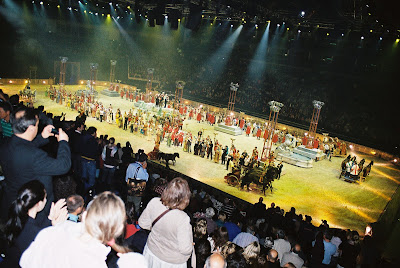
A cast of hundreds
Do I recommend it? It's up to you. The show is expensive, but that in itself makes this a once-in-a-lifetime evening.

And it's probably even better if you can understand Hebrew.

Labels: , ,

I've heard two theories:

1. As we age, we have fewer new experiences, and therefore fewer daily events that we really notice taking place.

2. As we age, a day becomes a smaller and smaller fraction of our total lifespan.

In conclusion: Keep learning and keep forgetting.

:)

Labels:


Script: Peter David
Pencils: Luke McDonnell

When the action focuses on the Wasp and Paladin for nine whole pages, issue #105 sure begins to feel like an edition of Marvel Team-Up.

Not that that's a bad thing. Who doesn't miss Marvel Team-Up? Clearly, no-one who's reading these issues.

This starts out as quite an unengaging story about a company that I've never heard of considering selling another company that I've never heard of to a character I've never heard of. Heck, I'll take the easy way out and let Spider-Man fill you in on NEVELL. Pay attention now.

Spider-Man: "It's a company that Janet van Dyne, A.K.A. the Wasp, owns, having just bought it outright... so that Northeastern, a shipping company NEVELL owns, wouldn't be sold to a lowlife gangster named Vince Granetti. Granetti wants to use Northeastern to smuggle drugs for his own company – Consolidated Importers. He had a union head, Bob Sanchez, knocked off just to encourage NEVELL to sell out. But Jan bought it instead. So Granetti sent that super-thug, Paladin, with an ultimatum. That ultimatum was... Is anyone listening here?"

Starfox: "With bated breath, webbed one."

Starfox's dry remark actually read "with baited breathe", which I would let roll, except that there are one or two other slips in the language in this one. The narrator's tense seems to slide around a bit too.

Narration: "Granetti had three shipments coming in this night. Spider-Man's time was wasted breaking up an innocent shipment of grapefruit.

The Wasp wasted her time apprehending stuffed toys filled with sugar.

So far it's been a fiasco, except that Spidey now has lots of sugar to put on his grapefruit.

No one except Granetti knew which shipment was drug-laden. That the real shipment was going by train.

Granetti's taking no chances. And he's wasting no time at all."


Not that I can really criticize or had a problem with that, me hardly using queen's english on this Blog, do I?

This story does run slowly, particularly in the first half, but this gives the author the opportunity to indulge in a lot of character-driven banter. As you may have gleaned from my other reviews, I think comedy in Spider-Man is generally a good thing, and this one is so dialogue-heavy that it plays-out like a really well-written sitcom.

Spider-Man: "Yeesh! What's that guy got anyway?"

Wasp: "A certain je ne sais quoi."

Spider-Man: "And that means...?"

Wasp: "'I don't know what.'"

Spider-Man: "If you don't know what it means, how can you say it?"

Wasp: "You're kidding, right?"

Spider-Man: "You'll never know."

lol

Labels:


Writer: Danny Fingeroth
Penciler: Greg LaRocque (#4), Jim Mooney (#5)
Inker: Vince Colletta (#4), Greg LaRocque (#5)

I do like the way they’re subtly altering the position of the hanging spider in the logo on the front of these things each issue. It varies things a bit, like the sofa gags on The Simpsons

I'm also intrigued at the inking and colouring on #4. The opening sequence takes place in darkness, requiring a lot of black. Usually the colours have to be exactly lined-up with the inks, as they are on page one, to awesome effect:


However pages 2-5 are a little less impressive. I think the excess colour is meant to get swallowed up by the black, but the actual printing hasn't made good on that. For example, look at the overlaps on page 4, panel 1:


Can you make that out on your screen? How the colours overlap the black? Like, around Spidey's socks and right hand, and the guy on the left's purple hat?

Anyhow, this does make Spider-Man look quite ghoulish!

As seems to happen with super-villains, the ironically-named Doctor Octopus is now receiving mental care.

As doesn't seem to happen with super-villains, he's actually making authentic progress.

I mean that's usually just a rouse, isn't it? A shallow attempt to fool a parole board and bluff one's way back outside and into freedom to wreak havoc again. But not so Ock. He's genuinely struggling with his inner demons and, tentatively, he seems to be winning.

Until an actual spider randomly finds its way into his room, and pushes him back over the edge again.

#4 leaves us in no doubt about Ock's unconscious state of mind, mainly because he spends so much of this issue wreaking all that havoc whilst actually unconscious. Although he's under sedation, across town his removable metal arms go berserk and make a beeline to set him free. They're not sentient, they're just still obeying his remote mental commands.

At the end, Ock is free again and faced with a choice – succumb to his obsession against Spider-Man all over again, or return to his treatment that seemed to be going so well?

I guess it's really a choice about whether or not to forgive. If Ock chooses to hang onto his obsession, then it'll probably destroy him again. If he actually manages to beat it, and let go of it, then the rest of his life could actually be a reasonable one.

This is Marvel, so it could easily go either way.

Alas, he selects the former. Dang.

Plunging into his hatred again, #5 shows him even building a robot duplicate of Spider-Man to practise against. Though these issues are set during the 1980s, when such a product seemed maybe just around the corner, here in 2009 I'm still waiting for technology like that to become available.

The conclusion is both clever and flawed. While the real Spider-Man is outside battling Ock's goons, the robot one is inside giving our super-villain another workout. Until it turns-out that the robot one is actually the real Spider-Man.

Nope, you can't pull a fast one like that on us, I'm sorry. The narration on page 18 panel 2, segueing from the real Spidey into the start of Ock's fight, clearly says "Meanwhile".

Also disappointingly Spider-Man doesn’t keep said robot afterwards, despite how handy it could have later come in for maintaining his secret identity. Hmm.

I do like Ock's silent breakdown at the end though, and even more so the way Spider-Man subsequently defeats all his henchman, by simply pointing-out what crowds of baddie-guards so often don't realise.

Their boss has been defeated – no matter how hard they fight, they're just not going to get paid now.

Labels:


Script: Peter David
Art: Bob McLeod

There are tons of issues of Spider-Man in which he has to swing-around New York to track-down whichever villain he's chasing, and I think I'm right in supposing that this strategy is usually successful.

I mean heck, that's the iconic Spider-image, isn't it? Spider-Man, swinging from a web-line, between New York skyscrapers. He doesn't need to be able to fly like other super heroes, because he gets everywhere by swinging. He doesn't need super-speed, because, well, same reason. If the recent three-part story with him battling the Vulturions in mid-air taught us anything, it was that, to all intents and purposes, Spider-Man can practically fly.

In this issue, the bad guy lives outside of the city, and is regularly commuting-in to do his daily burglarising. To track him down Spider-Man has to hitch a ride on top of a train heading northbound to the suburb of Scarsdale, and out of his comfort-zone.

Though he initially jumps off and straight into someone's garden, where he webs-up a ferocious pet dog's mouth, this should be easy, right?


No, this is going to be one of those days...

After accidentally snapping a neighbour's tree-trunk (it couldn't support his weight) and getting apprehended by the local neighbourhood watch, he suffers the huge indignity of having to catch the bus over to the villain's house. Except that he doesn't have any money on him. So he has to walk. In front of everyone.

It's a great fish-out-of-water story, and really demonstrates just how much the webslinger has come to depend upon his cramped city environment in which to function.

Another genius comedy from Peter David, just how many spins can he put on such a familiar genre?

Labels:


Story: Bill Mantlo
Art: Vince Giarrano & Pat Redding

Rocket Racer seems to have a rocket-powered skateboard, with magnetic clamps and internal gyroscopes that enable him to power up vertical surfaces, such as the wall of a building for instance.

He's also a youth trying to look after his mother and siblings who are getting taken advantage of by an unscrupulous bail bondsman, who keeps upping the Racer's interest-rates and coercing him to return to crime to pay-up.

Spidey's trademark morality and heart don't stand a chance.

Spider-Man: "This whole thing stinks! The bail system is supposed to work solely to insure the appearance of defendants at trial... not to force them to commit felonies to enrich bail bondsmen! Seems to me that this particular bail bondsman you got hooked up with – saw posting bail for a super-baddie as a tailor-made chance to engage in a little extralegal blackmail!"

This particular legal-eagle has a bounty-hunter empowered to lawfully bring in the Racer dead. Well, obviously he doesn't succeed.

The final panels, in which the Racer voluntarily walks to his legal punishment because he really believes that it's the right thing to do is a terrific ending, and hopefully not the last we've seen of him.

Labels:


Writer: Peter David
Pencils: Sal Buscema

I've been following the Marvel Chronology Project order to read these, and that lists this issue's prologue as coming just before Peter Parker, The Spectacular Spider-Man #100. So I made sure I read those opening four pages before that issue.


D'oh! Maybe I should have read those pages in retrospect...

Anyhow, if I've been praising Tom DeFalco's recent scripts for being so comedy-based, then Peter David is making those issues look like a Greek tragedy.

After the finely gag-packed parody Compulsion!, this time David weaves a shameless slapstick around the mishaps of Spidey's wannabee sidekicks.

The Toad, the fabulous Frogman and the spectacular Spider-Kid all share the same dream – that of replacing the Black Cat as Spider-Man's partner-in-crimestopping. The fact that the job isn't even available doesn't deter them from fighting each other for it, in a clumsy 7am battle which Spider-Man proves unable to prevent.

The biggest danger for Spidey is from the 47 gunmen who set-out to get him, nine of whom show-up hungover, while the other 38 just don't show-up.

The gags flow thick and fast, far too many to quote here, and Sal Buscema's pencils have to keep-up with Malcolm-In-The-Middle-esque daydreams, breaking the fourth wall (page 8 panel 6), a cameo from a muppet and, most challengingly, having to coax some funny facial expressions from just two white eyes on that black spider-mask.


When Spider-Man solves his problem by accidentally convincing them all to form a super-group without him – called The Misfits - we actually get several sarcastic alternate names from him, each complete with their own comicbook logos and ™ signs.

One of them - The Spastic Three™ - erm, dates the strip a little. (this was 1985)

Peter David may not display the depth and long-term planning of Tom DeFalco's over-arcing plots, but he sure sees the Marvel Universe as a good excuse for a whole lot of fun.

Labels:


Thoroughly disturbing horror movie about a robot programmed to behave like a child, though obviously it's never going to grow any bigger. (it can’t eat its greens)

When we first meet 'David', it's being test-run by a couple whose own little boy is tragically in a coma. Given that the product's intended market is the many childless couples in the future, this seems a bit of a folly. It also seems like an obvious recipe for disaster, and it is. The poor mother's feelings get so messed-up that she eventually throws the machine away in the woods, paradoxically punishing herself as though it was real.

For me, the middle of the film is the most intriguing part. Left switched-on to churn-away on auto-pilot, it meets other abandoned robots, and actually has conversations with some of them. Well, after a fashion.

Robot Teddy: "Do you know David? Where's David? Can you help me find David? I have to find David. Are you taking me to David?"

Their automatic interactions with each other result in a ridiculously dark series of consequences, as we observe what becomes of broken, unwanted toys.

Just like a scrap-derby, crowds of people come to vent their depravity by torturing these substitute-people. No-one seems to realise the damage they're doing to their own humanity.

David's unique programming - to simulate how a real child might behave - enables it and its friends to escape and go on a mistaken quest to find the blue fairy from Pinocchio. (David has been programmed to think the story is true)

The end of the movie sees David frozen in ice for a couple of millennia, until the technology exists to sort of grant it what it has been programmed from the outset to strive for. It's 'mother''s love.

This film has some great ideas and terrific imagery, but it is also riddled with holes, and seems to think it's a lot higher-brow than it actually is. In one scene David survives drowning. (it's waterproof) In another it breaks when it eats spinach.

There are two things that are absolutely outstanding though.

First, Haley Joel Osment is utterly brilliant in the lead role. In his early scenes, he plays robot David so flatly that he appears to just be a poorly-cast child actor, however once David's owner programmes it to need her, Osment is utterly convincing. All that flatness was intentional! Just like the robot is supposed to, he now acts just like a real child!

This outstanding performance has a huge bearing on my second praise-point. Although David remains throughout only a simulation of how a child might behave, its relationship with the woman who it considers to be its mother is stunning. I couldn't help but identify with the themes of loss and mortality, and there were many poignant moments when I recognised how I've felt about my own mother over the years.

AI is an odd film. One of those trippy late-night movies with no sense of time, that you get immersed in with no idea where it's going to go, or how long it's going to take getting there. Like Brazil, it's quite linear.

While there are emotional lessons under the surface, it's best not to go rationally looking for them because of how quickly the story falls apart. Even the narrator at the end explains that he has earlier given David some instructions, when there was no moment at which he could have done so.

Still, a sad story, if only there were someone to feel sorry for.

Labels:


So a while back I posted a review of the preceding volume in this series, and what should happen but Neil Norman himself reads it and sends me the next one!

I'm very pleased to report that it's yet another rollercoaster ride through feel-good SF themes from yesteryear. Usually when I reach the end of a CD I go back and replay my favourite ones. This time I must have gone through half the album again.

For me, this one carries a slightly different tone to earlier releases in the series. I still equate "Neil Norman And His Cosmic Orchestra" with the energetic rock style of his earliest releases in the series from the 1980s. Here we still get a liberal sprinkling of that throughout, but continuing the trend from volume IV, several of these are more serious and faithful to the originals. Both blend well together to provide a wider sampling of Neil Norman's talents.

It's all summed-up rather well by the opening track - Back To The Future. At first, with all the brass, xylophones and violins you could be forgiven for thinking that you were actually listening to the original movie soundtrack. But about a minute in you can hear Norman's trademark electric guitar creeping in underneath, lurking, waiting, plotting to rock things up just as soon as its secret masterplan to clear the stage of all those more serious-sounding instruments is unleashed.

We don't have to wait long.

Track 2 is the Mission: Impossible theme, played live to an enormous crowd of fans in Rio de Janeiro, complete with tannoy introduction in Brazilian! The crowd's ecstatic screaming conjures up memories of the dizzying popularity of The Beatles, or even The Goodies in their wilder moments. Neil and his friends sound oblivious, as they proceed to electrify such an iconic underscore with more metal conviction than the US rail network.

Track 3 - Some Of Us Have Been Behaving Strangely - isn't even a cover version of anything as far as I know. Instead we have six minutes of something that mixes the excesses of rave and dance music, and transports it all back in time to 1985. There are no insanely repeating car alarms here, but plenty of metal rock doing a similar job, only much better. Six minutes is a good length – I can really lose myself in stuff like this.

Having established the ground-rules, The Flash, Alfred Hitchcock Presents and Tales From The Crypt take us into that more subtle, orchestral sound that I was talking about, but it's the authentic piano going round in circles of Halloween that nails it for me. This album may not be as funky as some previous entries, but NN's diversity enables the urgency of his arrangements to emerge in a variety of new ways.

The Art Police, Mars Attacks, X-Men (Animated) and War Of The Worlds (TV) all have their own particular sounds to them, but The Crawling Eye heralds the arrival of something a bit new - tributes to forgotten black-and-white movies. What? You've never heard of Quentin Lawrence's 1958 classic The Crawling Eye? Here's how the sleeve-notes sum it up:

"One of the very best movies about a giant radioactive brain with tentacles and one eye squatting on a mountaintop who makes zombies out of dead people."

It sounds like pure joy, and Norman freely admits the post-modern place where he's coming from with his next track - the theme-song from the TV movie-strand Mystery Science Theatre 3000:

"You're wondering how he eats and breathes,
And other science facts,
Then repeat to yourself, 'It's just a show,
I should really just relax.'"


This number also features an instrumental break that sounds like 1970s TV Heaven.

Robot Monster features original sound-effects, atmospheres and even dialogue from the film, proving that with this one Norman has firmly stepped-over into more tribute than cover-version.

It's a respect continued throughout Journey To The Far Side Of The Sun and The Lost World Medley, the latter of which really does sound like it's the original soundtrack. I haven't compared them, I just mean it's so huge and orchestral. By the time that V For Vendetta comes on, with its Matrix-esque horns and, later, gentle piano lulls, this album has firmly departed from aiming for fun, and is instead beautifully cherishing the scores.

It's a million miles away from the crazy style that I associate with Neil Norman's work, but I'm pleased to say that it's a lovely new reason to continue enjoying his material.

All that said, Norman sure hasn't lost his sense of fun, or awareness of what retro-nerds like me have come to expect of him.

The final track Galactic Vortex is another original composition, this time by Les Baxter, but so exactly in the style of Norman's original 1980s albums, that it could seamlessly be passed-off as from one of them. I think he's just about done a tribute to his own work there.

This is another terrific entry into the series, and I can't believe he's talking about waiting maybe another decade before doing the next one.

I'd say my DNA has now been irrevocably altered.

Buy it here.

Labels: , ,


Writer: Peter David
Pencils: Rich Buckler

Like all the best Spider-stories, this one is intelligent, deadly serious and packed full of laughs.

Two university seniors, assuming themselves to be world-weary, hatch a little game to prove themselves smarter than the average super hero. They observe Spider-Man from a distance, and invent a fake super villain – the Blaze – with which to rattle his cage.

As is the way of these schemes though, things snowball out of their control, particularly when they find themselves on the run from a copycat who's stolen their creation and is lobbing fireballs at them.

As the title suggests, the whole tale is a parody of a well-known movie, and as is the way of homages, is riddled with in-jokes. Scarcely a page of Peter David's excellent script goes by without a silly gag somewhere.

Ashley, gazing out of the nighttime window: "Super-heroes are a superstitious, cowardly lot. And quite a lot to choose from. Which one to be the object of our little game? Which--?"

A bat suddenly flutters in the window.

"A bat! That's it! Of course! It's an omen! We shall go after--!"

Thomas: "Right. Sure. You bet."

Barry: "Uhm, Ash...?"

Ashley: "Hmph. Well... how about Spider-Man, then?"

My favourite SF stories tend to be the deadly serious ones enacted by funny characters, making this issue a tip-top one. If that weren't enough, Rich Buckler's pencils and Armando Gil's inks lace the whole dark nightmare with the uncomfortable realism of a horror story.

Though the end is a bit trite (did Ashley and Barry really never see Thomas again?) and the explanation for the cover effigy of Peter Parker / Spider-Man extremely contrived, this is excellent, just excellent.

Labels:


Writer: Tom DeFalco
Penciler: Ron Frenz

With a title like that, it goes without saying that this one's going to be crime caper!

Still on the brink of retirement, the Black Fox is completing his latest last theft ever, when he discovers the hard way that, once again, there are people out to get him.

This time it's a crack squad from the Symkarian government, who themselves are in the employ of another party – an insurance company. Well, that industry has a bit of a reputation for being thorough.

Out of the loop, Spider-Man manages to save the Fox twice, once by misreading the situation, and then again later by choice. It's an interesting decision on Spidey's part. The Fox is a bad guy, but the man of webs isn't going to just stand by and watch him get treated so nastily.

Ultimately Webs shows compassion and helps the Fox to escape, but not without slipping the jewel off of him and replacing it with a note that he must have written in a missing scene. Does Spider-Man really carry a pen with him? Well, he is a newspaper photographer, so I suppose so.

Though I usually highlight author Tom DeFalco's sense of fun, in this issue all the real merriment is to be found over on the letters page. Despite the number of months that it takes to mail an opinion in and get it printed, there's a great sense of joy amongst all the readers who've submitted theories as to the secret identity of the Hobgoblin. The script's red herrings have been getting slipped-in for over a year now, and clearly the idea has some more steam to go yet.

Mr Fox – fantastic!

Labels:


Writer: Louise Simonson
Penciller: Greg LaRocque

I guess if you have a good idea, then someone somewhere is bound to copy it, or at least riff.

It therefore follows that if you have a bad idea, the same thing might happen.

Spidey's classic villain – the Vulture – has been in jail for a while. You remember the Vulture – he's the guy with a pair of big wings.

Well, old Vulchie has been busy. Building a new pair of wings with which to escape from his prison cell. Really - just how on earth does he build a pair of giant feathery wings while locked-away in the slammer? "Morning Mr Warder, gee, my hammock really looks like it's falling apart today, huh?"

Well, actually he does it by making friends.

Unfortunately those self-same friends have been watching him closely, and copied him.

The Vulturions are basically a team of four Vultures. In each of these three issues Spider-Man scraps with them in the skies over New York, and exploits their inexperience to defeat them one at a time. With the Vulture himself escaping from stir to join in the fray in the last issue, what we basically have is the man of webs fighting the Vulture a total of 17 times in succession.

Yes, it does get just a tad formulaic.

Each of the three encounters also feature a major distraction for the webslinger. There's also a sub-plot running throughout the whole about Aunt May not being able to afford a hat, and Peter coincidentally buying her the same hat for her birthday. Hence issue #2 has him battling the villains whilst trying to avoid dropping it, while #3 has him trying very hard to finish them all off before the last post goes.

He fails. Peter Parker is, after all, the Charlie Brown of the Marvel universe.

It's issue #1 that holds the greatest distraction for him though. Whilst simultaneously battling the four Vulturions for the first time, Spidey is also physically engaged in fighting-off his own costume.

Yes, the black alien costume is back, disguising itself for the first time as his old red-and-blue duds, in order to con him into putting it on again, so that it can graft itself into his skin forever. Brrrrrr, evil, these alien costumes.

As a result, Spider-Man can't shoot any webbing, or swing across town to safety. In fact physical movement of any sort is just a clumsy battle. So just how is he supposed to fight off not just one but four Vulturions when something else is struggling for control of his very limbs?

#1 is consequently the best of these three issues for me, concluding as it does the whole alien costume saga, in a slightly ingenious and truly touching way.

The scripter may have written the same battle three times here, and got Joe Robertson's name wrong in issue #2 (twice calling him "Robinson"), but this tale is good, fun, action-packed, and a promising launch to the Web Of Spider-Man series.

Labels:


Writer: Craig Anderson
Artist: Paty

Another self-contained filler-strip, though the first one I've seen featuring the black costume, so I guess it must be recent.

Once more the altruistic Spider-Man / Peter Parker is on a quest to help out a couple of complete strangers who he's just run-into.

Philmont Magee is an aging wheelchair-bound patient at the local hospital, who due to a government error has been declared legally dead, and is about to be accordingly discharged. (!) Parker's consequent dash across Manhattan to sort out his case with social security, Medicare and an off-duty judge show just how dedicated to fighting the good fight the man inside the mask really is.

There's no radioactive blood required to fight a villain like City Hall - Peter Parker proves what a hero we can all be.

Conversely, his intermittent run-ins with the pneumonia-ridden teen Red 9, if anything, bring out his bad side. That they wind-up friends by the end is really the kid's doing.

No disrespect to the writer, (I liked this) but I do hope we get back to Tom DeFalco's ongoing storylines soon.

Labels:


Writer: Cary Burkett
Penciler: Larry Lieber

Another one from the heart, as Cary Burkett has Peter Parker befriending a girl on the bus, only to see her disembark and get knocked-down by a drunk hit-and-run driver.

Using what fragments he can recall of their conversation, he heads across the city to track down her twin brother – the only person who can donate a life-saving kidney.

Alas, said twin is battling with depression, and about to jump off the roof, unaware that that act will effectively kill his sister too.

Apart from Parker and occasional foe Killer Shrike, this is a small cast of unknown characters, yet Burkett made me care about each one of them. Even the doctor at the hospital has depth, assuming that Parker's quick exit is because he doesn't want to get involved, when in fact the exact opposite is true.

The narration is heart-wrenching stuff too:

"Donnie Gardner has been hearing voices... small, bitter whispers that claw at the edge of his consciousness... They tell him that life is nothing... that it is meaningless... And he listens to them... listens as they tell him that there is no point going on... That only death – sweet oblivion – will end the aching emptiness inside... And maybe the others will be sorry then... maybe they will see how they hurt him... And maybe his death will hurt them back..."

Parker's closing internal monologue may sound trite on the surface, but I think it's also quite profound:

"Even when things are at the worst, and we think nobody cares about us – that our lives are worthless... we can still reach out to others... care for them... and, in the process, discover just how important our lives really are!"

Labels:

I spent this weekend up at the Hayes Conference Centre in Swanwick, attending this year's National Conference of the Society For The Protection Of Unborn Children.

Though it was a bit of a trek getting there. Not much fancying the £58.10 return train ticket, I booked a cheaper coach from Victoria. Over an hour after departure we had made it only as far as Golders Green tube station! Between this, my train from Nottingham and cab from Alfreston, I was in for a long, albeit good, Friday. I like travelling.

The other plus side of this was that I missed the first evening's speeches, walking-in at the back just as the closing Q&A's were starting. I've never much been one for sitting in an audience listening to someone talk for ages at the front (hence my lifetime in and out of church) so maybe coming here hadn't been such a smart idea in the first place?

Well, I guess I really had three motivations for attending:

1. Abortion is a subject that really makes me feel negative. That's why I don't express that opinion much. I know I won't be sensitive, and that won't help anyone. I've been out on several silent group-protests around parliament though. A baby can't stand there holding an 'Abortion stops a beating heart' placard for itself, so I have to in place of one of them, or it doesn't happen.

2. My mum attends this weekend every year, though she accepted a lift up by car this time. Clever old Mum.

3. Sentimental one this – the Hayes is the conference centre where my mum and dad first met on a writing week in the 1950s, so I kinda' wanted to take the opportunity to visit it with her.

Anyhow, despite all those reasons, the highlight of day one still had to be walking about the complex and unexpectedly passing the legendary Terry Waite several times, who was present for a completely different conference!

And what a conference that one must have been. The following morning I accidentally went into their dining-hall and found myself downing my breakfast cereal while chatting to the guy who had set-up The Big Issue in 1991!

Anyhow, SPUC's morning speakers were impressively attention-holding too. Dr Talmir Rodrigues, a Federal Parliamentary Deputy from Brazil, and later Rev. Arnold Culbreath who spoke charismatically on 'The Dangers Of The Obama Presidency'.

After that we broke-up to go upstairs and each choose a workshop to attend. I selected 'British Victims Of Abortion: Dealing With The Hard Issues'.

Well, you know what that 'hard issue' is, and in respect of it we were given the following stats:

- 1% of rapes result in pregnancy.

- Nearly 80% of rape victims who had abortions said afterwards that they regretted it, and that it had actually increased their trauma.

- None of the rape victims who went on to have their baby expressed regret afterwards. Well, I guess you probably wouldn't.

I don't know where they sourced those stats from.

We also watched a recorded interview with Rebecca Kiessling who was conceived in rape, and feels just a tad forgotten when she hears pro-lifers making an exception for it.


After lunch, SPUC's National Director John Smeaton spoke of the legality of the unborns' right to life, and introduced various colleagues to speak of different cases. His own blog-post on this is here.

For the second optional workshop I selected 'Youth Activism', during which I made a note to keep an eye open for a film called Bella.

After that I went to a fringe meeting, more of a discussion really, on maximising the current potential of the internet. This was probably the only meeting at which I found myself expressing some quite definite opinions. Twitter cannot last. It's just too simple.

After the evening meal there was a Ceilidh dance, so I took along the book I'm currently reading – Douglas Adams' The Salmon Of Doubt - and sat there reading almost constantly. Dances!


Though on both nights I found it hard to get to sleep, once off I slept extremely well. The rooms at the Hayes are absolutely lovely. When, in the Bible, Jesus speaks of his father's house containing many rooms, they might well turn out to be just like these ones.


On Sunday morning we heard speakers from the Philippines, Australia, Canada and America, before a first-rate closing speech from Dr Jack Willke, President of the International Right To Life Federation.

He asserted that abortion "contains the seeds of its own destruction", citing the many changes that have taken place over the decades since it started becoming legalised, eg. ultrasound images, and the regret of many of those who have been through it. Obviously intended as a positive note for the future to finish on, this was my favourite speech of the conference, containing as it did so much reasoning that I hadn't heard before.

After that we attended a later-than-planned service just before lunch. Ex-gangster Rev. Frank Brookes had been going to preach out of Habakkuk, but since pushed for time elected to share his terrific testimony instead.

After eating, my mum and I found a few minutes to finally go wander about the grounds a little.


On the outskirts of the building we located a tunnel that she had discovered years ago with my dad. It had been dug as an escape tunnel by German prisoners of war ten years earlier during WW2. It's boarded-up now with a plaque on it, but I was pleased to stand there and make the connection 50+ years after my dad's visit.

After my mum had left in her lift, I made a quick recce of the rest of the grounds and took a few more photos.


Then it was time to catch the coach back down to London, together with many of the excellent speakers from the weekend that I had just enjoyed.

In fact, despite stopping-off at a service-station and helping to unload at SPUC's head office, I actually made it home before Mum did!

So a long good weekend too.

Labels:


Script: Cary Burkett
Pencils: Juan Alacantara

Though it lacks much connection to the issues surrounding it, Cary Burkett has put together a good all-round satisfying story here.

Despite the legal predicament that we last left him in, Mark Scarlotti, aka Blacklash, is back, his only explanation being the line "But I've been given one more chance."

Alas, true to Scarlotti's ill-fortunes (well, bad choices really) this one chance ain't gonna turn his life around either.

His petty theft job quickly has him battling honest hard-working security guards, again, and Spider-Man, again. What are the chances?

The generic cover by outsider John Byrne, though brilliant, looks like a stock one, featuring as it does a stylish image of the wrong costume.

For all that, this is a good tale. Under the surface Pete is dealing with his annual grief over Gwen Stacy's death, until ultimately he is able to use that angst to save someone's life, and his own. If Gwen hadn't died so tragically, it appears that he wouldn't have been able to save the damsel in this one.

Just how old is Peter though? How characters age in such a long-running, and slowly-progressing, narrative such as the Marvel universe has always been a bone of contention, and the ambiguity is kept up here by the dates on Gwen's tombstone in the final panel. It looks like she died in 1972, but the artist / letterer doesn't seem too sure...


This issue is dated 1985, but if page seven panel six is to be believed, I'd really like to suppose that this is set in late 2008...

Labels:

** Click here for preceding post(s) **

** Click here for following post(s) **