Steve Goble

Choose life. (Deuteronomy 30:19)

I saw my friends Alistair and David in Samuel Beckett's Roughs For Theatre 1 And 2 a few years back and really liked them, but as the curtain went-up and I saw the set of Beckett's much longer Happy Days tonight, the words in my head were "Oh heck, it's this one."

Was I prejudging it? Oh yes.

The first half of Happy Days is almost entirely a monologue by a woman buried up to her waist in sand. In the interval, I managed to down a coffee and briefly escape outside for a brisk walk, before enduring the second act... which she spent buried up to her neck.

Throughout, I found I was torn between trying to concentrate on the performance so as to give it a fair chance, and allowing my mind to wander so as to make the evening easier on myself.

It's certainly a play that's hard to perform badly. How can you not respect any performer who's plucky enough to give this their best shot? I salute the actress concerned, along with every other actress who's ever taken the role of Winnie.

Is there depth to this play that I was completely oblivious to? Yes, definitely. In fact, I am determined to believe so in order to preserve what hopefully still remains of my sanity.

Still, at least it's over now. I'll never have to sit through that again.

Though I suspect that she will, and good luck to her.

:)

Labels:

After eight episodes off, the house-writer is back.

One thing he's always been very good at is establishing characters quickly, and that's essential here, as most of Midnight is one very long scene set inside a coach. Although we're travelling across an alien planet, (points scored there) everyone apart from the Doctor is human.

Anyhew, the plot is all going well, with the Doctor's well-defined travelling companions all introduced okay, and initially this looks to be a comedy episode. Scenes are even being linked by non-diegetic on-screen captions, complete with a post-modern sound-effect of someone typing them.

Who is typing this?
Personally I never like that, as I think it breaks the illusion and looks a bit smug, but here it's also unnecessary, simply repeating the fade-outs' message that some time has passed.

Anyhow, when the windowless coach breaks down in the middle of an alien nowhere, the tone grows darker, as its occupants are terrified by the knocking coming from outside. There shouldn't be any life out there at all.

Suddenly, once again, the shot of Rose silently yelling "Doctor! Doctor!" appears on a screen behind him. As in The Poison Sky, there's no explanation for why she'd be yelling this before during and after not even making contact, and I doubt we'll ever find out what it's doing here in the future either. Anyway, as before, it's a major distraction from the action.

Then... actually can you guess what happens next? I'll give you a clue: it's the same thing that always happens in this show. Got it? Yes, that's right, one of the passengers becomes a zombie.

Zombie
Well, all right then, but this had better be the 22nd and final time.

She starts to repeat what everyone is saying, and suddenly this becomes the most dialogue-heavy Doctor Who story ever, challenging even Douglas Adams' verbosity. The entire cast does an excellent job here. It's very well rehearsed, and must have been mind-numbing to edit, as this situation continues for quite a long time, with her mimicking not just everyone's words, but their inflection too. (and yes, she does get a line wrong at one point, inserting "but" on the start of Hobbes' "That's impossible" – the editor's fault, and who can blame them with all this to order)

Eventually the zombie catches-up, and reaches the stage where she can speak the passengers' words in sync with them. An editing slip of a different kind it seems as, after realising this, the Doctor runs a series of tests to ascertain what she's doing – tests that would have made more sense before the realisation.

Aside from wondering who she is and what's happened, everyone including the Doctor is baffled as to even how she's doing it.

And the really tragic thing is, those three questions never get answered. Awful really.

As the bystanders become more and more scared, the Doctor loses his usual authority over them, and they come to blame him for their predicament. Their motivation for this decision is weak at best, but the fact that it happens is an original situation for him to be in.

Soon the zombie's only chanting in time with the Doctor's words, until eventually the inevitable happens – she begins to speak before he does.

The Doctor collapses on the floor, unable to do anything except mimic whatever the zombie says. He's well and truly beaten.

The zombie is now, very badly, pretending to be the original woman again, and noone notices quite how much she's hamming it up.

The zombie only gets defeated, and the Doctor saved, when one of the guest-characters realises that zombie-woman is speaking using only the words that it has learnt from the Doctor, specifically the French phrase "allons-y." Trouble with that of course is, the alien never heard him say "allons-y," because he said it before the alien had boarded. Maybe he said it again later, but the editor cut it out?

Anyway, somebody makes the usual token self-sacrifice, and everything is all right again, because the alien is outside again. Why it doesn't just come back again is a question never even asked.

Neat start to the story. So what happens in the rest of it?

;)

Labels: ,

I had to grit my teeth throughout the entire 78 minutes of this.

It's not that I didn't like it – I did – it's just that the whole feature-length movie is so unashamedly 1980s. The style of animation – ugh. The music – ooh. The characterisation – urrrr.

The narrative is abysmal too. This is a story that makes very little sense at all. Felix's famous bag of tricks seems to come with the condition that he can never use it to perform the same trick twice, not that anyone ever states this.

What this film explodes with though is ideas. The design of all the creatures, the unexpected one-liners, and the magic, just keeps hitting you thoughout without ever letting-up.

Do I recommend it? I'm afraid no. I think the painful style outweighs the genius of this film's ideas.

But maybe in small chunks.

Labels: ,


In 1976 the BBC broadcast the Doctor Who story The Deadly Assassin, which revolved around a virtual reality world called "The Matrix."


In 1999 the Wachowski brothers released a rather well-known film which also revolved around a virtual reality world called "The Matrix."


In 2008 the BBC broadcast the Doctor Who story Silence In The Library / Forest Of The Dead.

I guess this makes them even.

That said, this story nails Steven Moffat as the best writer Doctor Who has had in a very long time. Hang on, that's not quite as grand as it sounds, is it?

Despite consistently turning in just one story a season, (the solution to all four of which has been in the girl character's identity) Moffat proves that he has enough great story ideas to be script editor.

In this one, as well as virtual reality, he offers us a planet-sized library in the future, swarms of flesh-eating microscopic aliens that live in your second shadow, a girl who has another life whenever she closes her eyes, people who continue to talk after their death, and yet another group who remember their lives rather than live them.

Oh, and a book chronicling the Doctor's future!

Really – you could write a great story about each of those concepts, but they're all crammed together into this one, and that's in addition to all the usual Doctor Who-ish running-down-corridors and working things out.

And it's a scary tale this one too. The skeletons in spacesuits, the final log entry being calmly read-out by a dead person's face on a stone pillar, and the darkness.

I found the most chilling line was towards the end of episode one, when the little girl's psychiatrist sits down with her privately to reassure her not to worry about her 'nightmares'.

Instead he tells her:

"The real world is a lie, and your nightmares are real."

Oh, ...

Hey – and did I mention that both these episodes were set on an alien planet in the future? Zombies? Well, I'm actually not sure I can count the skeletons in the spacesuits, because it's neither the skeleton nor the spacesuit that is actually chasing our heroes, and the Vashta Nerada are only accidentally dragging the body everywhere.

This is Doctor Who firing on all cannons - the lighting, the music, and again, Steven Moffat's trademark one-liners...

Doctor: "The Library! So big it doesn't need a name – just a great big THE."

Doctor: "I never land on Sundays. Sundays are boring."

Doctor: "Now, the rest of you – helmets back on and sealed-up! We'll need everything we've got."
Donna: "But Doctor - we haven't got any helmets."
Doctor: "Yeah, but we're safe anyway."
Donna: "How are we safe?"
Doctor: "We're not, that was a clever lie to shut you up."

Really – he's not even trying.

My two teeny nitpicks would be the presence of a purposeless trapdoor in part two, (with no explanation of how the Doctor survives the fall and returns inside) and the CGI people at the end. Given that Donna realised she was in virtual reality when she saw that all the many kids in the playground were in fact the same two kids repeated, cutting this corner with a CGI 'crowd' shot of many repeated 'real' people was just quite stupid. Really lazy – some of them were making the same movements.

(Oh, and Miss Evangelista seemed to be better at the end too)

But those conceits are minor. There's only one element of this tale that I really didn't like, and if you've seen it then you'll likely have already spotted what that is.

With all these elements already bursting the story at the seams, Alex Kingston shows up as River Song - someone who heavily implies that she is the Doctor's girlfriend from the future.

Oh well.

But, y'know, hang on, that could work, if they handle it properly.

But no. We descend into smug innuendo and showing-off as said woman belittles him and shows him up like, like, well, like Donna when she first joined.

It also can't go without comment that the Doctor does get through a different girlfriend every season now. Rose, Madame de Pompadour, Joan, even his friendship with Sarah Jane got somewhat retconned. River Song? Just another one, so no big drama there. Rose had self-important delusions of somehow being the Doctor's only ever companion too.

When River heroically dies at the end, it comes as a relief, and is hardly unexpected. It's exactly what the Doctor's 'daughter' did in the story before last. She was even unexpectedly revived in a tag scene afterwards too. How formulaic is that?

The thing is, it quickly becomes apparent that River Song, while arguably material for a story on her own, just doesn't fit into this one. I might be completely wrong, but the whole story looks like it was once a great carefully-plotted epic, that has then had an extra character squeezed-in throughout.

The Doctor, against his character's motivation, has to keep stopping his efforts to save everyone's lives to give River some talky scenes, and the story's momentum has to accordingly keep stopping too.

I guess what really irritates me about this though is how much more sense the surrounding storylines might have made, without having to make room for this apparently additional one.

Humour me:

1. At the beginning of the story, River sends a psychic message to summon the Doctor to the library. That's why he and Donna travel there.

If we remove the River storyline from the plot though, why instead might the Doctor and Donna have made that journey? Well let's see.


At the end of the previous episode, (in other words in the Doctor and Donna's last scene) the Doctor dug out a book by Agatha Christie from the 50th century to prove to Donna how she was the most popular author in history. That seems like a much more natural reason for his taking her to this library in the future to me. Certainly more natural than neither of them even mentioning their recent brush with Christie. (BTW Donna also fails to mention her old job at Hounslow Library, but I digress)

2. After her arrival, River produces her diary which contains events from the Doctor's future. Throughout the story, the Doctor is tempted to read this book to learn of his future.

Again, if River were not in this story, where might a tantalising book of the Doctor's future come from? Oh that's right, the whole thing takes place in a library in the future. Yeah, yeah that would have made more sense too.

River even produces her book at around the same point as books begin flying off of the shelves around the Doctor, for no explained purpose. And, stone me, the entire story actually takes place in the BIOGRAPHIES section, meaning that all those books flying off the shelves around him are biographies. For me, this considerably ups the probability that the exciting book of his future was in the earlier drafts, but River Song wasn't.

3. Both the Doctor and River spend the story issuing orders to the crewmen who arrive. Again, without River, this would normally just be the Doctor.

4. When the Vashta Nerada are about to kill the Doctor, to prove how dangerous he is to them, he tells them to look him up in the library. With no means of doing this, the Vashta Nerada pause, and then without any explanation, decide to just believe him. Of course, if he'd had the biography of his future with him, (instead of having River hide her diary from him), then I guess he would have used that...

5. Just before the end, River knocks the Doctor out and sacrifices her life to save the people trapped in the computer. The 100-year-old child's stocky relative - Lux - does nothing except explain the plot, before being suddenly hurried out of the room and away from the action. Was that really all his character was supposed to do? Again, dramatically that sacrifice seems to have originally been Lux's to make, and a proper conclusion to his initially arrogant character's journey.

6. After River's death, the Doctor gets Donna back from the dead. Big dramatic moment – recovering her has really been his driving motivation throughout part two. Except, that scene has been cut. I guess with all those River scenes, that one had to be dropped, along with how he survived falling through the trapdoor, and how he got back inside the library again too.

7. At the end, after River's death, the Doctor and Donna stand on a balcony with her closed diary and sonic screwdriver. It looks like they're going to symbolically throw the unread pages to the wind. They don't though, they set the book down with her sonic screwdriver, on the balcony, and just walk away. That's right - they leave the poor dead woman's diary on a table outside a public library. The Doctor then gets an idea and runs back for the new sonic screwdriver, and then uses it to save River's life after all.

With no River, there's no new sonic screwdriver to save River in substitute of Lux's communicator, and his mysterious biography can just be thrown off the edge as the balcony implies. That sort of makes more sense too.

In the version that got filmed, as I recall, after the balcony scene the actual diary is just never seen again, and we're never even told what becomes of it. Sure, River has a duplicate of it in CAL, but that's not the same copy, is it?

8. River has told the Doctor that in the future he can open the TARDIS' doors by just snapping his fingers, so he's outraged at this. At the end of the episode he tries it, and for no explained reason it works.

It's just quite an odd thing for a person to say in conversation. Such an exaggeration of the Doctor's attitude and abilities is just the sort of act that you might expect a biographer to embellish such a hero with though. Well, you know what I'm supposing.

9. At the end of the story, the Doctor is left in a position where, when he first meets River in his future, he now has to take advantage of the woman's feelings. Ooh, I don't like that implication at all.

But all the above said, y'know, although I personally don't like love-interests cluttering-up science-fiction shows, I can understand why they almost always put them in. Getting people who don't like science-fiction to tune-in and watch as well, obviously boosts the ratings. Which is why my top reason for this storyline not belonging in this script is...

10. There is already a love-interest! Whilst inside CAL, Donna has a whirlwind romance with Lee, whom she falls in love with, marries, and even raises a family with, or at least remembers having done so. At the end of the story, she and Lee are both trying to find each other again in the real world, but tragically fail. There's yer love-interest storyline, already there.

I tell you, it's Jack Harkness standing around through The Empty Child all over again.

In conclusion, this story is about 80% brilliant.

Labels: ,

I feel that I am slowly accepting my old life back again, so today I attended the latest British Film Collectors' Convention over in Ealing.

I've been coming to these things for years now, although they're not really what I'm into Super 8 film-making for. I'm attracted to the whole idea of making films, while these conventions are aimed at film collectors. As a result they're predominantly populated by second-hand stallholders and geniuses who've built their own cinemas in their front-rooms.

In 2004 David and I actually ran our own stall there, and I was pleased to come away afterwards having made a profit on a broken Siemens 9.5mm projector that I'd bought from a junk shop years earlier.

Thanks to the New Zealand years, that had been the last one of these I'd attended, until today.

Arriving shortly before the end, (as usual) I missed paying full price and made a cursory circuit of the remaining stalls, pausing only to buy a DVD for Herschel as a house-warming gift. (I hope his new house doesn't get too warm, or it'll melt)

After that I crept into the darkened cinema hall, and sat down. I'd missed the big 3-D spectacles that had been screening earlier, (along with the big 3-D spectacles that they'd been watched through) but found a sequence from Paul Newman's The Sting in progress off Super 8.


The picture-quality didn't impress me, and the room was so echoey that I couldn't really tell how the sound was, but without words to fill-up my brain, it set me thinking.

My own Super 8 productions are not getting any younger, so I recently conceded that, when finished, I would probably have to show them on HD, which would sadly rob them of the magic of real film. Nothing too surprising about that, until this morning when I read of a company who actually transfer HD back onto Super 8! This was a bit of a revelation to me. Now I have the chance to strike a brand new film copy from an HD version. But would the slight drop in quality be worth the expense?

Scrutinising the fuzzy image ahead of me, I had time to suppose not.

Next up were two cartoons – Mickey and Donald in The Band Concert and Tom and Jerry in Hollywood Bowl. Both shorts were entertainingly based around an orchestral performance, but half my attention was still on the picture quality. These colours were so deep and vivid that I had never seen anything like it! If I transferred my own films to HD, these rich textures were what I could be losing forever. Hmm... Food for thought, until I later learnt that I had been watching 35mm!

The final extract was a reel of Charlton Heston in El Cid. This was showing in Super 8 scope. I'm still absolutely gobsmacked that an image just 8mm in width can be so effectively blown-up to about 4-5 metres! Incredible.

Afterwards I caught-up with the projectionist, (who I think I last spoke to in 2000) before catching the bus back home again.

I have to say, I feel quite inspired.

Labels: ,

Script: John Peel
Art: John Stokes

Short UNIT spin-off about the Quarks (and the Dominators) threatening Earth, first presented as a back-up strip in Doctor Who Monthly #64 in 1982.

At just four pages, my impression before re-reading today was that it would be a bit thin, but it does tell a good story with a beginning, middle and an end, as well as a reasonable amount of action.


Although the original show was still going strong in 1982, licenced spin-offs that didn't feature the Doctor were quite rare, and the chance to behold a 'new' UNIT story was probably a real boon. It's also doubtful whether anyone worried that much about canonicity in those days. I think I just took it in my stride that this was some sort of alternate Who-universe in which all the Marvel strips took place. Today it's rather more complicated, so I try not to think about it too much...

Oh all right, it's set in 1984 while Lethbridge-Stewart is still a Brigadier, so is that before, after or during the yet-to-be-filmed Mawdryn Undead story from 1983???

Still, the UNIT dating controversy aside, (which didn't really exist in 1982, by this world's calendar anyway) it's encouraging that, in 2008, this strip still stands up so well.

Labels: , ,

Good evening.

With the economic downturn dominating both the broadsheets and the tabloids this week, ya gotta chuckle at the irate Daily Mail's mercilessly extreme headlines...


Meanwhile, evidently higher on the agenda of local people...


Goodnight.

Labels: , ,

I had no sleep last night.

And I had to meet David this morning.

So before leaving home, I downed some sugary coffee and tried to transfer some money into my current account, blearily got my own details wrong three times, and froze myself out of my own account. I had to set it all up again with questions and everything. Urrrgh.

Then I visited the bank's branch in town to draw said funds out but, as is usually the case, there was no money in the cash machine.

This used to happen to me at ANZ in Howick all the while. Eventually I'd gone in and filled-out a suggestion form, pointing out how simple it was to create a procedure whereby someone just checked the ATM at the start and end of each day. I like to assume that ANZ did just that, as afterwards I never had that problem again.

Here in the UK, I've suggested the same thing too many times to remember, but the bank's cash-machine is still usually without any money. Yes, usually. Not always, just usually.

This morning I was too tired to argue, so I just asked for the money at the window where they regularly had to employ someone to deal with all the people who couldn't use their empty cash machine a few feet away. But today there was another problem. One pound was missing from my account. The girl at the desk couldn't tell me what it was. She told me I'd have to phone up their helpline.

I couldn't get my head around that. This was a bank that refused a human employee the authority to talk to me face to face about my account, but did grant it to another human employee in a faraway callcentre. Call me old-fashioned, but isn't it usually the other way around?

So I rang the callcentre, and they told me that Amazon had taken a pound out of my account just to test that it worked.

Whu...?

Probably realising that it would cost the bank more than one pound to explain to me why Amazon had been able to take my money without my knowledge, the girl on the phone just credited my pound back again.

Back at the window, I got my pound out, and my other pounds too.

Train. Sit down. On my way. Phew. If all went well, I might only be reasonably late.

And then we stopped. The driver's voice came over the tannoy that, a little way ahead of us, was another stationary train with... somebody lying under it.

Oh... dear...

Presently we slunk forward just to the next station, which meant I could change lines, and pray while waiting. A fast train charged through, that really could have stopped to pick us up in the circumstances. The next one did stop, so I caught it, and a few minutes later at last rendezvoused with David.

Sugary tea at caféteria. Then a bleary trudge over to an abandoned film-editing suite. It's been empty for years, and it's being cleared-out this week. David had already befriended the workmen, and convinced them to let him save a few reels, but most had been thrown in a truck to be destroyed. And that's why he'd invited me here today, with no sleep. The instinct to save old recordings is written deep in my bones. I can't explain it.

The workmen weren't at the site, so we headed into town to have lunch while we waited. David wanted a proper meal. I knew I needed a Subway for the starch. So I bought one, and took it with me to eat opposite him at the café. It was kind of them to let me do that.

Back at the site, the workmen were present and chatty, and kindly said we could take whatever we wanted. We found ourselves picking through the meagre wreckage that had not yet been incinerated.

The place was an absolute state. Nearly everything had gone, and now all that was left were some wooden boxes, a lot of earth, a ton of electronics, and a locked safe that hadn't been opened for a very long time indeed.

I found some mag tracks, a big cart, a gigantic computer disk, (even bigger than the ones I used at school in the 1980s) a few film cans with handwriting on them that I actually think I recognise, and a big walk-in safe that hadn't been opened since who knew when.

I found a bleached newspaper, dated in the late 80s.

I found a Polaroid photo:


Producing black rubbish sacks from my brand new 24p Tesco rucksack, we saved what little we could, put it in a box, and hauled the box away onto the bus.

Leaving David at his place, I heaved my sack onto two trains, and fell asleep, quite literally hitting the sack. Surrounded by rush-hour commuters, also going home.

At the terminus, I hauled my sack onto the bus. Nearly home now.

Then I remembered the road-diversion currently in place.

Due to about 50 metres of pavement works, we literally went on a ten-mile tour of the surrounding towns for an hour. My whole life flashed past me. No, really, it did. There was that office where I had temped before leaving for New Zealand in January 2004, there was my old school, this hill was where I used to begin cross-country runs, the park, the Thames, locations where I'd been filming... this list could be much longer.

Eventually back home, I finally fell into bed and slept like a log.

The day had not been good or bad. Yet I felt that I had expressed a part of my character that would have lain dormant behind a desk in an office chained to a job-description.

I had done what I had done because it was who I am.

And I felt good about that.

Labels: ,

Dallas credits
Bonkers. Why are there not more films like this one?

The Fifth Element is a science-fiction comedy with its accent firmly on farce. The tale of how half a dozen different factions all end up fighting over a case of four world-saving stones is probably best defined by the scene in which Korben (Bruce Willis still playing David Addison) has most of these people simultanously show up at his flat hoping to steal his identity. He hides the alien girl in his shower. He hides the priest in his bed. He hides the army in his fridge. Then the cops arrive. More tea, vicar?

Director Luc Besson keeps hitting the viewer with more and more way-out imagery of his highly credible take on the twenty-third century. The roads, the aircrafts, the radio stations... there really is an entire society dreamt-up here.

And then, in the middle of all this cyberpunk chaos, he suddenly sticks in an entire opera number. And I do mean opera – it's an oasis of peace in such an otherwise noisy film.

Next to the excellent optical effects, the 90s CGI makes you chuckle, but there are so many good ideas in this, that this is one movie that will stand up to many viewings.

The film's core plot may be lacklustre rubbish, but everything else is a modern sf classic.

Labels:

One guy has a pair of glasses and a smile...
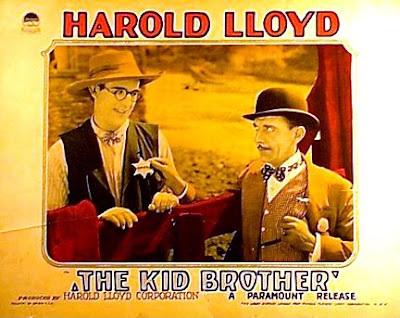
Harold Lloyd in a western!

Well actually, since there are no bar-room brawls, drunken sherriffs or real gunfights, it's more like Harold Lloyd in half a western.

This homely tale casts Harold against type as the weedy youngest son of a sheriff out in the countryside. There are no death-defying sequences on trams/building sites/skyscrapers (delete as applicable) in this one, but a host of ingenious visual gags, several of which depend upon dressing-up farm animals to look like people. In other words, this one aims more for jokes than excitement.

And having quite recently watched Safety Last!, it's a little odd to then witness Harold playing a character so much less sure of himself. Every time he fleed from an angry local, I couldn't help but think, "Hang on – but this is the guy who last week could support his entire body weight on the fingertips of just one hand!" Consequently, this hero's journey was something I was rooting for all the way!

The Kid Brother takes a little more getting into, but is good, solid Harold, and yet more evidence of why history has rightly remembered his films so highly.

Labels:


The brilliant Milton Jones at the Bearcat Comedy Club tonight. Opening act Henning Wehn was urkomisch too. Much fun had by both Perry and myself!

Labels:

Memory is a funny thing. Have I said that before?

Recently a very quiet, and extremely trivial, memory flickered across my brain, of a film I'd sat and watched on The Disney Channel in Howick some while back. It had a boy in it, and a plot concerning his getting knocked off his bike and finding a lot of money. Which he then spent.

The more I thought about it, the more vague and useless details came back to me. He had befriended a portly limo driver, played by someone who I recognised. Said kid was also trying to impress a girl who really didn't deserve it. He was lonely.

Like all Disney productions, I had found myself sucked-in quite early on, and had sat there watching the entire thing start to finish, but what the heck was it called? And perhaps more importantly, what the heck had it actually been about?!

I've just spent the past hour or so Googling strings of words like '"Disney channel" boy money limousine driver bicycle', and reading umpteen Disney synopses on Wikipedia, including Now You See It... which I remembered getting similarly sucked-into the second half of. They do your head in after a while!

Finally I found myself going through an entire list of Disney theatrical movies, in reverse alphabetical order, until, tired and just about to give-up, I finally hit the B's and recognised the words... Blank Check!


Finally it all made sense. Thanks to the miracle of the internet, I could now read all the online autopsies at the IMDB and Wikipedia. I re-read the entire plot, identified the actor I'd recognised as Rick Ducommun (when did he start getting older roles?) and I even rediscovered some of the film's quotes again.

But it's nothing like I remember. Was it really this verbose and knowing? Did it actually contain lines like:

"Hey, Applesauce, what's with the long fance my man? I just bought your pad, you got some cash. Sucasa is about to become micasa. A groovin' thing, Man"?

I think the above line was ironic. But maybe I should watch the film again. Just to refresh my memory.

But nah. I've already seen it once. Even if the whole thing has been uploaded in ten-minute sections on YouTube...

Labels: ,

This is one Doctor Who plot that I didn't examine too closely.

It was a whodunit, and I can never keep up with those.

Agatha Christie has a great reputation for writing such things, but since I've only ever come across her work in its original form once, I just don't know whether it's deserved or not. For me, The Mousetrap didn't hold together at all well, but y'know, maybe if I see it again I'll realise that I was wrong.

Putting a Doctor Who spin on things however, this 1920s whodunit sees Agatha Christie herself faced with solving a murder, not to mention also determining which aristocratic dinner-guest is secretly a giant wasp-monster that keeps eating people.

And you have to admire a brief like that – what other show could come out with such inspired silliness, and play so much of it so straight?

Yet even I found myself bothered by such questions as why the unicorn hung on at the house after stealing the necklace, and how everyone could tuck into dinner just after the Doctor had been poisoned, not to mention how on Earth Christie got outside and into a car so quickly towards the end. Like I said, maybe a good thing that I wasn't examining the plot too closely.

And this might well have been a brilliant story. Although it's set on Earth, there are actually no zombies, and it all looks like a straightforward traditional piece of Who. Even the moment when the Doctor, whilst trying to recover from being poisoned, gasps at Donna that he needs to be shocked, works well, because the kiss she consequently gives him is logical, and therefore I thought funny. And just for a change has no romantic undertones. Donna is such a maneater that the Doctor's repulsed fright is exactly the shock he just asked for.

But overall, I'm afraid that this was one episode that was very hard to get into, and will be very quickly forgotten by this viewer. Not out of choice, mind, but because of... the music.

By the end of this 40-minute escapade, I think we'd had, maybe as much as an entire minute without an orchestra continuously barfing all over the soundtrack.

Without wishing to sound too whinging, (although I know this will) for me it actually did render the whole thing unwatchable. Yes I know I did actually watch it, but I really don't want to spend another 40 minutes squinting with my ears. What a shame - it was by Gareth Roberts too, who I think is a great writer.

Perhaps they will be good enough to give the DVD a "no music" option?

Labels: ,


Just look where the twenty-third series of Doctor Who from 1986 entitled The Trial Of A Time Lord starring my favourite Doctor Colin Baker was in the WHSmith DVD chart today! Proof if proof be need be that the old show still easily outstrips today's wannabe pretenders. Sheesh - I see The Simpsons, the new Battlestar Galactica, Heroes, Futurama, heck, even the popularity of the current Doctor Who series appears to be paling by comparison. Sorry 'bout that Herschel. Hey - the 35mm camera never lies, y'know.

Labels: ,

** Click here for preceding post(s) **

** Click here for following post(s) **