Steve Goble

Choose life. (Deuteronomy 30:19)

A while back I said I thought that The Book Of Judges had a few good film-plots in it.

If that’s true, then The Book Of Daniel has a whole TV series.

Our heroes face an evil tyrant, get thrown into a furnace, and even get encaged with a lion!

I’m humming the Quantum Leap music even as I type this...

In my earlier reviews, I’ve made much of God’s tendency to change the outcome of events depending upon the key players’ moral choices, and initially Daniel is consistent with this.

Yet towards the end, the prophesies become so extreme and specific, that they just cannot be predetermined by the choices of men now. Chapter eleven goes into so much detail about the rise, fall and responses to each other of various powers in the future, that those events cannot be the consequence of people's choices in the present. There are too many more choices to be made before those things potentially come to pass. I won’t quote that one here – there’s far too much of it.

So – the 60,000 sheckel question – can anyone tell me if the events predicted in the last two chapters of Daniel actually came to pass?

Labels:

The other night I actually dreamt that I was reading the Bible. Clearly this is all starting to get to me...

Of course, according to Esther 6:1, all these old records could be just the thing for insomnia:

That same night the king could not get to sleep, so he ordered the official records of the empire to be brought and read to him.

- Esther 6:1 (Good News)


Hmm, I have to make do with this blog...

Esther is a great book, especially if you’re waiting 50 minutes for your train, as I was. The fact that it tells its story so well is sometimes pointed at as proof that it’s fiction. That doesn’t make sense to me though, because I regularly attempt to tell true stories from my own life as well as possible on this blog. Maybe the people who reason that way tend to sleep quite soundly at night, so they never get to read that much.

I shan’t detail the plot here, but it’s one where you can really get on board with the lead players. Esther herself is God-fearing, beautiful, and risks her life to do the right thing. Well, what more can you ask for in a heroine?

I used to see this tale as a good example of predetermination – as Haman builds the very gallows on which he himself ultimately gets hung – but now I see it more as God simply using the circumstances that are there. Of course, that assumes that God wanted Haman dead.

Mordecai seems to be pondering the same thing at one point, as he displays both open and closed theism tendencies in the same sentence. What might happen if Esther doesn’t help?:

If you keep quiet at a time like this, help will come from heaven to the Jews, and they will be saved, but you will die and your father’s family will come to an end. Yet who knows – maybe it was for a time like this that you were made queen!”

- Esther 4:14 (Good News)


Sadly, towards the end of the story, the good guys go on another holy bloodbath, subtracting respect for the heroes, but at the same time painting them with greyer strokes, perhaps therefore making them easier to believe.

The Jews in the provinces also organized and defended themselves. They rid themselves of their enemies by killing seventy-five thousand people who hated them. But they did no looting.

- Esther 9:16 (Good News)


Oh, well, that sounds all right then.

One thing that I’ve been pondering recently is the extraordinary amount of killing that God sanctions in the Old Testament. I approached these books thinking that I would be able to read a great deal of reluctance into God’s actions, but it’s an absolute bloodbath.

I told myself that God was showing mankind the consequence of sin. I convinced myself that God was rightfully protecting the Israelites, whom he had chosen to save. I’ve been reminding myself that God would surely be forgiving these mass-murders. Y'know, maybe the people at the time who wrote the records down never figured all that out.

But God instructs the perpetrators. God rewards the perpetrators. God actually punishes those whom he tells to kill, but who then – quite rightly in my opinion - don’t do it.

Somewhat later in the Bible, Jesus shows up and changes the rules, telling everyone to be nice from now on.

If Jesus’ example was so great, then why didn’t God send him earlier?

Labels:

*** contains spoilers ***

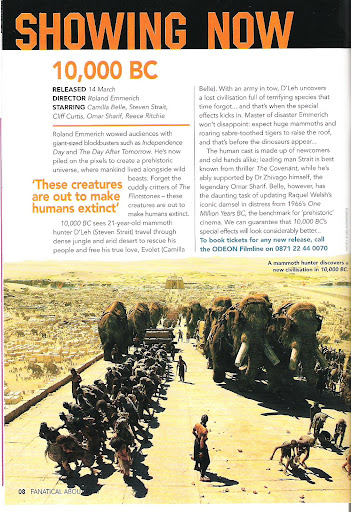
My friend David said he wanted to watch a mindless film tonight, and by the end of the evening I had to agree that 10,000 BC certainly qualified.

We missed the very start, however this meant that I avoided seeing the cinema trailer for the upcoming new Doctor Who series, which was just as well, because I might only have got annoyed about the mis-spending of my licence fee on such publicity.

Alas, the other effect of missing the start is that it robbed me of being able to fairly criticise the film's thin characterisation, confused plot etc., which is great, because this means I get to be brief.

The CGI was excellent. I believed those crashing mammoths, and the sabre-tooth was great too. And it was shot partly in New Zealand!

Both the print and the neg from which it had been struck were seriously scratched in the first half.

The plot was extremely predictable. When the girl died at the end, it was obvious that she would come back to life again, even though there had been no magic in this world up to that point. Movies!

What I did find curious though was the story’s setting. Here we are in the twenty-first century, trying to imagine a past that we have no way of ever checking or correcting. It goes without saying that our guesses are very, very probably wrong.

Then along comes this film, making an equally good stab at imagining what our past might have been like, and people sagely ridicule it for ‘scientific inaccuracy.’

As you may know, I don’t believe either the evolution theory or this film’s one. I don’t believe that the earth even is 12,000 years old – any more than I believe that it will still be here in 12,000 years' time - because it’s plainly impossible for anyone to confirm such a theory.

Again – no matter how clever a scientific technique for calculating an ancient thing’s age, we still have no way of checking, even once. It’s all based on educated guesses. Rocks today, cells today, today’s version of everything comes from today.

Lately I’ve been reading alot of written records from 2-3,000 years ago (about 9-10,000 years after this film is set), and the worlds are fairly similar. (While the author might have lied, I still consider a written account from the time to be a bit weightier than trying to make it out from what atoms are doing millennia later)

A mammoth task
From that perspective, it was quite illuminating to sit there watching huge panoramic shots of thousands of workmen building the pyramids, and suppose that King Solomon’s worksites (assuming that the account is true) may not have looked so different.

Labels:

It’s revision time again, as 2 Chronicles manages to cover the events of both 1 and 2 Kings in such a way as it’s hard to spot much difference. (I know the differences are there, but I sure can’t be bothered checking)

This is King Solomon’s reign again, and the reigns of the many Kings of Judah after him.

I do have four notes though:

1. By 2 Chronicles:8, the tribe of Benjamin, who numbered in the hundreds three or four centuries back at the end of Judges, are now back up to 280,000, and that’s just fighting men. The human race was younger then, and evidently a lot more fertile. No wonder being childless was such a stigma.

Such quickly expanding numbers (common in the Old Testament) give creationism a fairly strong case. I'm not a mathematician, but it figures to me that if you projected such booming birthrates back-through-time for earlier and earlier generations, the world population's exponential decrease wouldn't take too long to come down to a population of two. (same for the birds, fish and so on)

Of course, it wouldn't be that exact, projections of how the natural world behaves never are. (something that I think the evolution argument could acknowledge a bit more too) And then there are all the unknown events along the way, that will always remain unknown. Still, every time I hear that the world's population is continually expanding, to me, creationism does seem to be implied.

2. God’s reconciliation of (dare I say it) karma and forgiveness is on show right throughout this book, including the following super-sentence:

"When they sin against you—for there is no one who does not sin—and you become angry with them and give them over to the enemy, who takes them captive to a land far away or near; and if they have a change of heart in the land where they are held captive, and repent and plead with you in the land of their captivity and say, 'We have sinned, we have done wrong and acted wickedly'; and if they turn back to you with all their heart and soul in the land of their captivity where they were taken, and pray toward the land you gave their fathers, toward the city you have chosen and toward the temple I have built for your Name; then from heaven, your dwelling place, hear their prayer and their pleas, and uphold their cause. And forgive your people, who have sinned against you.

- 2 Chronicles 6:36-39 (NIV)


(I know that’s two sentences, but the second one did naughtilly start with a conjunction)

Also:

Then the prophet Shemaiah came to Rehoboam and to the leaders of Judah who had assembled in Jerusalem for fear of Shishak, and he said to them, "This is what the LORD says, 'You have abandoned me; therefore, I now abandon you to Shishak.' "

The leaders of Israel and the king humbled themselves and said, "The LORD is just."

When the LORD saw that they humbled themselves, this word of the LORD came to Shemaiah: "Since they have humbled themselves, I will not destroy them but will soon give them deliverance. My wrath will not be poured out on Jerusalem through Shishak. They will, however, become subject to him, so that they may learn the difference between serving me and serving the kings of other lands."

- 2 Chronicles 12:5-8 (NIV)

He went out to meet Asa and said to him, "Listen to me, Asa and all Judah and Benjamin. The LORD is with you when you are with him. If you seek him, he will be found by you, but if you forsake him, he will forsake you.

- 2 Chronicles 15:2 (NIV)


3. It’s always bugged me a bit that in the OT, God focuses most of his attention on royalty. But silly me, the big organisations were probably the only ones who had the money and resources to keep records down the centuries. If God was pursuing relationships with all the little people too, in general they wouldn’t have kept archives, scrolls, or even written things down in the first place. The royal accounts are just the ones that

a) Were written down,
b) Were archived, and
c) Survived the archiving process.

4. The author's perspective.

It’s easy to perceive the God of the Old Testament as, well, a bit of a human. He gets angry, he has people killed, and war seems to be a great and glorious thing. (maybe I should have said klingon)

Here’s the thing though – these accounts are the perceptions that the writers had of him at the time. From a nation’s point of view, it’s understandable that victories were their most obvious examples of a god in control of events, rewarding and disciplining ‘our’ and ‘their’ nation.

In my opinion, the nation of Israel (or Judah, whatever) certainly counts as a group of people following God. Were they the only group to have a relationship with God at that time? While a ‘special relationship’ is certainly implied, is it right to attribute this solely to God keeping his promises down the years to Abraham, Moses, David et al? Might God have made similar promises to other individuals in foreign lands regarding their descendants? Promises that no record was kept of, and/or which were broken?

Hanani the seer:

For the eyes of the LORD range throughout the earth to strengthen those whose hearts are fully committed to him. You have done a foolish thing, and from now on you will be at war."

- 2 Chronicles 16:9 (NIV)


It’s clear that God’s promises are subject to us keeping our commitments to God.

It also makes sense to suppose that, before eventually wiping them out, God had spent the history of each of those nations attempting to turn them also back to himself.

Israel and Judah keep returning to their covenant with God again and again, but at the end of the Old Testament they’re in dreadful shape, and God is promising a new King (Jesus) who will restore everything again.

Obviously, that happens around the turn of the calendar, by which time, to me, one of two things has become clear.

Either:

a. Trying to save people by nation has not worked, or

b. It was never actually determined by nation.

Did Jesus change the criteria, or explain it?

Labels:

What if someone who knew the future told you that you were going to massacre tons of people?

You’d try to avert that, right?

The LORD said to him, "Go back the way you came, and go to the Desert of Damascus. When you get there, anoint Hazael king over Aram. Also, anoint Jehu son of Nimshi king over Israel, and anoint Elisha son of Shaphat from Abel Meholah to succeed you as prophet. Jehu will put to death any who escape the sword of Hazael, and Elisha will put to death any who escape the sword of Jehu. Yet I reserve seven thousand in Israel—all whose knees have not bowed down to Baal and all whose mouths have not kissed him."

- 1 Kings 19:15-18 (NIV)


You got that? God's decided that Hazael, Jehu and Elisha are all going to kill a heap of people for him. A fairly radical moment for what would later become turn-the-other-cheek Christianity.

But my top question is this – what if they'd refused? Would that have been right?

The fascinating thing is, I think that's exactly how Elijah felt. He's the one who's told by God in the above excerpt to contact the other three and give them their bloody instructions. He doesn't seem to like the sound of all that. So the only instruction he carries out is the part to make Elisha his successor as prophet.

And Elisha seems to agree with him, because after Elijah has left this life, he doesn't tell Hazael and Jehu either.

And he keeps his silence, for over seven years.

Until, yikes, Hazael comes to him.

Hazael went to meet Elisha, taking with him as a gift forty camel-loads of all the finest wares of Damascus. He went in and stood before him, and said, "Your son Ben-Hadad king of Aram has sent me to ask, 'Will I recover from this illness?' "

Elisha answered, "Go and say to him, 'You will certainly recover'; but [or Go and say, 'You will certainly not recover,' for] the LORD has revealed to me that he will in fact die." He stared at him with a fixed gaze until Hazael felt ashamed. Then the man of God began to weep.

"Why is my lord weeping?" asked Hazael.

"Because I know the harm you will do to the Israelites," he answered. "You will set fire to their fortified places, kill their young men with the sword, dash their little children to the ground, and rip open their pregnant women."

Hazael said, "How could your servant, a mere dog, accomplish such a feat?"

"The LORD has shown me that you will become king of Aram," answered Elisha.

Then Hazael left Elisha and returned to his master. When Ben-Hadad asked, "What did Elisha say to you?" Hazael replied, "He told me that you would certainly recover." But the next day he took a thick cloth, soaked it in water and spread it over the king's face, so that he died. Then Hazael succeeded him as king.

- 2 Kings 8:9-15 (NIV)


Ever since I was a teenager, I’ve been fascinated by the relationship between man’s free will, and God’s. I think it was my idea.

Throughout the Bible God encourages people to choose to stop sinning, yet in some places he actually causes them to sin. (eg. the hardening of Pharaoh’s heart in Exodus 9:12) In Hazael’s case above, it’s not really clear whether he subsequently kills people because he chooses to, or because God chooses for him to.

He does protest at the above prophesy "How could your servant, a mere dog, accomplish such a feat?", which rather implies innocence of such intentions, but he could equally well be lying.

It is clear from later chapters that God uses King Hazael, with his Kingdom of Aram, to keep the Israelites in check, which in itself is a good thing.

So the LORD's anger burned against Israel, and for a long time he kept them under the power of Hazael king of Aram and Ben-Hadad his son.

- 2 Kings 13:3 (NIV)


So had God actually decided Hazael’s future, or was he simply using what Hazael already had in his heart to do? Did God want Hazael to begin his massacre when he'd first told Elijah many years earlier? Did Hazael's murderous intentions then fester through the long years that Elijah and Elisha kept stum from him? Given the way that Elisha breaks down and cries, his secret sure seems to have become a source of pain for him.

Poor Elisha. Even when, after so long, Hazael improbably stands in front of him and asks him for a prophesy, Elisha still never actually anoints Hazael king, or gives him instructions to kill anyone. Rather, he sounds resigned to those future events. If anything, even knowing the will of God, Elisha appears to be more discouraging Hazael from following it. As such, Hazael seems to begin his massacre without very much influence from Elisha.

Throughout the Old Testament, God frequently changes people’s futures on the basis of their having a change of the state of their heart in the present. Hezekiah’s experience in chapter 20 is a prime example:

In those days Hezekiah became ill and was at the point of death. The prophet Isaiah son of Amoz went to him and said, "This is what the LORD says: Put your house in order, because you are going to die; you will not recover."

Hezekiah turned his face to the wall and prayed to the LORD, "Remember, O LORD, how I have walked before you faithfully and with wholehearted devotion and have done what is good in your eyes." And Hezekiah wept bitterly.

Before Isaiah had left the middle court, the word of the LORD came to him: "Go back and tell Hezekiah, the leader of my people, 'This is what the LORD, the God of your father David, says: I have heard your prayer and seen your tears; I will heal you. On the third day from now you will go up to the temple of the LORD. I will add fifteen years to your life. And I will deliver you and this city from the hand of the king of Assyria. I will defend this city for my sake and for the sake of my servant David.' "

- 2 Kings 20:1-6 (NIV)


So we, as well as God, appear to be father to the future.

But if God changed Hezekiah’s future on the basis of his new change of heart, that begs the question – who made that choice of Hezekiah’s?

The obvious answer is that Hezekiah did. Yet just two chapters earlier, when Sennacherib stated that the events of his life were of his own choosing, God refuted him and said they were his doing:

By your messengers
you have heaped insults on the Lord.
And you have said,
"With my many chariots
I have ascended the heights of the mountains,
the utmost heights of Lebanon.
I have cut down its tallest cedars,
the choicest of its pines.
I have reached its remotest parts,
the finest of its forests.

I have dug wells in foreign lands
and drunk the water there.
With the soles of my feet
I have dried up all the streams of Egypt."

" 'Have you not heard?
Long ago I ordained it.
In days of old I planned it;
now I have brought it to pass,
that you have turned fortified cities
into piles of stone.

- 2 Kings 19:23-25 (NIV)


So Sennacherib thought he had done those things because he had chosen to, when in fact he had chosen them because God had chosen for him to choose them. That’s how the above passage reads to me.

Muddying free will even further though is God’s attitude to the final holy executioner predicted in the opening passage above - Jehu.

Elisha the prophet again steers clear of delivering the prophesy of kingship himself. Perhaps in something of a resigned compromise, he sends another prophet to do it instead, instructing them:

Then take the flask and pour the oil on his head and declare, 'This is what the LORD says: I anoint you king over Israel.' Then open the door and run; don't delay!"

- 2 Kings 9:3 (NIV)


Surely Elisha again knew what a bloodbath would surely follow. After all, here’s the start of what the young prophet actually told Jehu when he got there:

Jehu got up and went into the house. Then the prophet poured the oil on Jehu's head and declared, "This is what the LORD, the God of Israel, says: 'I anoint you king over the LORD's people Israel. You are to destroy the house of Ahab your master, and I will avenge the blood of my servants the prophets and the blood of all the LORD's servants shed by Jezebel. The whole house of Ahab will perish. I will cut off from Ahab every last male in Israel—slave or free.

- 2 Kings 9:6-8 (NIV)


So, armed with instructions from God to kill people, Jehu keenly becomes the definitive religious zealot. He callously mass-murders everyone he can from Ahab’s family – over a hundred people – inviting others to join in with him, and boasting “Come with me and see my zeal for the LORD.” Ahab himself had died… err… some 12 years ago now. A long time, really, though he had been alive at the time of the original prophecy.

It's almost as if Elijah and Elisha had tried really hard to stop God's deadly plans from coming to pass, but years later Elisha found it to be inevitable.

So Jehu killed everyone in Jezreel who remained of the house of Ahab, as well as all his chief men, his close friends and his priests, leaving him no survivor.

- 2 Kings 10:11 (NIV)


Jehu also kills the king of Judah, and gleefully lures all the Baal-worshipers to their death, by pretending to be one himself. How did he lure them all there? Why, he threatened to kill them of course – the same as the penalty for any soldier who let one escape.

Far from the respect he probably thought history would have for him, Jehu comes across as someone who Christianity is surely thoroughly ashamed of.

But here’s the thing – I’m wrong. Jehu actually is right. He actually is obeying God, and God, believe it or not, is pleased with him for all this killing.

The LORD said to Jehu, "Because you have done well in accomplishing what is right in my eyes and have done to the house of Ahab all I had in mind to do, your descendants will sit on the throne of Israel to the fourth generation." Yet Jehu was not careful to keep the law of the LORD, the God of Israel, with all his heart. He did not turn away from the sins of Jeroboam, which he had caused Israel to commit.

- 2 Kings 10:30-31 (NIV)


So it’s not that black-and-white then. God approves of Jehu’s killing Ahab’s descendants, but not of his other sins.

Still, let me repeat the first half of that yet again just soas we’re clear, God approves of Jehu’s killing Ahab’s decendants. Of course he does. He told him to do it. All moral arguments aside, God did tell Jehu to do it.

But here’s Hosea 1:4-5:

Then the LORD said to Hosea, "Call him Jezreel, because I will soon punish the house of Jehu for the massacre at Jezreel, and I will put an end to the kingdom of Israel. In that day I will break Israel's bow in the Valley of Jezreel."

So I basically have four problems now:

1. That God instructed Hazael, Jehu and Elisha to kill all those people.
2. That God gives a reward for killing all those people.
3. That God gives a punishment for obeying him.
4. That God’s punishment is exacted upon the perpetrators’ descendants, and not the perpetrator.

(sigh) This book started out so well. The adventures of the prophets Elijah and Elisha were really fascinating. But then it all descended into this bloodbath of unpleasant stuff that doesn’t make sense to me.

But as I make my way through the Old Testament, I find I’m starting to form a couple of off-the-wall theories... (only theories mind you, so please don't zealously kill all my descendants for this)

1. That mankind genuinely did not know what was right, and what was wrong. It had not yet been “written on their hearts.” The only hope they had was to blindly obey whatever God told them to do. God knew that any new king would fight Ahab’s family anyway, so God decided the outcome as always. The actual act of killing was not something he approved of, simply a choice of man that he could decide the winner of.

2. That maybe God incited man to sin as some sort of a live vaccination. In sinning, we were supposed to learn why sinning was wrong. We were supposed to argue with him as part of that learning process, as occasionally people did.

Labels:

1 Kings is the first half of 1 Kings and 2 Kings, which are themselves the second half of 1 Samuel, 2 Samuel, 1 Kings and 2 Kings, which used to be called 1 Kings, 2 Kings, 3 Kings and 4 Kings, so much so that 1 Samuel and 2 Samuel are still sometimes called 1 Kings and 2 Kings respectively, while 1 Kings and 2 Kings often get referred to as 3 Kings and 4 Kings. The whole original book was called Kings, and it’s thought it comprised two-fifths of an even longer book containing Deuteronomy, Joshua and Judges as well.

I’m sure the tale of all these books would itself have made a good book by Dr Seuss.

Anyhew, 1 Kings itself is, would you believe, a book of two halves.

Come back!

The first half (we’ll call it Kings 1.0 just to be funky) is about King David’s son – Solomon – becoming and being King. Remember the pattern we saw in David’s life?

The King With The Sin

Good God.
Good King.
Good God and good King.

Good King sings.
Good God gives good King who sings good things.

Good King who sings takes in prim feminine.
Good King who sings takes in prim feminine's ring.
Good King who sings has fling with prim feminine in ring.
Good King who sings slings prim feminine's ring and kills him.
Good King thinks good King wins.
Good God thinks good King's fling stinks.
Good God thinks good King is crim.
Good God disciplines.

Crim King and prim feminine have little king.
Little king's limbs fall limp.
Little king's sibling's limbs fall limp.
Crim King’s sins sink in.
Crim King’s good things shrink.
Crim King bins his sins.
Crim King becomes good King.
Good God wins.


Well, I realise that you probably don't want to ever wade through reading anything like that ever again, but I'm afraid that in 1 Kings events take a similar pattern for his son Solomon:

The King With The Sin’s Other Little King

Good God.
Good King.
Good King's little king.
Good King's little king is dim.
Good King's limbs fall limp.
Good King is binned.
Little king becomes dim King.
Good God and dim King.

Good God makes dim King think.
Dim King becomes King who thinks.
Good God gives King who thinks good things.
King who thinks gives rings.
King who thinks has flings.
King who thinks gives flings' gods things.
Good God thinks flings' gods stink.
Good God thinks King who thinks and gives flings' gods things is crim.
Good God disciplines.

King who thinks’ limbs fall limp.
King who thinks’ kindy's things shrink.
Good God wins.

(DSV)


Anyway, in English.

One night, while he’s still a boy, King Solomon has a dream.

At Gibeon the LORD appeared to Solomon during the night in a dream, and God said, "Ask for whatever you want me to give you."

- 1 Kings 3:5 (NIV)


WOO-HOO! Solomon’s answer?

"Now, O LORD my God, you have made your servant king in place of my father David. But I am only a little child and do not know how to carry out my duties. Your servant is here among the people you have chosen, a great people, too numerous to count or number. So give your servant a discerning heart to govern your people and to distinguish between right and wrong. For who is able to govern this great people of yours?"

- 1 Kings 3:7-9 (NIV)


So Solomon becomes the wisest person ever, and builds the huge temple to God that his father King David had planned out. But the temple, as I read it, is only a physical symbol of Solomon’s putting God ahead of everything else in his life. Inside his heart, there is other stuff of greater importance to Solomon than God, namely marrying a thousand different women. I ask you – that doesn’t sound wise by any man’s thinking...

And while that sounds like a ridiculous situation (maybe the local amphitheatre ran a sitcom entitled A-Thousand-And-One’s Company), the challenge that Solomon faced – and lost – is a familiar one:

His wives’ opinions on God differed to his own.

We don’t know how much Solomon was swayed, but it was enough to prove that something – maybe just good manners – were of a higher priority to him than God was. I think we’ve all been in situations where we didn’t like to offend people, not just in marriages, but with friends, employers, even total strangers.

They were from nations about which the LORD had told the Israelites, "You must not intermarry with them, because they will surely turn your hearts after their gods." Nevertheless, Solomon held fast to them in love. He had seven hundred wives of royal birth and three hundred concubines, and his wives led him astray. As Solomon grew old, his wives turned his heart after other gods, and his heart was not fully devoted to the LORD his God, as the heart of David his father had been.

- 1 Kings 11:2-4 (NIV)


So Solomon’s power wanes, and he dies, after which his son Rehoboam loses ten-twelfths of the Kingdom, including the name Israel. Whilst it’s made clear that these events are God’s doing, as the second half of this book begins, mankind’s free will appears to be becoming more powerful...

When Rehoboam arrived in Jerusalem, he mustered the whole house of Judah and the tribe of Benjamin—a hundred and eighty thousand fighting men—to make war against the house of Israel and to regain the kingdom for Rehoboam son of Solomon.

But this word of God came to Shemaiah the man of God: "Say to Rehoboam son of Solomon king of Judah, to the whole house of Judah and Benjamin, and to the rest of the people, 'This is what the LORD says: Do not go up to fight against your brothers, the Israelites. Go home, every one of you, for this is my doing.' " So they obeyed the word of the LORD and went home again, as the LORD had ordered.

- 1 Kings 12:21-24 (NIV)


The depressing second half of the book recounts the rise and fall of the next kings of both Israel, and Rehoboam’s remnant Judah, as well as introducing the prophet Elijah. They sound like dark days – mankind wreaking havoc as God persists in his attempts to get people to just, very basically, do what he tells them to do. This appears to be an entirely different plan to the one he later sets in motion via Jesus. This last excerpt sounds like a world where doing the right thing is very hard to even aim for:

By the word of the LORD one of the sons of the prophets said to his companion, "Strike me with your weapon," but the man refused.

So the prophet said, "Because you have not obeyed the LORD, as soon as you leave me a lion will kill you." And after the man went away, a lion found him and killed him.

The prophet found another man and said, "Strike me, please." So the man struck him and wounded him. Then the prophet went and stood by the road waiting for the king. He disguised himself with his headband down over his eyes. As the king passed by, the prophet called out to him, "Your servant went into the thick of the battle, and someone came to me with a captive and said, 'Guard this man. If he is missing, it will be your life for his life, or you must pay a talent of silver.' While your servant was busy here and there, the man disappeared."

"That is your sentence," the king of Israel said. "You have pronounced it yourself."

Then the prophet quickly removed the headband from his eyes, and the king of Israel recognized him as one of the prophets. He said to the king, "This is what the LORD says: 'You have set free a man I had determined should die. Therefore it is your life for his life, your people for his people.' "

- 1 Kings 20:35-42

Labels:

I think, for the non-Christian, one of the most off-putting things about Christianity today is the singing.

I went to schools where we had to sing songs that, really, seemed to have little relevance to our lives.

Whether you agree with Christian thinking or not, the songs we sang at school do little for most adults today too. Of course, there are many churches who don’t sing those songs. They sing different songs. Which makes no difference at all if you don’t like singing, which most people don’t.

If you’re running a church, and you want to attract more non-Christians in, you’ll never sell salvation to many people when part of the cost is having to sing. Every week. About God. In public. Forever!

I think, for non-Christians, the only thing more off-putting than being expected to again act like a child at school every week, is actually being expected to start taking the lyrics so incredibly seriously.

All of which flies in the face of The Psalms.

A lot of Christians consider these 150 songs / poems to be beautiful. I have no problem with that - everybody's different.

Today (the date of this post) I read all 150 of them, and I feel fairly non-plussed. There are bits that remind me of things about God that I like, but as songs, or rather as poems, I'm afraid I don’t really like any of them. At this sentence you may like to duck to avoid the bolt of lightning coming past you at my words on this screen.

Teaching is hard to find in here too, written as so many of these appear to be as allegorical expressions of feelings about God. I’m always a bit wary when someone tries to mount a Biblical argument based upon the cries of a psalmist.

When the earth and all its people quake,
It is I who hold its pillars firm.

- Psalm 75:3 (NIV)

God is a righteous judge,
A God who expresses his wrath every day.

- Psalm 7:11 (NIV)


Of course, you do have to temper that with bits like:

The sacrifices of God are a broken spirit;
A broken and contrite heart,
O God, you will not despise.

- Psalm 51:17 (NIV)


There’s teaching in that last excerpt for sure, but partly because, like so much of the Bible, these are not facts that we can test, only take on faith.

What I do like about The Psalms though is the very fact of their inclusion in the Bible. Most of them strike me as predominantly expressing faith in God through trying times. And there’s nothing more real about our Christian faith than that.

The psalms are very encouraging, and very comforting when the psalmist still has no answer from God by the end, but generally they appear to me to be man speaking to God with man’s wisdom, rather than vice versa.

Remember, O LORD, what the Edomites did
on the day Jerusalem fell.
"Tear it down," they cried,
"tear it down to its foundations!"

O Daughter of Babylon, doomed to destruction,
happy is he who repays you
for what you have done to us-

he who seizes your infants
and dashes them against the rocks.

- Psalm 137:7-9 (NIV)

In my anguish I cried to the LORD,
and he answered by setting me free.

- Psalm 118:5 (NIV)

Labels: ,

The Adventures Of Jesus Christ Across The Eighth Dimension!
As film/TV versions of the easter story go, this one was quite hard to get into.

Partly because, as is curiously the way with easter adaptations, little or no time is taken to introduce us to the characters – it seems assumed that we already know who they are, and Jesus’ back-story.

Partly it was hard to get into because of such polarised regional UK accents, and endless famous faces to break the illusion and distract.

But mostly it was hard to get into because it was made by the BBC, and, well, they just can’t get anything right.

Even before transmission it had been made in six half-hour instalments, with the intention of being stripped across the six nights of easter week. By the time we got to see it, it had been spliced down into four, of varying lengths, to show on varying weeknights at any time where they would fit. When Jesus gets thrown into a dungeon only to be released a minute later, you can’t help but glance at a clock to confirm that, yes, this event was originally intended to be a cliffhanger, but had now become just padding.

But back to the start.

Right from the opening scene – in which Jesus buys a colt instead of predicting where they will find one – the writer seems embarrassed of Jesus and of what four different written records say about him. Sure enough, apart from the resurrection, all Jesus’ miracles have been removed from this account. There's a throwaway line writing off his miracles before the story's start as possibly illusions, but that really is it. Consequently, Jesus is shown comforting sick people, but not trying to heal any of them.

And I can understand why they did that – like it or not, Jesus is more believable without the miracles.

The thing is though, without the miracles, Caiaphas’ worries that Jesus might cause trouble make little sense – he’s just the latest harmless oddball to make claims about God.

Compare that with the guy in the Bible.

In the temple courts he found men selling cattle, sheep and doves, and others sitting at tables exchanging money. So he made a whip out of cords, and drove all from the temple area, both sheep and cattle; he scattered the coins of the money changers and overturned their tables.

- John 2:14-15 (NIV)


Here he raises his voice a bit, and overturns three tables, but without the whip thing and the driving everyone and their cattle out thing, he’s just not much of a threat to Caiaphas or anyone. (I accept that it's disputed whether the above extract is an account from his last days or earlier)

The irony is that the writer has gone on the record on the BBC website as saying that he didn't want to tell the Jesus story in a vacuum, and yet by removing something as central as Jesus' miracles, that's exactly what he has accidentally done.

While this does arguably add injustice to Jesus' crucifixion, it also makes it harder to empathise with the decisions Caiaphas has to make.

The public nature of the crucifixion (there’s a “large crowd” following in Luke) has for a long time struck me as one of the most important aspects of Jesus’ death. It happened in front of so many witnesses that there’s just no wriggling out of the account. You can’t say it was someone else – too many people were there. You can’t say he was only unconscious – again, there were too many witnesses.

For some reason, not even the disciples are present in this version, and as for why a few of them arrive at the moment when they do, well I guess that’s another missing scene. It’s a shame, because there is some very good character motivation at other times, particularly the amount of arguing Jesus does with the disciples, and Judas’ whole inner turmoil. But those are just characterisation. When it comes to motivation to drive the story, well I think that should matter too.

The scene when Jesus encounters a group of streetwise prostitutes is probably in hindsight a source of regret to all concerned, so I'll just pass over that.

However...

It took a bit of doing, but the series won me over. The good things were so good that they overcame many more bad ones. Despite a modest budget, confusing editing and the uneven mixture of realism and cinematic gloss (including hundreds of petals being poured on Jesus in slow-motion with just the one landing on him in the cutaway), this was a version that firmly aimed at telling the human aspect of easter.

And, as such, Jesus himself was an odd beast. Almost accidentally so.

He seems fairly empty-headed, but that just makes him ordinary. His biblical dialogue is mixed in with forgivably shallower new stuff, (“That’s not what I said”) but that too is great because again it makes him more real. He’s aware of the prophesies about himself, and deliberately plays up to them, as he would have had to have done.

But once he gets arrested the whole thing really takes off.

This Jesus really doesn’t want to go to the cross, hides it from those persecuting him, and then loses his faith in God at the end when it’s all too late. Unfortunately the words with which he expresses that - “My God, my God, why have you forsaken me?” – well, the way he said them, it was as if he genuinely meant them. I infer therefore that this Jesus didn’t know they were also the opening words of Psalm 22. Both the psalmist and Jesus ultimately choose to reclaim their faith afterwards, so maybe there was actually a subtext there.

In summary, there’s so much that is wrong with this series, yet against the apparent embarrassment of the production team, (an inherent problem with non-Christian productions) it accidentally created a Jesus much more like the one I think I know. This is truly an example of a character and a story that is so good, it just can’t be told badly even when there is this much going against it.

The bottom line is that we really get to see Jesus' oft-unrecognised humanity in this.

Because of that alone, if I had to recommend a film or TV version of the Jesus story to anyone, then this is definitely the one I would pick.

And when Jesus had cried out again in a loud voice, he gave up his spirit.

At that moment the curtain of the temple was torn in two from top to bottom. The earth shook and the rocks split. The tombs broke open and the bodies of many holy people who had died were raised to life. They came out of the tombs, and after Jesus' resurrection they went into the holy city and appeared to many people.

- Matthew 27:50-53 (NIV)


Stop that – it’s silly.

Labels: ,

If the last couple of chapters of 2 Samuel read like deleted scenes, then the whole of 1 Chronicles reads like a special edition.

It is the same story as 2 Samuel, but with a heap more names on the start, the plotline about King David going on the run from his son removed, and those pesky deleted scenes re-inserted where they apparently come. George Lucas would be proud.

In the census scene, God has actually been removed and replaced by Satan. Disappointingly, King David doesn’t walk around him and tread on his tail.

And also in this version, in a Greedo-ish moment, just before Saul tries to take his own life, there’s now a Philistine archer who shoots at him first...

Oooooohhhh, that’s going to be controversial with fans of the earlier version...

This is also the book that has the prayer of Jabez buried away in it too, famous now from Bruce Wilkinson’s extrapolatory book. (Is that actually a word? Sure, why not.) I pray it sometimes, so I’ll reprint it here:

And Jabez called on the God of Israel saying,

"Oh, that You would bless me indeed,
and enlarge my territory,
that Your hand would be with me,
and that You would keep me from evil,
that I may not cause pain!"

So God granted him what he requested.

- 1 Chronicles 4:10 (NIV-UK)


After that there are production photos, a “Making Of” featurette, and an easter egg, which was cutting-edge stuff for the Old Testament.

Labels:

They say you should never judge a book by its title. 2 Samuel must be the definitive example of this. While the word “two” does indeed appear 19 times in the New International Version, this is also 19 times more than you will find the word “Samuel.”

Of course, this is because 1 Samuel and 2 Samuel used to form one big long book. In fact, before that, 1 Samuel and 2 Samuel used to form an even bigger, longer book, together with 1 and 2 Kings. As I am currently attempting to read a book of the Bible in one sitting each day, I am extremely grateful for this. Now if they could just do that with Isaiah...

The book of 1 Samuel featured Samuel anointing a good man - Saul – to be King. God blessed Saul’s kingdom. Saul became lax in properly recognising God’s authority over him however, so God took the kingdom away from him, telling Samuel to instead anoint another good man to be king – David. Saul refused to let go of the kingdom, and his life gradually descended into chaos until he died. David, having gone on the run and lost everything to Saul, never gave up on following God, and ultimately received back everything he’d lost, as well as his promised kingship.

The book of 2 Samuel picks up where 1 Samuel finished, and follows a spookily similar pattern of events, with one key difference.

Like Saul, David becomes king. Like Saul, God blesses David’s kingdom. Like Saul, David becomes lax in properly recognising God’s authority over him however, so God takes the kingdom away from him.

The key difference: Instead of trying to hang onto the kingdom, (as Saul had) David chooses humility and willingly gives it up, and so this is where the two tales really diverge.

To a certain extent, circumstances are repeating themselves for David. Last time he was on the run from his father-in-law King Saul, this time he’s on the run from his own son King Absalom.

But while his circumstances remain similar, David's response to them remains quite different. Unlike his bold fighting attitude last time, this time David is clearly a broken man, refusing to drive events, instead choosing to be weakly driven by them.

As King David approached Bahurim, a man from the same clan as Saul's family came out from there. His name was Shimei son of Gera, and he cursed as he came out. He pelted David and all the king's officials with stones, though all the troops and the special guard were on David's right and left. As he cursed, Shimei said, "Get out, get out, you man of blood, you scoundrel! The LORD has repaid you for all the blood you shed in the household of Saul, in whose place you have reigned. The LORD has handed the kingdom over to your son Absalom. You have come to ruin because you are a man of blood!"

Then Abishai son of Zeruiah said to the king, "Why should this dead dog curse my lord the king? Let me go over and cut off his head."

But the king said, "What do you and I have in common, you sons of Zeruiah? If he is cursing because the LORD said to him, 'Curse David,' who can ask, 'Why do you do this?' "

David then said to Abishai and all his officials, "My son, who is of my own flesh, is trying to take my life. How much more, then, this Benjamite! Leave him alone; let him curse, for the LORD has told him to. It may be that the LORD will see my distress and repay me with good for the cursing I am receiving today."

So David and his men continued along the road while Shimei was going along the hillside opposite him, cursing as he went and throwing stones at him and showering him with dirt. The king and all the people with him arrived at their destination exhausted.

- 2 Samuel 16:5-14a (NIV)


As before, events kill David’s kingly adversary without any direct input from David himself. As before, David is gutted at his relative’s death. Unlike before, this time David is a shell of his former self. All his confidence seems to have died, such is his fear of what God may do to him the next time he sins.

Paradoxically, David's new attitude of humility seems a much better gameplan than his earlier one of proactivity. And yet, the awful death of his son makes the outcome of his humility such a hollow victory for him.

The lesson might therefore appear to be that proactivity is better than humility, but of course the second set of events is driven by David's sin with Bathsheba, obviously requiring a different response on his part.

After all that, at the end of the book, there are deleted scenes. I kid you not.

Labels:

Rogue Squadron: Requiem For A Rogue part 2
Story: Michael A Stackpole
Script: Jan Strnad and Mike W Barr
Art: Gary Erskine

Dark Times: The Path To Nowhere part 3
Writers: Welles Hartley, Mick Harrison
Art: Douglas Wheatley

Marvel executive earlier today
In the late 1970s, like every other kid in the UK, I used to collect Marvel UK’s comic Star Wars Weekly.


It was a great way of reliving parts of the very first film I’d ever seen at the cinema, and I’ve lost count of the number of times I've re-read those issues down the years.

Marvel UK were of course just reprinting strips originally presented by Stan “The Man” Lee™ in the US, with new recaps, competitions for the Super 8 and LP versions, and adverts offering lightsabers for only £2.95.


So imagine the nostalgia-rush I got last Saturday when, out in W H Smith with Herschel, I saw this...


And as if that wasn’t great enough, just look at the back cover...


Ignoring the colour ink and the price, the following evening I settled down to find out just how much the world of British Star Wars comics, and I, had changed since “the day.”

First up, the Star Wars universe is much bigger now, so much bigger in fact that they actually have three different levels of canonicity. As a result of this expansion, there were precious few characters in here who I had even heard of, just Wedge and Darth really. Nonetheless I determined to read its two strips in chronological order, which meant starting with the back-up strip - Dark Times: The Path To Nowhere part 3. Or more accurately, starting with the British recap...

They should have called this story MARGIN OF ERROR
My affection for the naff way British reprints are still adding a recap border to pretend that the middle of a strip is actually its first page, quickly fell away as the reduction in the original strip's standards immediately leapt out at me. Just look at the page above. Just how many repeated panels can you see?

Okay, now how about the next page?


Please. This is a clearly a great artist, but I didn’t ask the shop assistant to reuse my pound coin twice.

Fortunately the writers on both these strips weren’t recycling their sentences. Some thought had gone into these episodes, with both tales featuring characters who’d thought through events and were struggling to see their bigger picture.


Also, there’s one great advantage that British reprints have nearly always had over the original American publications – our pages are bigger, making some of the terrific artwork truly breathtaking.


(I think Orvax IV kinda' looks like Asia)

After that, it was nice to see that my old favourite Transformers comic was still going strong too...


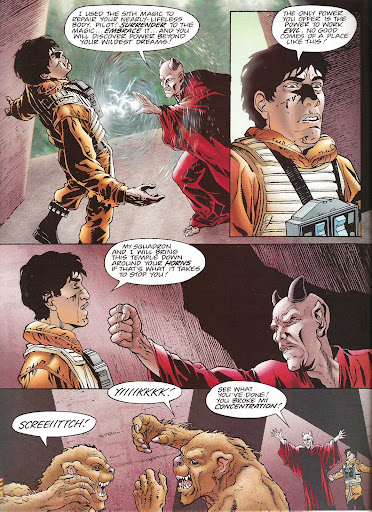
The lead strip - Rogue Squadron: Requiem For A Rogue part 2 had a similarly bland recap border (though in both cases I valued the character run-down) and a simpler script. It also seemed to have a thinly-veiled religious sub-text, featuring a horned red villain called the devaronian who, frankly, is so weak that he’s no threat at all.


Again, great artwork. I enjoyed this.

Heck, of course I did, I’d decided in the shop to enjoy the whole mag, no matter what it contained. I mean how can you not unconditionally love any comic that comes with a “FREE LIGHTSABER!”?

Good moaning, I want to learn the ways of the Farce.

Labels:

Suffering With Steve Goble. Don’t miss this – why suffer elsewhere?

So was advertised a church Youth Fellowship meeting in East Twickenham in 1991, which I led on The Book Of Job.

Memories of such meetings are the stuff of shame. Although I had co-led an 1823 meeting on the same subject about a year earlier, my abysmal preparation still found me winging the entire evening without having actually read the book.

So the whole ‘teaching’ thing became very much a floor-discussion. “What do you think?” I kept on asking them all, deflecting their attention away from me and onto themselves. It must be said, such a shameless piece of Kostanzaing served me pretty well, and afterwards the church’s pastoral assistant grinned encouragingly at me “You have such a gift, mate!” He proceeded to offer me a few pointers on how to deal with the crowd, which I took to be encouragement for possible future leadership. Today I have to wonder if he was just trying to improve my blagging technique...

17 years later, I have read The Book Of Job a couple of times now, and I have to say, if I were somehow Quantum Leapt back into myself on that dark recession-filled evening, the amount of explanation I could offer those teens would now be significantly less.

In fact, far from speaking for an entire evening on the subject, I think I can now sum up the entire Book Of Job in just one, easy-to-comprehend, one-syllable word...

WHAAAT?????

THE PLOT:

1. Satan is reporting back to his boss, who is God.

2. Because a man called Job is so good, God agrees with Satan that he can steal his belongings, murder his children and afflict his body with all manner of physical agony.

3. Job’s three friends sit with him for a week, saying nothing, following which they all argue with him in very long poetic monologues, which the clutching-at-death Job somehow responds to in equally long poetic language.

4. However God’s side of the case is then argued by Elihu, who is Job’s fourth friend of the three.

5. Then God shows up, talks about how great he is and doesn’t answer Job’s questions, so Job repents.

6. Finally God blesses Job more. We never get back to Satan.

Whilst writing this post, I looked this book up on Wikipedia, fully expecting to find much discussion of whether the book is in fact considered allegorical fiction, but was surprised to learn that it’s generally considered to be true.

As Job himself gasps:

"Oh, that my words were recorded,
that they were written on a scroll,
that they were inscribed with an iron tool on [Or and] lead,
or engraved in rock forever!

- Job 19:23-24


Yeah, or if only they were reproduced for 3,000 years in the most popular book on the planet...

However Wikipedia has also helped me to find some of the following solutions to the above points...

1 & 2. The word translated into English as ‘Satan’ is sometimes translated as ‘the accuser,’ implying that it is/was this being’s... err... job to find and expose mankind’s sinful nature. This would make his and God’s motivation one of deliberately provoking Job to see which path he chose.

3. I think a lot of this dialogue, as with other bits of the Bible such as crowd dialogue, may be paraphrased.

4. Elihu’s sudden presence as Job’s previously unmentioned fourth friend, for me, qualifies the account as genuine. If you were making this story up, or at least editing it, you’d go back and fix the earlier verses.

6. Well of course he does – he’s God.

5. I saved this point for last, despite Word 2007’s rather obsessive attempts to renumber these paragraphs. Job’s expression of his pain in (probably not serious) cries for God to be called to account for afflicting him, which I think we’ve all been through, are in fact an attempt to reconcile logical reasoning with faith. When God speaks of his sovereignty in such beautiful terms, Job’s faith is strengthened against his imperfect human logic, so he abandons his logical arguments in favour of emotional trust.

"The wings of the ostrich flap joyfully,
but they cannot compare with the pinions and feathers of the stork.
She lays her eggs on the ground
and lets them warm in the sand,
unmindful that a foot may crush them,
that some wild animal may trample them.
She treats her young harshly, as if they were not hers;
she cares not that her labor was in vain,
for God did not endow her with wisdom
or give her a share of good sense.
Yet when she spreads her feathers to run,
she laughs at horse and rider.

- Job 39:13-18 (NIV)


I have to say, I’m challenged quite deeply on that last point. We have been made with a brain. If we are not to test God to discover whether he is indeed good, then we are not to test any false god either. Or, in discovering a ‘god’ who appears to do wrong, we must be expected to knuckle down and trust that it is the perfect God anyway. That sort of reasoning would seem to endorse random idolatry.

We do have some comfort:

But those who suffer he delivers in their suffering;
he speaks to them in their affliction.

Job 36:15 (NIV)


In Job’s case, God does actually provide him with an experience to strengthen his faith. I guess the lesson for us is that, in our suffering, we must look for that.

But what do you do if you don’t find it?

Labels:

When, as a teenager, I read the first 9 books of the Bible, (in my first attempt to read the whole thing) 1 Samuel was the book that I really enjoyed.

Because, every night, I felt like I was watching an increasingly farcical TV soap opera.


It all starts off very seriously. A barren woman makes a promise to God in prayer, that if he blesses her with a child, she’ll dedicate him to God. Well, they both keep their promise.

When the boy Samuel grows up, living in the temple, he’s visited by God. Samuel becomes a great speaker for God.

Unfortunately, the people of Israel want a king to lead them. God doesn’t like that idea, because he’s supposed to be their king. He also believes that any human king will just get corrupted with power. Still, God digresses and seeks out a really good guy to be king for them. No, not Samuel, he’s the one who gets to tell the lucky winner – Saul.

Honest Saul’s kingship starts out pretty well. Gradually he makes mistakes though, assuming that he knows God’s actual will in spite of what Samuel has communicated to him. Ultimately God tells Samuel to go and anoint a new humble guy to become king instead – David.

Well, Saul doesn’t like that. So he hangs onto the kingship. Up until now, he’s been quite a believable character.

Once God’s blessings leave Saul and are heaped on David though, Saul sinks further and further into denial, becoming a desperate comedy oaf, to David’s foil.

Stressed about everything, Saul hires a harpist to calm his nerves – unwittingly hiring David.


So he keeps sending David off to war to try and get him killed, but David keeps on winning, which ironically keeps making him even more popular with the masses. Saul repeatedly throws spears at David... in the house.


One night Saul tries to kill David in his bed, but the cunning MacGuyver has left an idol under the sheets with some goats’ hair poking out the top.

So David left, fleeing from Saul, and went to King Achish of Gath. The King's officials said to Achish, "Isn't this David, the king of his country? This is the man about whom the women sang, as they danced, 'Saul has killed thousands, but David has killed tens of thousands.'"

Their words made a deep impression on David, and he became very much afraid of King Achish. So whenever they were around, David pretended to be insane and acted like a madman when they tried to restrain him; he would scribble on the city gates and dribble down his beard. So Achish said to his officials, "Look! The man is mad! Why did you bring him to me? Haven't I got enough madmen already? Why bring another one to annoy me with his daft actions right here in my own house?"

- 1 Samuel 21:10-15 (Good News)


In a later scene, while David is on the run from him, Saul’s men and David’s men are hidden from each other on opposite sides of the same hill. In another sitcommy coincidence, Saul takes a leak in the very cave where David is hiding, watched in silence by David’s petrified followers.

When I read this as a teenager, I reasoned that if this was fiction, then the writing team had clearly changed since the opening chapter about the dramatic tragedy of that poor childless woman.

By the end of the book, in a section which my NIV Bible entitles Saul and the Witch of Endor, Samuel has died, so an increasingly desperate Saul decides to contact his ghost for advice. Unfortunately Saul has also outlawed all mediums in his land, so he just has to go to an illegal medium disguised as one of his own subjects. (I like to think he dressed up as a woman, complete with boobs, lipstick and accidental double-entendres, because, y'know, the whole farce just seems to be going that way)

Even better value is the Darby Translation, which actually translates ‘medium’ as ‘a woman who has a spirit of Python.’ Now they both read like men dressed up as women... with very high-pitched voices...

(one of whom might explode at any moment)

And, despite the gravity of what transpires, the ensuing argument Saul has with Samuel’s ghost is such a melodramatic situation that it’s hard to take very seriously. Far from telling Saul how to save his life, Samuel instead tells him that he’s going to die. With his family. Tomorrow. D’oh!

Though I type the above with a bit of a snigger, I have tremendous respect for Saul. He was a real person, like me. He made mistakes, like me. And he lost everything. As we all ultimately do, except, he died knowing his children were dying that day too. I hope that’s not like me.

He quite literally didn’t even have a prayer.

Or did he? The most galling thing about Saul’s end is that he doesn’t come across as an unusually bad man for the Old Testament. My modern Christian perspective says that God would forgive him, heal him, teach him and save him. I think God ultimately saves everyone. Even those who continually turn away from God can hardly hold out against him forever, and God has rather alot of time, patience and love.

If that’s true, I might meet Saul one day and have to explain why I wrote a blog entry poking fun at his downfall and death.

But I think that, in Heaven, it just won't matter that much to him.

Labels:

This doesn't happen in the comic
Scripts: Ian Boothby
Pencils: Mike Kazaleh

Futurama is one awesome TV show.

Forget relevance, learning and sacrificing everything for ratings, this is SF comedy, for SF fans. If you’re not a serious fan of Star Trek then the episode Where No Fan Has Gone Before probably won’t contain a single joke for you.

Futurama Comics #49 here in the UK, is barely a patch on the intense inspired insanity of the TV show. And yet, Futurama is so thick with cleverness, that even a bare patch of it is wonderful.

So now that someone has published an entire Futurama parody of Doctor Who, well, my £2.60 never stood a chance.


The sparse panels mean that there are nowhere near as many gags packed-in as in the TV show, yet pop-culture references abound, and it’s easy to hear the original actors’ voices delivering these desperate lines.


Generally, time-travel writers have an annoying tendency to prove themselves incapable of their subject matter, but for me this one falls apart only in the last three pages.

This is probably because whoever wrote this displays a broad appreciation of the original Doctor Who show’s history, too. For example, one of the villains who Fry and friends have to defeat is called the Candyman...


...who bears a scary resemblance to Doctor Who’s Kandyman...

Who can make the sunriiise?
The Daleks show up too, though they’re obviously not named as such, and it’s a terrible shame that, upon getting blinded, none of them comes out with their lesser-known catchphrase “My vision is impaired, I cannot see.” I suspect they said it in an earlier draft – probably why the script has them getting blinded in the first place – but maybe cut out by someone who didn’t know the subject so well.

My dialogue is impaired
But the second half of the strip is when things really kick into gear. Our heroes travel into their own future, and discover a truth so shocking that it elicits this response from them:


Quite what they’ve just been told I won’t tell you. But if you like Futurama enough to want to know, then you should really seek out a copy of this for yourself.

Labels: , ,

Doctor Who fans have had to put up with quite a lot over the years, but surely the worst atrocity must be the BBC’s determination to destroy over a hundred episodes in the 60s and 70s, while the show was still so popular. (it ran until 1989)

the LAST DALEK is a short film by BBC Designer Tony Cornell. In May 1967, Cornell was doing visual effects on The Evil Of The Daleks, when he heroically took his 8mm cine camera into work with him, stood next to the BBC’s camera, and filmed some of the action from another angle.

Today, now that six of those seven completed episodes appear to be have been accessioned by that great film archive in the sky, Cornell’s ‘Making Of’ short has become like golddust.


Watching the silent footage this evening, more than anything else I couldn’t understand how any organisation could go to so much time and money making something so elaborate, only to throw it all away afterwards. Doctor Who comes in for a lot of stick for being made on the cheap, but pictures like these defy that exaggerated urban legend.

Dalek horror movie: HUMANS ATTACK!
On this DVD extra, the effects designers provide a valuable commentary of their incinerated work, though the whole thing is hampered a bit by the apparent addition of a film-projector sound effect throughout.

A while back I watched a recon of this story, that married up some of this footage with an off-air tape-recording of the episode’s audio, but tonight it became clear that there are several more shots that can still be salvaged from this footage, albeit with a bit of cropping and airbrushing.

As home-made docos go, this one was rivetting.

Labels: , ,

If you wanted to make a parody that would both celebrate and poke fun at Doctor Who, you’d probably make The Seeds Of Death. Especially episode 3.

In the red corner, the effects are some of the cheapest in the show’s history...

Place in bowl for steaming
The rocket landing on the moon, complete with smoke blowing quickly to the side. The blink-and-you’d-miss-it T-MATT effect. (which I admit we’ve all used, ahem) The show’s second extensive use of soap suds.

Space opera or soap opera?
The moment when, to frantically restore the vital radio transmission, Phipps changes a lightbulb, is the stuff of Red Dwarf.

I change the lightbulbs.
Yet there is a sense that this is all being done as knowing comedy. Patrick Troughton, who began his run as the Doctor by playing him quite quiet and almost sinister, by this point has well and truly descended into the knockabout comedy that so defined his three returns to the series. For example, his line immediately before the radio transmitter breaks down is an asking-for-it “We are coming in on your signal now. Whatever you do, keep transmitting.”

Later the same episode, he gets a whole Chaplinesque mute chase sequence, gurning and running away down various corridors from a lumbering Ice Warrior, to what can only be described as silent movie music. I may get lynched for saying this, but I honestly felt like I was watching Sylvester McCoy in Vision On. Anyone who thinks that the similar sequence in Love & Monsters is out of place in Doctor Who, really needs to see this.

Mr Sylvester?
Thanks to time-and-space.co.uk for this image
But though I poke fun, The Seeds Of Death is a brilliant story. It defines everything that makes Doctor Who such a joy, not least because of the great concept, plot, fine dialogue, characterisation, imagination, audio and visuals. And serious sense of fun.

Big set, filmed from a distance to look even bigger
My last word of praise though has to go to the completeness of the DVD release. The last time I watched this story was off the movie-length omnibus release on VHS in the 1980s. That had been over two hours long, in the middle of which the Doctor was suddenly unconscious with his face hidden for 25 minutes.

Finally seeing this one episode at a time on DVD, complete with each episode's sub-credits and recaps, over several weeks, you can really see how episodic this exciting cliffhangered serial is.

The start of each episode - DVD extras?

Labels: ,


Fairly early on in the Bible there’s a book that is quite unexpectedly straightforward.

The story of Ruth may be only 4 chapters long, but it makes you wish that the entire Bible could be like this. It’s linear, doesn’t delve into lots of challenging imagery, and contains nothing to provoke sage accusations of being made-up.

Heck, it’s even incredibly nice.

When Ruth’s… no wait a minute, I’m not telling you the plot. This is the one book of the Bible I’ve read that I can actually recommend to anyone to read – it’s short, has a beginning a middle and an end, and couldn’t offend anybody.

And its over-riding message of hope in a hopeless life is one that we can all smile at.

Oh, what the heck, it's all here...

Chapter 1 (5:45):


Chapter 2 (5:41):


Chapters 3 and 4 (9:05):


Labels: ,

What would happen if God actually did cease his involvement with our lives, and left us to the harsh muse of chaos theory?

Well, remember those poor people at the end of Joshua? The ones who feared that their descendants might not ‘get’ the whole God thing? Bad news.

After that whole generation had been gathered to their fathers, another generation grew up, who knew neither the LORD nor what he had done for Israel.

- Judges 2:10 (NIV)


The LORD replied, "When the Egyptians, the Amorites, the Ammonites, the Philistines, the Sidonians, the Amalekites and the Maonites oppressed you and you cried to me for help, did I not save you from their hands? But you have forsaken me and served other gods, so I will no longer save you. Go and cry out to the gods you have chosen. Let them save you when you are in trouble!"

But the Israelites said to the LORD, "We have sinned. Do with us whatever you think best, but please rescue us now." Then they got rid of the foreign gods among them and served the LORD. And he could bear Israel's misery no longer.

- Judges 10:11-16 (NIV)


With generations of Israelites repeatedly turning from God and then later regretting it, Judges becomes a book of both monotony and excitement.

In the monotony corner, the same thing keeps on happening again, and again, and again...

10 Good things happen.
20 The Israelites get complacent and forget God.
30 God stops helping them.
40 Things degenerate
50 Things get so bad that eventually they decide to turn back to him.
60 Goto 10

It’s all starting to look fairly BASIC...

(well I don’t know, why DO you read this blog?!)

Also, while we’re on the subject of long-winded content, is this the longest sentence in the whole of the NIV?

"Now if you have acted honorably and in good faith when you made Abimelech king, and if you have been fair to Jerub-Baal and his family, and if you have treated him as he deserves- and to think that my father fought for you, risked his life to rescue you from the hand of Midian (but today you have revolted against my father's family, murdered his seventy sons on a single stone, and made Abimelech, the son of his slave girl, king over the citizens of Shechem because he is your brother)- if then you have acted honorably and in good faith toward Jerub-Baal and his family today, may Abimelech be your joy, and may you be his, too!

- Judges 9:16-19 (NIV)


(and the next verse starts with a conjunction, too)

On the exciting side, Judges also shows us the other side of the coin, pitching ordinary people against impossible odds, which they have no chance at all of achieving without God's heavy intervention. As such, there are a couple of really good movies in here, such as the hero’s journey of Gideon, who actually keeps getting rid of more and more troops in order to ensure that they don’t later credit their victory to themselves.

Also, I want to stop and talk about Samson. He’s a superhero. He’s an everyman with a past. His life is wrapped up in his identity, shaped by decisions made by higher beings before he was born. And he wrestles a lion. And then says nothing about it afterwards. I’m amazed that more babies don’t get named Samson.

The final account of the book is a much grimmer one, of an unfaithful concubine who is forgiven by her husband, but then gang-raped and killed by strangers. This sparks a war of retribution in which nearly the entire tribe of Benjamin is killed. Making some deranged form of peace afterwards, 400 Israelite girls have their entire families murdered before they themselves are permanently given to the enemy as wives. When there turn out to be more male Benjamites than girls, they are then authorised to storm an innocent town during a dance to forcibly abduct more girls to make up the numbers.

God’s appearances are rather fleeting by this stage. Towards the end, the Israelites’ morality grows worse and worse, and with it, events take place in an increasingly random and chaotic manner.

And as God’s involvement seems to seriously diminish, the following verse is quietly repeated...

In those days, Israel had no king; everyone did as he saw fit.

Labels:

I went to a small-press comics exhibition today. It was a small two-room affair, full of black-and-white photocopied material by people who, in every single case, I’d never heard of. As is the case with small-press publications, there was a real spread of material that I both did and didn’t connect with. The one that really got my attention was an autobiographical comic that depicted the author clearing out a lot of his papers from childhood, and showing us all the early material that he used come out with at school. I guess anyone who drew comics at school can identify with that. As a pre-teen, amongst all the issues of Pippin in Playland, Whizzer And Chips and good old Plug comic that I used to read, I began putting together my very own semi-photocopied mag called The Emu Comic. I was seven (or maybe even younger) when I first circulated it around infants school, and I was still publishing it a couple of years later at junior school. This was for members of The Emu Club (which I also ran), and the comic chronicled the adventures of my mum's puppet emu. Each issue was 8 A4 sides, four of which were photocopied – an expensive luxury in those days. Pages 2, 4, 6 and 8 therefore just had to be copied-out again onto the back of the photocopies. There were only ever two copies of each issue, one of which was the master. The back page featured a list of my friends' names, (some of whom had also submitted some of the material) so that they could read it, tick themselves off and then pass the issue onto the next person. The last name on the list was mine. The environmentally-friendly Emu Comic ran for five issues. Then, between the ages of about eleven and thirteen, I made 14 Doctor Who-ish issues of To Alex from Gob, purely for my best friend Alex to read. He was also simultaneously producing a similar title for me! As I recall, in a move that was later copied by every single kids’ title available today, every issue had a free gift. But I think that for me it was all about the ongoing comic strip inside - The Keys Of Marinus 2. This was all about Alex, me and my budgie Ford travelling time and space in a TARDIS with a faulty chameleon circuit, to collect a series of Yale keys needed to save an alien planet. Whilst writing and drawing these strips, I got into collecting BBC sound effects records too, so it wasn’t long before Alex, Ford and myself were recording the strips onto audio tape. Very soon I found that I was writing the comics specifically with the audio version in mind, and long-winded dualogues quickly became the order of the day. Alas, a happily barmy era such as that could never last in a world like this one… My best friend's mum had a clear-out, and my hard-toiled comics were among the casualties exiled to the local rubbish dump. Alex and I went to different secondary schools, and lost touch. One of the cassettes we’d recorded got seriously eaten in the machine, so I had to splice-out the chewed section and copy it onto another tape, improvising a scene on my own to cover the material that had been lost. In fact, there was only one paper issue that was junked without having been audio-taped – the last one. I still have the final final issue though, because I simply never finished it. Then in my teenage years I got into collecting Marvel Comics for a while. I never collected DC Comics, except for Star Trek. I was fascinated by Spider-Man’s cool new black costume, which, it transpired, was also an alien symbiote. Despairing of Marvel UK’s inept reprints, I managed to collect nearly all of the 12-part US mini-series in which it had been introduced - Marvel Super Heroes Secret Wars. This was a great introduction to the shared Marvel universe, and there were several titles that I started collecting each month, plus others when storylines crossed-over. Yes, I had walked straight into Marvel’s cunning marketing trap. About a year later, Marvel had another cunning plan, ingeniously entitled Secret Wars II. This would be only nine issues long, but the narrative continued through, I think, every single Marvel universe title. This required me to buy a significantly higher number of extra issues, many of which weren’t even generally available in the UK. As I began to invest my finely budgeted pocket-money in train tickets to specialist comic shops in London, (specifically Forbidden Planet 1) someone at Marvel must have been rubbing their hands in glee again. Until it all backfired on them. I decided that I wanted to read their massive 9-month crossover story arc in the correct order. So I would buy the issues, but then put them to one side, intending to read them later, after I had procured the chronologically earlier issues. One day, I suddenly realized that I had forgotten to buy any comics for, ooh, about a year. I was on the wagon again, and apparently had been for some time. In your face, Marvel! Oddly, I’d drawn very few comic strips of my own during those comic-reading years. Come age 17 (in 1988) one of my college buddies - Rik - was editing Defective Comics, and he got me writing comic strips again for about the next 8 years, most of which he painstakingly drew. To read some of them now, you might think that I was still writing for audio… Predominantly these 60-odd strips were superhero / film / TV parodies, but the shocking thing was that people actually paid good money to read them by mail order. Both the issue number, and the readership, had exceeded 100, and spawned an independent discussion magazine, by the time Def finally folded. Finally, although I took some photos for Dave Pitman's Tales From The Flat last year, the last comic-strip I actually wrote was in 2004. Rik and I co-wrote an officially-licensed six-part series based on the TV sf show PATCHwork. By “co-wrote” I mean we plotted the whole thing together, but I only scripted episodes two, three and six. This is a bit of a shame, as only episode one ever got drawn before the project was nixed. I think the mag was supposed to be aimed at quite high-brow scientific types, while PATCHwork of course was far too omnicerebral for that. Anyway, since they wouldn’t publish it, here, then, for the first time in history, now, live, on-stage, as it happens, now, here, on this very blog, is the world-premiere of that very strip… PATCHwork!

Labels: , ,

** Click here for preceding post(s) **

** Click here for following post(s) **