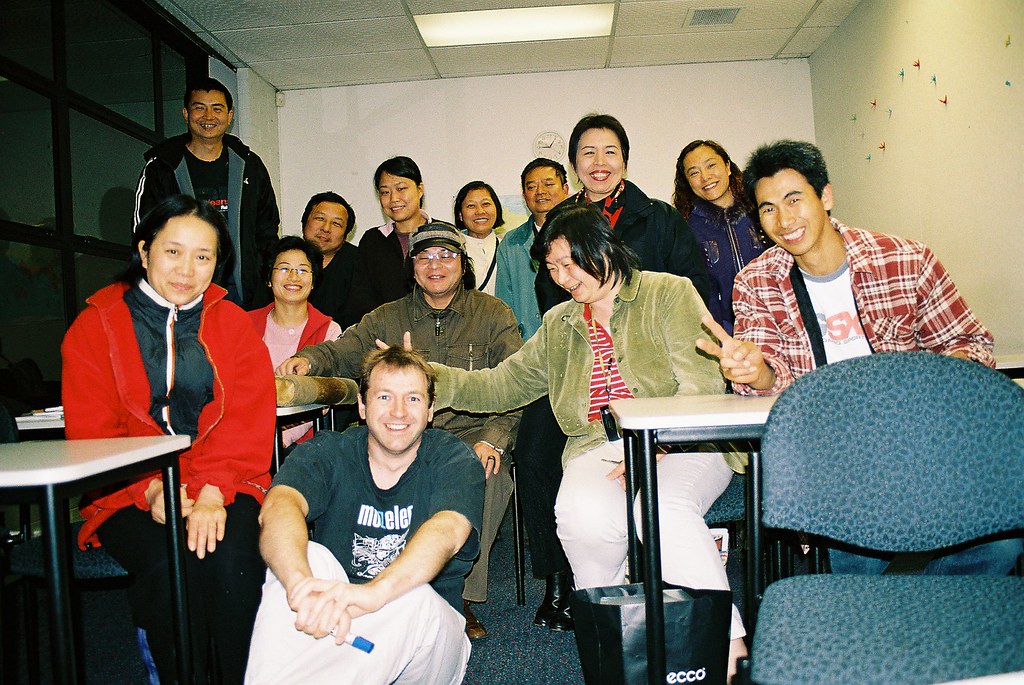
Steve Goble

Choose life. (Deuteronomy 30:19)

The Book Of Haggai has so much going for it.

1. It offers yet another perspective on the rebuilding of the temple, previously told by eyewitnesses Ezra and Nehemiah.

2. It’s only two chapters long.

3. In my opinion, it’s pretty well one of the clearest pieces of teaching in the whole Bible.

I’m not going to muddy it by reprinting or rephrasing anything here. Go read it yourself.

Go on, it’s only two chapters.

Labels:

Like, don't give me hassle, man
Ever had déjà vu? No? How about now?

Lately I've been doing quite a bit of outbound phoning work for a company in Auckland. Not selling or anything, just keeping in touch with several-hundred clients who haven’t responded to an email.

And the joy of the global office is this: I’m on holiday, so I’ve been making all these NZ-wide calls from the UK. Which turns out to be significantly CHEAPER than calling NZ from NZ.

I mean how does that work? Is it because, as New Zealand gets further away, it appears to get smaller? Or is it down to the thirteen-hour time-difference, which requires me to do all my phoning off-peak, as in overnight? Or is it cheaper because the whole of New Zealand has craftily snuck down the beach, leaving only a computer to simulate responses to the rest of the world?

“Hi – No-one in New Zealand is available to take your call at the moment. Please leave a message at the tone. Sweet as, bro.”

Or... is it cheaper because the British phone companies have cut one corner too many?

Last week, I called client 26380 on the guy's mobile. An Indian-sounding guy answered. I briefly explained who I was, to which he asked me to hold on. He then put down the phone, went out of the room, and yelled to the client that I wanted "There's someone on the phone!" Not very professional, I thought.

I then sat there for several minutes listening to his blaring TV, (obviously a residential house then) increasingly wondering what the delay was. The Indian guy had left the room, and then shouted. That implied that he had not actually seen the person, so he'd probably been shouting up/down a flight of stairs, or through a closed door. Maybe the client was on the toilet? Or taking a shower? I didn't like the idea of taking the blame for dragging someone out of the shower for a business call.

Suddenly a dog started barking, so loudly that my cat sitting opposite me in the UK sat up and stared at my phone in horror!

After about five minutes of this chaos, the Indian guy who'd answered came back to check that I was still there, but was so quick that I couldn't offer to hang up and call back later.

Great.

Becoming bored, I started listening to the guy's TV. It was a CNN news item about Google Earth, and its military implications in Israel. Eventually, at around about the ten-minute mark, I gave up, hoping that my client would not be offended when he finally came in to discover that I had gone!

Ha! Funny story. So funny that I emailed my colleague in Auckland to tell them about it, and regaled friends here in the UK with the tale too. Even funnier when, tonight, I phoned-up client 26421 and a very similar thing happened again, minus the dog. Another yelling Indian, another absent client (a woman this time) and another blaring TV, although no report about Google Earth.

As I sat there waiting patiently for this female client to come to the phone, I had to wonder if she and the male client last week both shared a house with the same incompetent Indian relative who spent his days watching TV and answering their calls so badly.

Then the dog started barking. This time, my other cat sat up and stared at me. I reasoned that there were probably many houses in New Zealand that contained an Indian, a TV and a dog in the same room.

This Indian guy also returned to the phone, but this time I was ready for him. I told him that I'd call back, but he also was too brief to let me get a word in edgeways. Crazy.

As I found myself waiting once again, I wanted to hang up the phone, but just as before, I didn’t want to risk offending the woman who I was waiting for. And anyway, that was what I had eventually done to that male client last week. If this actually was the same house, then the Indian guy might well remember me from that first call, and I could get a reputation for dragging people to the phone and then hanging up on them. But it was a company call, so I didn't really have the luxury of hanging on forever.

And yet... I was intrigued to find out what would happen if I stayed on the line this time...

I figured it was time to start listening to the blaring TV again. Fortunately this was reporting today's news, rather than last week's. Or that's what I thought. A few moments later, it was talking about Google Earth... and its military implications in Israel...

What was going on here? Was this actually the same mobile phone that I had called last week? Was this Indian guy just watching the same DVD again? Of news? Maybe he was a professional journalist spending a week editing a documentary that he was making, and just happened to be playing the same clip when I'd phoned both times? That all seemed quite unlikely, but not as unlikely as the other explanation. The weird explanation. The explanation that I could only believe by giving in to grim paranoia.

The explanation that the Indian, the absent client, the TV, the dog and indeed the entire house, including the telephone... were not real, and I was listening to a very long recording.

I hung up. I rung back. After a long pause, which I remembered from the start of my first call last week, I got an engaged tone.

I rang again, I was told the line was unavailable.

I rang again, I got a garbled voice-mail message.

I rang again, a 1970s engaged-tone faded-in. Whoa.

Five calls to the same number. Five different results, none of which connected me to the person to whom I wanted to speak.

Wait a minute, that last engaged tone had faded-in. Nothing fades-in on a telephone in this digital age... except... a recording of something fading-in.

So therefore... I had just been listening to a recording of an engaged tone. Maybe the other 'unavailable' messages I had got had been recordings too? Including the Indian guy and his whole house?

Digging out the mobile number that I'd called last week for comparison, I ascertained that they were two different mobile numbers, on two different networks – Telecom and Vodaphone.

So I rang the second client's landline, intending to ask her, politely, if she knew what was going on. Was this some sort of joke service that NZ mobile users can subscribe to instead of letting their friends hear an engaged tone?

I got through to her landline answerphone, on which she went to great pains to give out a third mobile number. This I then telephoned... and my blood ran cold as it was suddenly answered by the scary Indian guy.

Indian guy: "Hello?"

Me: (FEELING LIKE A COMPLETE IDIOT) "Hello. I called earlier. Who am I talking to?"

Indian guy: "Yeah?"

Me: (NOTHING)

Indian guy: "Okay, hold on." (INDIAN GUY LEAVES THE ROOM AND SHOUTS FOR SOMEONE, TV BLARES, DOG BARKS ETC.)

Well, that settled it – the Indian guy was definitely a recording, and clearly quite unaware of this fact.

Dang it, I knew that woman had been far too keen to give out her new mobile number on her landline answerphone. These people must, in fact, have both diverted all their calls to a harmless practical joke line, designed to wind their friends up. Phew, the world made sense again.

But my brilliant conclusion was still subjective. There was one last test I still had to carry out to confirm this.

I went and got my own NZ mobile phone, turned it on, and rang up myself. I was expecting this call to get diverted through to the NZ mobile I was holding in my other hand, here in the UK.

As I sat there listening to the BRR BRR ringing of a phone that should be connecting to me, I had to wonder if the whole fabric of the universe might just fall apart if I heard myself answer at the other end...

BRR BRR. BRR BRR. BRR BR-

"Hello?"


It was the Indian guy!

(PAUSE) "Yeah?" (PAUSE) "Okay, hold on."

At this, he ignored his blaring TV and left the phone to go and shout out of the room for me to come and answer myself.

I hung up. At half-past-three in the morning I really wasn't ready for that conversation. And neither, I suspect, was I.

So here's my question: Did I speak to four different Indians, all of whom spoke the same words with the same inflection, none of whom listened to me, one of whom had stolen my SIM card without my knowledge, each of whom had an identical quad dog, and all of whom were watching the same DVD of CNN news about Google Earth, OR...

...is the international phone company that I use playing these recordings as a means of charging customers for calls that they cannot connect?

Enjoy listening to him yourself, again and again, here.

Labels: ,

(This is an expanded version of a comment I posted on Rhett's blog.)

10. Space Invaders

Yes, this really is me, aged 10.
Down nine places to number 10, it's the original Atari classic Space Invaders. Despite my childhood addiction, a freeware version for Windows has killed-off my love for this, which might be for the best, as when I was a kid I fed my addiction with far too many 10p pieces. Only on holiday, mind. No amusement arcade in my town.

9. Bamboozle!

Wrong, back, etc.
The Methuselah of teletext TV in the UK. I used to play this game whilst doing my overnight radio show in 1993, and it was retro even then! Still going strong even today! (on page 390) Quizmaster Bamber Boozler asks 12 (usually) general knowledge questions, unless he's away, when it’s presented by another of his family, or Santa, or anyone really – it can get a bit surreal. That's not even Bamber in the screengrab above (from 4th June 2005) – that's Turner the Worm from the comic strip page!

8. Gran Turismo

Yes, that really is me behind that windscreen
Awesome graphics, inspired music. So much detail that it almost stops being fun. The only thing that puts me off GT is that whoever gets ahead first usually wins.

7. Tetris

Things were actually going really well...
Nothing gets me closer to my death than Tetris. I first lost a lot of sleep to the falling coloured blocks when I was 23, on a visit to Ethiopia in 1986. I know what you're thinking – my age in 1986 doesn't tally with my age in the sidebar. Like I said, it put years on me. Fortunately I had just shed 7 or 8 years, so I was actually about 16 again. Weird month.

6. Uno

Uuuuu-no.
In New Zealand I would play this over the internet on MSN. The system kept crashing, and offered quite restricted options, for example you could only play 4-handers. Best moment would be when all four of us were on Uno, and it was my turn to go. It was what I call Unogeddon. And yes, I won!

5. The Hitchhiker's Guide To The Galaxy

Getting to the end is not impossible.  Just very, very improbable.
Groundbreaking text-game released in 1984. Over 20 years later, it's still groundbreaking! The game even sends you back in time to become a character you met earlier. (an antidote to computer game violence if ever there was one) It's now available to play for free – with pictures! - on the BBC's website, which is where I finally had a crack at it. Have a go yourself here. Just don't blame me if you can't even get out of Arthur's bedroom at the start. (I couldn't) Clue: turn light on.

4. The Simpsons – Road Rage

Goble, doing all the work, as usual.
It's Crazy Taxi only in Springfield. You play a character from The Simpsons, and pick up other characters from the show to drive them wherever they want to go. It's got a few irritating bugs (eg. Rev. Lovejoy picking-up people who want to go to his own house to meet him) but what really makes the games are the characters' soundbites. When picking-up Dr. Nick, he announces "Hi, everybody!" and you can't help but join in. Really needs a replay option though, so that you can review your adventure, especially if it's been a two-player battle.

Herschel enjoys playing himself, or, if he's feeling particularly bizarre, playing someone else and picking himself up.

3. Super Monkey Ball Deluxe

Let's GO!
Ball games – snooker, bowling etc. - but with a live monkey inside each ball. Sometimes they open their spheres to use them as wings. Watch the little fellas drown again and again and again. Ha ha ha. Took all the fun out of the real-life versions for me.

2. SSX / SSX Tricky

I didn't know backs could bend that way!
The original of this snowboarding game has never been bettered. The incredible level of off-course detail is amazing. After 6 years, Herschel and I are still finding heaps of new areas and shortcuts on familiar tracks. This and the characters' soundbites – particularly DJ Ross L's commentary – make this a game a ton of fun, with courses that continue to challenge. Later releases SSX3, SSX On Tour etc., gradually sucked all the fun out, muting the hilarious characters and disabling the 2-player replay option in favour of smoother graphics. Computer games are supposed to fun, guys.

But my number one computer game would have to be...

1. Jammy.

The unchallenged apex of the computer-game industry
This was a PC game I made in the 1990s on my 486 using a package called Klik & Play. Earth was being invaded by double-decker buses, which you had to destroy using a bouncing ball. I obviously wasn't just using the pre-programmed icons that came free with the package, honestly. I used to play that game for hours. Hey – someone had to.

Labels: ,

Whoever writes the introductions in my Good News Bible is starting to sound a little bored.

The book contains the familiar prophetic themes: A day of doom and destruction is threatened, when Judah will be punished for her worship of other gods. The Lord will punish other nations also. Although Jerusalem is doomed, in time the city will be restored, with a humble and righteous people living there.

Well, I can honestly say that I identify with that. Despite making these notes for myself, I’m still finding it very hard to retain what prophesy is in which book, and yes, I guess I am finding it a little samey. I know that’s not quite what the above intro said, but it seems to be what I’m taking from it.

And hey – saminess hardly equals bad. For example, giving a book a good strong opening line is generally a good thing to do, so if every book in the world did that, then they’d all be samey in a good way.

Ah yes, great first lines in the Bible, stuff like:

In the beginning, when God created the universe, the earth was formless and desolate.

- Genesis
(worthy of Douglas Adams, I think)

The most beautiful of songs, by Solomon.

- The Song Of Songs

Before the world was created, the Word already existed; he was with God, and he was the same as God.

- The Gospel According To John

And onto this list (that got your attention Rhett) of Biblical books with great first lines, steps Zephaniah’s awesome opening gambit...

This is the message that the LORD gave to Zephaniah during the time that Josiah son of Amon was king of Judah. (Zephaniah was descended from King Hezekiah through Amariah, Gedaliah, and Cushi.)

No, not that awesome opening line, the next awesome opening line! (granted not technically an opening one now – I’ll delete that above paragraph unless I get lazy)

The LORD said, “I am going to destroy everything on earth, all human beings and animals, birds and fish. I will bring about the downfall of the wicked. I will destroy all mankind, and no survivors will be left. I, the LORD, have spoken.

And, just in case y’thought he wasn’t serious, verse 12...

At that time I will take a lamp and search Jerusalem. I will punish the people who are self-satisfied and confident, who say to themselves, ‘The LORD never does anything, one way or the other.’


As you might expect after such a complete proclamation of destruction, what immediately follows doesn’t really enlarge the threat, rather it goes into details to remove from the recipient’s mind any possibility that there might be some people who are exceptions.

The final two lines of that opening chapter assert their cliffhanger quite definitely:

The whole earth will be destroyed by the fire of his anger. He will put an end – a sudden end – to everyone who lives on earth.

But if you’ve been reading these things along with me, you’ll be expecting a familiar samey pattern to kick-in with the start of chapter two. Yes, a call to repent.

Shameless nation, come to your senses before you are driven away like chaff blown by the wind, before the burning anger of the LORD comes upon you, before the day when he shows his fury. Turn to the LORD, all you humble people of the land, who obey his commands. Do what is right, and humble yourselves before the LORD. Perhaps you will escape punishment on the day when the LORD shows his anger.

So, it seems that this future actually is 100% certain – in other words, it's as certain as we are about the way we’re living.

And I like that line – “Do what is right”. I think everything boils down to that.

Or not.

Everyone gets stuff wrong, deliberately sometimes, including me. What would be the right thing for God to do about that?

Chapter three has a few ideas.

Jerusalem is doomed, that corrupt, rebellious city that oppresses its own people. It has not listened to the LORD or accepted his discipline. It has not put its trust in the LORD or asked for his help.

- Zephaniah 3:1-2.

But the LORD is still in the city; he does what is right and never what is wrong. Every morning without fail, he brings justice to his people. And yet the unrighteous people there keep on doing wrong and are not ashamed.

The LORD says, “I have wiped out whole nations; I have destroyed their cities and left their walls and towers in ruins. The cities are deserted; the streets are empty – no one is left. I thought that then my people would have reverence for me and accept my discipline, that they would never forget the lesson I taught them. But soon they were behaving as badly as ever.

- Zephaniah 3:5-7


Until, as is usual with the pattern that seems to be emerging, things will be okay for those who do the right thing.

The LORD has ended your punishment;
He has removed all your enemies.

- Zephaniah 3:15


A word of warning here, to anyone who might not have figured it out. “Do the right thing” doesn’t mean “obey what someone else tells you is right.” If you think this was written by church leaders wanting to frighten the masses into obeying them, then please feel free to consider chapter 3 verse 4 for yourself.

Labels:

What if all everyday packaging was in fact just a smokescreen for instructions you didn’t know you were already obeying?

Such is the brilliant middle of THEY LIVE - a John Carpenter sf/horror from 1988 – which as you might gather starts and ends in rather less awesome fashion.

What this roughly-made film really boasts though is a style so pedestrian that it borderlines on dull. That’s not a criticism though. While I couldn’t connect with the lead character – particularly his inability to think things through (something the writers also seemed to suffer from) – it was thoroughly refreshing to watch a film that didn’t try to rush through everything as quickly as possible, for fear of losing viewer-interest.

That sequence in the middle where Nada sees the world properly for the first time really was captivating, if, again, not thought through. (the technique that hides the subliminal messages should also subliminally tell us who is an alien)


WATCH THIS FILM
WATCH THIS FILM
Also, at one point our heroes use an alien watch to transport themselves into a mysterious tunnel the aliens are using.


I assumed they were under the city, until I saw the starfield and realised they were on the alien saucer.


Until it turned out they were in a building. Whu...?


Also, the over-long street-fight in the middle suggested strongly that this director really didn’t care about losing impatient audience-members. We were (I hope) getting the film that he wanted to make. The sudden ending, too, seemed to confirm this.

Rough, disjointed, slow... but from a director free to tell his own story in his own way. Go Carpenter.

Even if in the Making Of documentary afterwards, he did come out with:


“All of my films in one way or the other are about people who are trapped in situations where they are no longer able to control what’s going to happen to them, or where they are, or what they’re up against... The heroes are people who must rise to the occasion and face either ultimate evil or something that is so extraordinary and outside the realm of their experience, but through it they show great dignity and warmth and character.”

Really? I thought it was about a muscleman blasting aliens to bits...

Labels:

Most of us want to know why bad things happen to good people.

Habakkuk, quite understandably, wants to know why good things happen to bad people.

And he’s not alone, I seem to recall the writer of Ecclesiastes becoming unhappy about the same thing.

The Babylonians are in power, and for ‘Babylonians’ we can read the word ‘dictators’, ‘army chiefs’, ‘the mafia’, ‘police officers’, ‘Mac-users’ and even, yes I’ll say it, ‘Christians.’ And hey – let's add 'Steve Goble' to that list. Anyone who thinks they’re right, no matter what.

God’s answer to Habakkuk is that, yes, the Babylonians are evil, and, yes, God is deliberately making them strong, even though they are evil.

The inescapable lesson there is surely that success is no indication of God’s approval.

Tell that to some of today’s ‘rabid’ Christians, who crow about the victory they think God is rewarding them with. (better not – they might execute judgement on you ‘in God’s name’)

The Babylonians, we’re told, are only being made strong in order to effect God’s will upon those whose morality he is trying to save. A plan that depends upon their humility.

Whether or not it was written later, in the last chapter Habakkuk seems to accept God's answer, which surely required some humility on his part.

How much worse, then, for those who choose to use that God-given strength to do wrong.

Labels:

Recently, while writing about the books of Joel and Hosea, I said that I had read both these two books in the past, but had made no notes in my Bible, and could not remember either of them. Well, ha ha, I’ve just read Nahum, and now I quickly come to review it I discover much the same thing...

What Nahum has got though, is a very clear agenda: the people of the city of Nineveh are bad, and as a result they’re going to lose everything. What we have here are three chapters detailing the unstoppable fall of Nineveh.

"I am against you," declares the LORD Almighty.
"I will lift your skirts over your face.
I will show the nations your nakedness
and the kingdoms your shame.

- Nahum 3:5 (NIV)


Well, I say unstoppable. This is all future-tense.

Conversely, The Book of Jonah tells of Nineveh’s doom in the past tense, and of how they averted it by listening to another prophet’s call for repentance. Assuming it’s the same potential fate we’re talking about. My Good News Bible isn’t sure where Jonah comes. And I haven’t read Zephaniah yet.

All that aside, I gather that some version of the place is still going in Iraq these days...

I’m intrigued by Nahum 2:5a:

The officers are summoned;
They stumble as they press forward.


Reminds me of Exodus 14:25a:

He made the wheels of their chariots get stuck, so that they moved with great difficulty.


In both situations, God's dictating the outcome, without taking anyone's free will away.

Labels:

For mash, get Smaaash.
Well, this is good, standard Doctor Who, and make no mistake.

Alien planet, locals enslaved by aliens pretending to be gods, lots of to-ing and fro-ing, 4 episodes, film-sequences, oh yes, and arguments. In fact, I don’t think anything much gets decided without one. A lesson in characterisation and drama-writing there. But hey – if you have Philip Madoc on the cast, then of course you’re going to get disagreement. Don’t tell ‘em your name, Doctor Who.

On a slightly more serious note, credit must go here to the special effects team. Today if you want an alien’s head to dissolve, it immediately gets farmed out to a CGI company. Back then, someone had to actually have the scientific savy to know what chemical would dissolve what solid well on camera, and then build the alien head accordingly. As a result, the destruction of the Krotons at the end of this one looks impressively real, especially when you think of how glossily spectacular a computer would probably have made the same effect look today.

Despite the terrible Kroton designs (they really need to stop giving all the alien robots two arms now) this is pretty well what I signed-up for.

The Krotons lose their heads
Thanks again to http://www.shillpages.com/dw for these screencaps.

Labels: ,

After the first issue, I decided to read this one in chronological order, so I started with the back-up strip: The Fantastic Four Meet The Skrulls From Outer Space!

The skrulls are the Marvel universe’s resident shape-shifters. (Star Trek has its changelings, Babylon 5 has its changeling-net, The X-Men had The Changeling, Doctor Who has... Doctor Who, no hang on, I’ve contradicted meself) (I’ll start this paragraph again)

The skrulls are the Marvel universe’s resident race of shape-shifters, and in this story they’ve been impersonating the FF to ruin their reputation...


That’s a fine plan, so long as the real FF don’t have alibis. Anyway, the FF are indeed blamed for their doppelgangers' crimes, and locked-up by the army, from where they escape quite brilliantly. But not quite as brilliantly as Johnny’s plan to expose the skrulls and clear their names:


That’s a fine plan too, in fact so fine, that it actually works...


There’s then a fight between the Fantastic Four and the skrulls, during which their advantage of being able to shape-shift doesn’t really seem to occur to them. You can see them all thinking about it afterwards in the next frame:


So, pretending to be their shape-shifting counterparts, the FF head on up to the skrulls’ main saucer to dissuade their leader from invading the Earth. But this time Reed has the finest plan yet.


After that there’s a rather nice throwaway scene back on Earth in which Ben briefly becomes human again.


Finally there’s another bust-up with the three remaining skrulls, who have now remembered their abilities, and this enables the FF to at last prove their innocence to the authorities. They defeat the three aliens, and Reed makes up a handy excuse to cover for letting the fourth one get away.

The story concludes in a way I cannot possibly debate the morality of.


So, the main strip then.

Some years later, and similar themes are being treated somewhat more psychologically. The military are again holding members of the FF hostage, the shape-shifter of the piece relies instead on suggestive thought, and Ben Grimm is a human once more, but desperate to become the Thing again.


It lasts longer this time, but not that long...


Whoaaaa – that’s a panel to enlarge and make a scary mask out of.

Credit really must go to the more modern material, for retaining all the wonder and fun of the 1960s tales, whilst at the same time treating the whole thing very seriously. The later strip really doesn’t emulate the earlier one, but the writing has clearly grown-up together with the FF’s original readers.


As reprint magazines go, this one really appears to satisfy all ages.

Labels:

Micah’s the sort of short book you can read in a week (it only has seven chapters), yet being filled with such varying bits of prophesy, I’ve found it a bit hard to get a handle on. Still, I’m determined to find something that I can remember the book for, other than just because its title happens to be the same as one of my friend’s kid’s names.

I could mark it in my head for its foretelling of the coming of Jesus, some 600 years in advance:

The LORD says, “Bethlehem Ephrathah, you are one of the smallest towns in Judah, but out of you I will bring a ruler for Israel, whose family line goes back to ancient times.”

So the LORD will abandon his people to their enemies until the woman who is to give birth has her son. Then his fellow-countrymen who are in exile will be reunited with their own people. When he comes, he will rule his people with the strength of the LORD God himself.

- Micah 5:2-4a (Good News)


Well, God or no God, in 600 years there was probably going to be someone who said that at some point. Law of averages.

Alternatively, I might focus in on what Micah predicted would become of God’s people after Jesus’ arrival:

His people will live in safety because people all over the earth will acknowledge his greatness, and he will bring peace.

- Micah 5:4b-5a (Good News)

The people of Israel who survive will be like refreshing dew sent by the LORD for many nations, like showers on growing plants. They will depend on God, not man.

-Micah 5:7 (Good News)


(I’m picking just the bits that I want to look at here)

Well, many Christians hardly live in safety today, and we definitely don’t have peace yet. However taken together, these extracts do sum up the huge change that took place in the church after Jesus had shown up.

Previously, God had taught Israel by giving them instructions, including to sacrifice whatever was most important to them. For most people, this meant giving up their best source of income - their best animals. That really required faith, to trust that God would sustain them without it. It really forced a decision to choose which was more important - material things, or God. Also, implicit in that, was an understanding of right and wrong.

Unfortunately they had followed these instructions to the point where they had lost sight of the lessons contained therein. Sacrificing the animals had become a ritual - no faith required, or consideration of right and wrong. Without that fundamental understanding of putting God first, they didn't put God first in the rest of their lives either. They divided against themselves, and ultimately lost everything.

Social justice is far more important to God than just blindly following bureaucratic rules.

So Jesus didn’t restore things to simply repeat the same exercise we’d flunked. He could have just given us a new set of instructions to follow and gradually suck all understanding out of. He didn't.

He taught us the same lesson of putting God first, and examining right and wrong, with a different example. He told stories. He answered questions with questions, to provoke people to examine right and wrong. He taught by example.

Micah’s on the same page, metaphorically, if not literally:

Will the LORD be pleased if I bring him thousands of sheep or endless streams of olive-oil? Shall I offer him my first-born child to pay for my sins? No, the LORD has told us what is good. What he requires of us is this: to do what is just, to show constant love, and to live in humble fellowship with our God.

- Micah 6:7-8 (Good News)


Today God’s nation is not geographical (with our antagonistic borders and armies etc.), but philosophical, and ‘foreigners’ are still welcome to join, and sacrifice stuff to God for the same underlying reason - to make sure that God is more important to us than those things.

You’ve got to wonder why God didn’t start out this way. The arguable success of God’s later plan rather implies that the earlier one was not as good. Why didn’t he emphasise this kindness to others thing back in Leviticus? Oh yeah, yeah that’s right he did, throughout chapter 19...

Well he should have made it clearer. Oh, I’m just whinging.

With infinite power, God has no need to ever repeat himself anyway.

And let’s not forget the most obvious difference of all between the two plans – every single living person back then was different.

One facet that both plans share though is that, to work, they both require a response from us. That would be why the earlier plan didn’t last then. Same with the garden of Eden one. I would argue that God’s plan for the church that we see happening today, is also dependent upon us, and is therefore also failing to some extent. There are enough of us, including me, still getting it wrong.

Final lesson, containing everything that everyone could be today, must surely go to the end of the book though:

There is no other god like you, O LORD; you forgive the sins of your people who have survived. You do not stay angry for ever, but you take pleasure in showing us your constant love. You will be merciful to us once again. You will trample our sins underfoot and send them to the bottom of the sea! You will show your faithfulness and constant love to your people, the descendants of Abraham and Jacob, as you promised our ancestors long ago.

Labels:

In 1969, after nearly six years on air, Doctor Who was heading for destruction.

The entire regular cast would leave at the end of the current series, and the show was in rethink mode anyway. Plans were afoot to, if there was another series, cut the number of episodes in it and make much longer stories. Longer stories were cheaper, because the sets didn’t have to be redesigned from scratch as often.

Presumably to save further money, the show would no longer be set on alien planets, but, broadly speaking, be set on Earth in the near future. An army division (U.N.I.T.) was conceived to work with the Doctor to save near-future Earth from a different super-human threat each story.

TV series very rarely survive such drastic changes to their format, so to test the waters, this 8-part pilot story was made, and slotted into the current series.

But the best pilots come about when everyone really goes the extra mile to pull off something special.

Consequently, the result is one of Doctor Who’s all-time finest stories.


There’s not a whole lot I can add to the above line. Doctor Who’s always been a show that you had to bring something to yourself to complete it, but just occasionally it hits you with a classic in which (almost) everything comes together.

The story is, for the most part, well thought-through. The characters have depth, and are played well. The cracking film location work is actually like watching a film. The incidental music continues through your head afterwards, in a good way. And the monsters? Yep, these Cybermen are scary.


In the opposite corner, there are a couple of episodes in the middle that drag. Packer's intercom plays a speeded-up voice. (a TV convention I never understood in drama) The smooth-talking human villain – Tobias Vaughn – is seen to lose his cool in private, and with it his dangerous cleverness. And his excuse for having two identical offices several miles apart – with just the different landscape outside the window - really isn’t fooling anyone.


But the rest of the production overcomes all this, and the eerie atmosphere of this being my Earth survives to this day, in 2008.

I mean, old black-and-white science-fiction shows have a reputation for getting the future painfully wrong. Flying cars, holographic TVs, world peace etc. But The Invasion is that rarest of beasts – a tale of the future that, 40 years later, actually comes across as about 90% contemporary.

First up, there's the Brigadier’s video-phone call to Major Rutledge.


Nothing too unforeseen there.

But wait - most of the world's computers and technology have been made by a single global company - International Electromagnetics - who routinely sneak additional circuitry into all their products. International Electromagnetics are repeatedly referred to as "IE." That's right - IE is programmed to do alot of extra stuff, without you knowing, and which you can't turn off. What browser are you reading this in?


But top of my list has to be the Doctor’s frustrated argument with an automatic telephone-answering machine, which just repeats several pre-recorded sentences, and fails to put him through to anyone. This would have been quite a clever joke in the 1960s. Today however, it hits its real-life target so accurately, that it's deadly satire.


But the best thing about these prophetic visions, is that the rest of the world looks exactly the same as it always has done. Well, in my lifetime anyway.


When the current production team remade this story in 2005, they instead set it on a paralell Earth, which offered similar creative freedom, and protection from dating too much, but at the expense of what makes Earth-bound stories so involving.

Finally, every great Doctor Who story must come to an end, and I found that as the final episode began, I was sitting a little less confidently in my seat. Alas, my gut turned out to be right.


As is so often the way, in the rush to tie everything up, the story fell apart at the seams. U.N.I.T. don’t simply bomb the transmitter, they land and try to break into it on foot. Despite having twelve long minutes in which to do so, the Cybermen don’t move their ship out of the way of the Russians' missile, and we’re never told why. The device that afflicts the Cybermen with emotions becomes nothing more than a gun. And as for all the hundreds of other Cybermen roaming about in London, errr, well, our focus is kept so firmly on the other plotlines that we just never find out. I guess they’re still out there then.

If only someone had realised, that would have made a really good ending.


VAUGHN: "Come, Packer, we must prepare for tomorrow night."
PACKER: "Why, Vaughn? Whaddarewegonnado TOMORRA night?"
VAUGHN: "The same thing we do every night, Packer, try to TAKE OVER THE WORLD!"

(They're Packer, They're Packer and Tobias Vaughn, Vaughn, Vaughn, Vaughn, Vaughn.)

Labels: ,

Tonight at Cession, Frank read out a short fictional monologue that I had written. It's based on what might have become of the paralytic that Jesus healed, after his family had lowered him through the roof to beat the crowds...

It's been a month since, against my will, my family forcibly lowered my shattered body through a ceiling, and had me publicly healed by a guy who they all insisted was from God.

And today, right now, alone at the top of this hill, where I should be thanking God for my miraculous new lease of life, I'm feeling thoroughly, thoroughly embarrassed.

A month ago, when the initial realisation kicked-in, when my decrepit legs had suddenly swelled into healthy bones and strong muscles, of course I stood up, jumped, danced, and leapt about like a child.

Of course I did – it was an impossible dream come true.

I ran around the room praising God and singing, I broke down, I cried, and I wholeheartedly, publicly endorsed that man, who'd just miraculously healed me, to be everything we thought he was. Yes, in the euphoria of my delight I said rather a lot of things that I now wish I hadn't.

Today, a month on, the warmth of that emotion is fading, and my coldly logical brain is developing an immunity to my madness. Clever words like "adrenaline," "misdiagnosis," "psychosomatic disorder," "mind over matter," "liar" and even "coincidence" dance through my head like sage teachers of the law.

They are all highly unlikely explanations, but none are quite as unlikely as saying that man was from God.

Even if this healing were from God, what colossal thing could God now be expecting me to do, in order for me to deserve this?

If I use my legs for evil, if I kick someone, or trip someone up, will I become paralysed again? If I just have an evil thought, will I become paralysed again? If I simply stay at home and do nothing, and waste the new life God has given me, will I become paralysed again?

On that analysis, this really could be only temporary.

I'll have to live every day like it's my last with legs.

Now my family thinks that I'm mad. I really am grateful for their faith – where I had none. But they can't understand why I won't just blindly follow this man, purely because he healed me. That's what it seems the whole of Capernaum assumes I'm going to do. I ask you - what kind of logic is that? You don't blindly sacrifice everything to follow your doctor, because he's only good at being a doctor.

No. I still have a decision to make about that guy. A choice of my own free will. My family can't make this choice for me. My friends can't make it for me. I'll take everything on board, but this is my choice to make.

And having listened to that guy talk, with such respect, for a month now, one thing about him has become very clear indeed.

He wants me to make my own decision too.

Labels: ,

Just soas you know, this is another book that I've read before, out loud, and since clean forgotten.

Even now it's hard to recall what I read earlier this afternoon. Perhaps I'm overdoing it with reading the prophets. Maybe I should read the remaining six in chronological, rather than Biblical, order? Whatever happens, writing these brief reviews for myself is seeming like a better and better idea...

Yet again I see the same pattern emerging; (Maybe because I want to see it)

1. People turn from God.

2. God tells them of their impending discipline.

3. Some people believe their impending discipline is true.

4. They realise that the only way they can get God to change his mind is to make a conscious decision to turn away from their wrongdoing.

5. As God is the source of all goodness, turning away from wrongdoing, by default, means turning towards God. There's nowhere else to turn away from wrongdoing towards.

Joel predicts the entire cycle of events, one that subsequently did play out, and that's probably an argument in favour of saying that God knew exactly what would happen in the future. That said, it could equally be an expression of hope – did everyone fall into line, or did they all make individual free will choices?

Anyway, Joel went on to predict what would happen in points 6 and 7 too...

6. Further forewarning of disciplining from God, for everyone.

7. (unclear if it's final) Judgement, for everyone.

At only 3 chapters, I'm not going to quote much from it here (and as I type this my internet connection is down so I can't get into bible.com!), but it is an encouraging pattern, that makes moral sense to me. It's also not as difficult as I've previously found it to reconcile this account of God with the more obviously loving aspects that we're told of in the New Testament.

Lastly, some pondering must go to what happened to the soldiers who had been going to invade earlier. When we first heard of them, this army sounded pretty unbeatable:

At the sight of them, nations are in anguish;
every face turns pail.
They charge like warriors;
they scale walls like soldiers.
They all march in line,
not swerving from their course.

Joel 2:6-7 (NIV)


And yet a mere 13 verses later, after the people have turned from their wrongdoing towards God...

"I will drive the northern army far from you,
pushing it into a parched and barren land,
with its front columns going into the eastern sea
and those in the rear into the western sea.
And its stench will go up;
its smell will rise."

Joel 2:most of verse 20 (NIV)


I'm supposing that they each had their own disciplines in their lives to consider or ignore too.

Labels:

According to my notes, I read The Book Of Hosea a while back. Out loud. And yet, there are no notes in the margin of my Bible, and I have no memory of any of it, save of course for the strangely familiar chapter 15, verse 14.

Anyway, not one to mistrust my notes, today on the train I read the whole thing in my head, and found I was marking quite a few bits. This isn't further evidence that I’d missed it earlier – it's just that I tend to mark verses more now than I used to.

I also tend to read books one chapter at a time, however I discovered that I think Hosea works pretty well in one sitting. Why? Well, because of (ready?) because of its almighty contradictions.

First up, just as in the other prophecy books I've read recently, woe is the order of the day. Sometimes I write these things a bit flippantly, but here's where I back off. Read this death of all hope for the people of Ephraim from chapter 9:

Hosea 9:11-17 (NIV):

Ephraim's glory will fly away like a bird—
no birth, no pregnancy, no conception.
Even if they rear children,
I will bereave them of every one.
Woe to them
when I turn away from them!
I have seen Ephraim, like Tyre,
planted in a pleasant place.
But Ephraim will bring out
their children to the slayer."
Give them, O LORD—
what will you give them?
Give them wombs that miscarry
and breasts that are dry.

"Because of all their wickedness in Gilgal,
I hated them there.
Because of their sinful deeds,
I will drive them out of my house.
I will no longer love them;
all their leaders are rebellious.
Ephraim is blighted,
their root is withered,
they yield no fruit.
Even if they bear children,
I will slay their cherished offspring."

My God will reject them
because they have not obeyed him;
they will be wanderers among the nations.


Much of Hosea is about the terrible things that will happen as a result of turning away from God. Not in hatred, but in simple discipline. I'm guessing that the people had had many earlier opportunities to turn away from hurting each other, and that these are the extreme measures that God is finally onto.

By chapter 11 things are still looking pretty bad...

Hosea 11:1-7 (NIV):

"When Israel was a child, I loved him,
and out of Egypt I called my son.
But the more I [Hebrew they] called Israel,
the further they went from me. [Hebrew them]
They sacrificed to the Baals
and they burned incense to images.
It was I who taught Ephraim to walk,
taking them by the arms;
but they did not realize
it was I who healed them.
I led them with cords of human kindness,
with ties of love;
I lifted the yoke from their neck
and bent down to feed them.

"Will they not return to Egypt
and will not Assyria rule over them
because they refuse to repent?
Swords will flash in their cities,
will destroy the bars of their gates
and put an end to their plans.
My people are determined to turn from me.
Even if they call to the Most High,
he will by no means exalt them.


That last verse is pretty interesting isn't it? If "the Most High" means God, then even if they do turn back to God, things are not going to be brilliant. They literally don’t have a prayer.

I have to say, I don't get that.

And then, out of nowhere, verse 8 suddenly happens...

Hosea 11:8-9 (NIV):

"How can I give you up, Ephraim?
How can I hand you over, Israel?
How can I treat you like Admah?
How can I make you like Zeboiim?
My heart is changed within me;
all my compassion is aroused.
I will not carry out my fierce anger,
nor will I turn and devastate Ephraim.
For I am God, and not man—
the Holy One among you.
I will not come in wrath. [Or come against any city]


That sounds like forgiveness. I guess I shouldn't have taken verse 7 in isolation above, as it's clearly meant to be read together with what immediately followed.

Following straight on...

Hosea 11:10-11 (NIV):

They will follow the LORD;
he will roar like a lion.
When he roars,
his children will come trembling from the west.
They will come trembling
like birds from Egypt,
like doves from Assyria.
I will settle them in their homes,"
declares the LORD.


And it all still seems to come together with a choice from us to turn back to him. Turning back in fear? Yes, but a big bully can make that happen. Turning back in fear with a realisation that we're wrong and he's right? Okay, we're out of bully-territory now, so long as God actually is completely right.

Once again, God is prepared to go to whatever lengths we are to turn us back from bad to good. No matter how evil we get, he's prepared to show us the equivalent reasons why it's wrong, until we learn it and turn away.

Often our suffering seems completely unrelated to the sins that we know we've committed. We wind up calling events 'random.' It's a bit trite to say that "God has a reason that we don't understand," so I guess in these instances we should start trying to find one. That doesn't answer the question, I know.

I have to wonder if some of our suffering is so that others can learn. I certainly believe that Jesus' suffering was.

Hosea certainly gets to suffer that others may learn what to make right in their lives. Early on God asks Hosea to show everyone an extremely stark picture of God's relationship with us, and feelings for us.

Hosea 1:2-9 (NIV):

When the LORD began to speak through Hosea, the LORD said to him, "Go, take to yourself an adulterous wife and children of unfaithfulness, because the land is guilty of the vilest adultery in departing from the LORD." So he married Gomer daughter of Diblaim, and she conceived and bore him a son.
Then the LORD said to Hosea, "Call him Jezreel, because I will soon punish the house of Jehu for the massacre at Jezreel, and I will put an end to the kingdom of Israel. In that day I will break Israel's bow in the Valley of Jezreel."
Gomer conceived again and gave birth to a daughter. Then the LORD said to Hosea, "Call her Lo-Ruhamah, [Lo-Ruhamah means not loved] for I will no longer show love to the house of Israel, that I should at all forgive them. Yet I will show love to the house of Judah; and I will save them—not by bow, sword or battle, or by horses and horsemen, but by the LORD their God."
After she had weaned Lo-Ruhamah, Gomer had another son. Then the LORD said, "Call him Lo-Ammi, [Lo-Ammi means not my people] for you are not my people, and I am not your God.

Hosea 3 (NIV):

The LORD said to me, "Go, show your love to your wife again, though she is loved by another and is an adulteress. Love her as the LORD loves the Israelites, though they turn to other gods and love the sacred raisin cakes."
So I bought her for fifteen shekels of silver and about a homer and a lethek of barley. Then I told her, "You are to live with me many days; you must not be a prostitute or be intimate with any man, and I will live with you."
For the Israelites will live many days without king or prince, without sacrifice or sacred stones, without ephod or idol. Afterward the Israelites will return and seek the LORD their God and David their king. They will come trembling to the LORD and to his blessings in the last days.

Labels:

As I'm still recovering from wading through 48, somewhat intense, chapters of The Book Of Ezekiel, it was somewhat refreshing to breeze through The Book Of Obadiah today... all one chapter of it.

I guess I was half-expecting it to be more of the same – lots more appeals for repentance or God'll have to teach you the much harder way – but this time it came with a really strong call for common sense and level-headedness.

I'm not suggesting that the other prophets' books don't come with that, but here the warning is specifically for the nation of Edom.

First up, if I've understood this correctly, the people of Jerusalem didn't heed God's appeals to them to repent, so God sent them the disaster he had promised – an invasion.

However, God's intention in allowing / making another nation invade was not so much to 'punish' Jerusalem, as to teach them. God is after all big on emphasizing that he's everyone's father, and therefore of course he wishes to turn people away from their wrongs and teach them.

The Edomites, as observers, saw how sinful Jerusalem had become in God's eyes, and took the moral high ground. They decided that they must be better.

Because of the violence against your brother Jacob,
you will be covered with shame;
you will be destroyed forever.

On the day you stood aloof
while strangers carried off his wealth
and foreigners entered his gates
and cast lots for Jerusalem,
you were like one of them.

You should not look down on your brother
in the day of his misfortune,
nor rejoice over the people of Judah
in the day of their destruction,
nor boast so much
in the day of their trouble.

You should not march through the gates of my people
in the day of their disaster,
nor look down on them in their calamity
in the day of their disaster,
nor seize their wealth
in the day of their disaster.

You should not wait at the crossroads
to cut down their fugitives,
nor hand over their survivors
in the day of their trouble.

"The day of the LORD is near
for all nations.
As you have done, it will be done to you;
your deeds will return upon your own head.

- Obadiah 10-15 (NIV)


This sort of religious arrogance reminds me of one or two 'Christians' I've known, and also of the sort of "told you so" soundbites that emerged after the World Trade Centre attack.

Certainly I wish that people could see how instantaneously even a tiny little bit of authority can transform them. You only have to turn on the news to witness yet another reporter losing that battle. Or, some might argue, you only have to read the paragraph I've just typed...

Hmmm, I think the book is there to remind me to look at myself, and check where I'm not judging people with the appropriate humility.

Labels:

I gotta admit, the prophets of the Old Testament are starting to get to me a bit. There's only so many times that I can read of all the woes awaiting the people of Israel, Judah etc. before, and I'm just being honest here, it all starts to merge into one.

Looking back through my notes, I see that I've read Hosea previously, but flicking through it now I can't recall any of it. But then, I suppose that if all these prophesies were in fact from God, then confusing them all with each other may not be such a bad thing. After all, it's not really about the messenger(s), is it?

Certainly I don't want to become deaf to the message these people were preaching though. While I see the original messages as being appeals to the people of that time to avoid the coming discipline by learning to do the right thing now, I also see them as lessons to us today of how God's 'mind' (if you will) works.

And more and more, I don't think God has the whole future set in stone...

This is what the Sovereign LORD showed me: He was preparing swarms of locusts after the king's share had been harvested and just as the second crop was coming up. When they had stripped the land clean, I cried out, "Sovereign LORD, forgive! How can Jacob survive? He is so small!"

So the LORD relented.

"This will not happen," the LORD said.

This is what the Sovereign LORD showed me: The Sovereign LORD was calling for judgment by fire; it dried up the great deep and devoured the land. Then I cried out, "Sovereign LORD, I beg you, stop! How can Jacob survive? He is so small!"

So the LORD relented.

"This will not happen either," the Sovereign LORD said.


This is what he showed me: The Lord was standing by a wall that had been built true to plumb, with a plumb line in his hand. And the LORD asked me, "What do you see, Amos?"

"A plumb line," I replied.

Then the Lord said, "Look, I am setting a plumb line among my people Israel; I will spare them no longer.

- Amos 7:1-7 (NIV)


Further on in the same chapter, these rather general statements, perhaps perceived at the time as meant for other people but not the listener, are made personal...

Then Amaziah said to Amos, "Get out, you seer! Go back to the land of Judah. Earn your bread there and do your prophesying there. Don't prophesy anymore at Bethel, because this is the king's sanctuary and the temple of the kingdom."

Amos answered Amaziah, "I was neither a prophet nor a prophet's son, but I was a shepherd, and I also took care of sycamore-fig trees. But the LORD took me from tending the flock and said to me, 'Go, prophesy to my people Israel.' Now then, hear the word of the LORD. You say,


" 'Do not prophesy against Israel,
and stop preaching against the house of Isaac.'


"Therefore this is what the LORD says:


" 'Your wife will become a prostitute in the city,
and your sons and daughters will fall by the sword.
Your land will be measured and divided up,
and you yourself will die in a pagan [Hebrew an unclean] country.
And Israel will certainly go into exile,
away from their native land.' "

- Amos 7:12-17 (NIV)


I don't believe this is God proving that he knows the future. I believe this is God emphasising the importance of turning back to him, also known as turning away from treating oneself as most important.

Finally, the book of Amos also helps me to see all the complicated rituals of the Old Testament in a little clearer context. You've probably read these words from God before:

"I hate, I despise your religious feasts;
I cannot stand your assemblies.
Even though you bring me burnt offerings and grain offerings,
I will not accept them.
Though you bring choice fellowship offerings, [Traditionally peace offerings]
I will have no regard for them.
Away with the noise of your songs!
I will not listen to the music of your harps.
But let justice roll on like a river,
righteousness like a never-failing stream!

- Amos 5:21-24 (NIV)

Labels:

When I was a kid, Marvel UK would try to reprint Marvel US comicbooks in A4 - a different shaped page to what they had been intended for. This disappointed me.

Years later, they realised how much extra work they were making for themselves, and started reprinting them into the same shaped page-format. This confused me.

Today, I had no idea whatsoever that I was reading a British reprint. I wonder if that was their plan from the start...


Marvel comics seem to be pretty easy to slide back into though, even after many years of absence. Things today seem to have moved on a little from my time, but not much. For example, when I used to collect The Fantastic Four in the 80s, Reed and Sue's son Franklin was about six years old. Just old enough to start having adventures of his own. In this issue’s main strip, first published in 2002, he's seven.


Hrrrm, he knows of the Harry Potter series. If this story is therefore set when it was first published in 2002, then I guess the comics I was reading when he was about a year or so younger in the 1980s were actually set around the millennium then...

Anyway, these chapters were easy to follow, and any confusion over who the Inhumans were was clearly explained in a helpful text interlude between episodes.

Things slowed down a bit every time there was a crowd-pleasing fight, and I had to wonder whether this was down to a change in the storytelling style, or just a change in myself.

Best of all though, the lead strip was fun. It's encouraging to know that this decade’s writers (in this case Karl Kesel) are clued-up enough to balance all the serious adventure with characters who have a sense of humour...


After that there was another text piece about the origin of Marvel comics. Much of this was stuff that I already knew, but hey, if you're interested in a subject it can be quite reassuring to be told that your facts are right, right?

Actually, I've always thought that my belief that Stan "The Man" Lee's prose was overly verbose and alliterative was an exaggeration on my part. Not if this frame of his they reprinted is to be believed:


If further evidence of Smilin' Stan's spectacular style were needed, we could surely have had no better example than his next back-up strip. Reprinted from Stan's writing heyday in 1964, the title says it all: "The Fantastic "Origin Of Doctor Doom!""

No, wait, actually this next frame said it all...


I swear, you've got the whole story of little Victor von Doom's descent to the dark side all right there. Despite the twelve-side page-count, storytelling just doesn't come any more quickfire than this:


After that rollercoaster of raconteuring, it quickly became colossally clear that the incredible inner-chronology of this mighty Marvel mag was ballistically becoming titanically topsy-turvey.

After the above-mentioned 2002 and 1964 stories, we were actually taken even further back to the Fantastic Four's very first adventure from 1962. The fact that all three strips also contained flashbacks within them, didn't help matters. Chris Nolan eat your heart out. Instead of publishing three separate text histories, why didn't they give us a key to tell us what order all these pages came in? Sheesh, it's like trying to follow the Bible...

And yes, this was written by Stan too, for only he can completely change a character's resolute decision in a mere three panels:


It may sound like I seek to knock the grandaddy of comicbooks, but I don't. I love Stan Lee™. I think he's brilliant. Hey – who doesn't? His achievements in the comics-field are far too numerous to list. Even his CV is an epiphany-inducing epic.

Who can fail to be impressed by his undying conviction that whatever amazing thing is currently happening is the most awesome gobsmacking event ever in universal history? His words are so full of amazement that you just don't want him to be wrong.

And this very first Fantastic Four adventure is a prime example. Just look at the start. Mister Fantastic – the leader of the Fantastic Four in case his name didn't tip you off - fires-off the FF's flare gun in order to alert the other three to return to base immediately...


Clearly the Earth is in a pretty serious emergency – just witness how the Invisible Girl knocks people out of the way in the street to heed the urgent call...


And then there's Ben Grimm, aka The Thing, who smashes right through a doorway sooner than waste a valuable second getting through it in whatever gentler way he had presumably entered:


But that's not all, oh no, next he feverishly smashes his way up through a road, causing a crash...


And as for Johnny Storm – The Human Torch – he's in such a hurry to save the world that he actually leaves three things destroyed in his wake, starting with his very own car!


Not content to merely destroy ground-based vehicles, next it's the turn of several unfortunate nearby aircraft...


Yep, you read that right, by the time they finally all got together at HQ to answer Reed's signal, they had even accidentally caused a nuclear missile to be exploded within an (admittedly long) arm's reach of New York.

But I'm trivialising. All this wanton trail of death and destruction is a price worth paying for the urgency of the matter at hand when they do all finally get there.


Yes, Ben, pin-ups. Well actually photos that really couldn't wait.

I'm glad that someone on the team has their priorities straight.

Review of issue #2 here.

(Comic images in this post are copyright Marvel, and were used according to 'fair use' laws)

Labels:

** Click here for preceding post(s) **

** Click here for following post(s) **